
Tattoo Styles Explained: Types, Examples & Differences
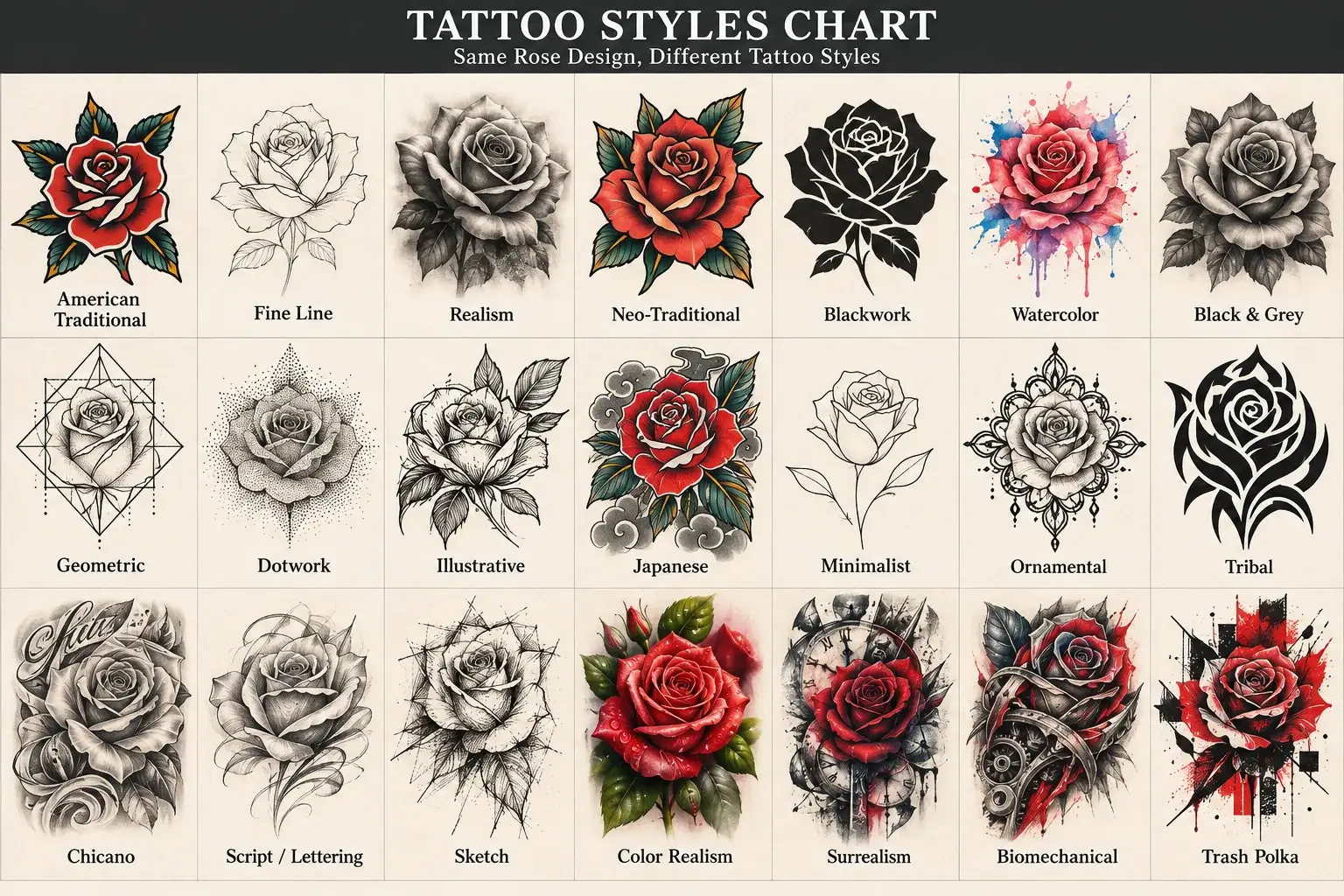
The same tattoo idea can look completely different depending on the artist's approach. A rose might feature bold outlines and solid colors in American Traditional tattooing, delicate botanical lines in Fine Line, or realistic petals and shading in Realism. The subject stays the same, but the tattoo style changes its appearance, level of detail, and design requirements.
There are many different tattoo styles, including established artistic traditions, modern approaches, and specialized tattooing techniques. Understanding these differences can help you choose artwork that fits your preferences, placement, and long-term expectations.
This guide explores popular tattoo styles, their defining characteristics, and the practical differences between them. You can compare tattoo art styles, understand what to look for in an artist's portfolio, and discover tattoo shops and artists throughout the United States.
Explore Different Tattoo Styles
Full List of Tattoo Styles
The styles below are grouped by approach. Several overlap, so a single tattoo may reasonably belong to more than one category. Open any style guide for examples, common designs, placement advice, and artists who specialize in it.
Traditional and Heritage Tattoo Styles
1. American Traditional
Bold black outlines, simplified imagery, and saturated colors define this style. Classic designs include roses, panthers, eagles, anchors, and daggers. Origins: It developed in the United States in the late nineteenth and early twentieth centuries, spread through port cities and shop flash, and was shaped by artists such as Sailor Jerry and Bert Grimm. Explore American Traditional tattoos
2. Neo-Traditional
Neo-Traditional expands traditional tattooing with decorative details, varied line weights, richer color palettes, and more complex shading. Animals, flowers, portraits, and ornamental frames are common. Origins: It grew in the late twentieth century as artists combined traditional foundations with Art Nouveau and illustrative influences. Explore Neo-Traditional tattoos
3. Japanese (Irezumi)
Japanese tattooing uses established imagery such as dragons, koi, tigers, peonies, waves, and wind bars in flowing compositions that are often planned around the whole body. Origins: Traditional Japanese tattooing, known as irezumi, flourished during the Edo period and was strongly influenced by ukiyo-e woodblock prints, including Utagawa Kuniyoshi's illustrations of heroes from the Suikoden. Explore Japanese tattoos
4. Neo-Japanese
Neo-Japanese applies traditional Japanese motifs and compositions with contemporary color, illustrative rendering, or Neo-Traditional detail. It suits clients who love Japanese imagery but want a more modern finish. Origins: It emerged as Western and Japanese artists blended irezumi conventions with modern techniques. Explore Neo-Japanese tattoos
5. Tribal
Tribal is a broad label for bold, pattern-based black tattooing. Because the term can refer to distinct cultural traditions, investigate the origins of a design rather than treating all tribal patterns as interchangeable. Origins: The contemporary Western tribal look became popular in the 1980s and 1990s, drawing on Bornean and Pacific designs; Leo Zulueta is often credited with pioneering it. Explore Tribal tattoos
6. Polynesian
Polynesian tattooing refers to traditions and contemporary work connected with Samoan, Māori, Hawaiian, Tongan, Tahitian, Marquesan, and other Polynesian cultures (Māori tā moko has its own guide below). Motifs, placement, meanings, and protocols vary between communities, so cultural knowledge and appropriate consultation are essential. Origins: These practices are centuries old, and the English word "tattoo" comes from the Polynesian word tatau. Explore Polynesian tattoos
7. Māori (Tā Moko)
Māori tattooing uses curvilinear spirals, koru forms, and flowing patterns that follow the contours of the face and body. Each traditional design is unique to the wearer, so it should never be copied from another person. Origins: Tā moko is the sacred tattooing tradition of the Māori people of Aotearoa New Zealand, historically carved into the skin with uhi (chisels) and closely tied to whakapapa (genealogy) and identity. Designs inspired by Māori art for people without Māori heritage are often called kirituhi, and should be created by an artist with genuine cultural knowledge. Explore Māori tattoos
8. Chicano
Chicano tattooing often features fine black and grey imagery, script lettering, religious subjects, portraits, and cultural symbolism. Composition and lettering expertise are especially important. Origins: It is rooted in Mexican-American communities in Los Angeles, including handpoked work made in prisons, and was brought into professional studios in the 1970s by artists such as Jack Rudy and Freddy Negrete. Explore Chicano tattoos
Realistic and Illustrative Tattoo Styles
9. Realism
Realism reproduces lifelike subjects using accurate proportions, lighting, texture, and shading. Portraits, wildlife, and detailed objects are common. Origins: It developed as improved machines, needle groupings, and black and grey shading techniques made photographic detail possible in skin. Explore Realism tattoos
10. Color Realism
Color Realism uses realistic rendering with complex color relationships. Successful work requires control over highlights, shadows, saturation, and the visual separation of details. Origins: It grew alongside black and grey realism as wider, more stable pigment ranges became available. Explore Color Realism tattoos
11. Micro Realism
Micro Realism applies realistic rendering at small sizes, such as miniature portraits and detailed objects. The design must allow enough space for important features to remain distinguishable as the tattoo ages. Origins: It became widely popular in the 2010s alongside the rise of fine line and single needle work. Explore Micro Realism tattoos
12. Portrait
Portrait tattoos represent a person or animal through recognizable features and proportions. They can be realistic, illustrative, traditional, or stylized, so choose an artist based on the exact approach you want. Origins: Portraits have appeared in tattooing for over a century, but highly lifelike portrait work grew with modern realism. Explore Portrait tattoos
13. Illustrative
Illustrative tattooing draws on techniques from drawing, illustration, and graphic art. Linework, textures, and shading may resemble book illustrations, pen drawings, or comics. Origins: It borrows from centuries of print and book illustration rather than from a single tattoo tradition. Explore Illustrative tattoos
14. Sketch
Sketch tattoos imitate expressive drawing through loose-looking lines, overlapping marks, and unfinished effects. These marks should be intentional rather than the result of inconsistent application. Origins: The style is inspired by artists' preparatory sketches and became popular as clients sought a hand-drawn, artistic look. Explore Sketch tattoos
15. Etching / Engraving
Etching tattoos recreate the appearance of historical prints through fine parallel lines, crosshatching, and structured textures. Sufficient spacing is important because dense marks can lose clarity at small sizes. Origins: The style imitates European engraving and etching from the fifteenth to nineteenth centuries, including the work of printmakers such as Albrecht Dürer and Gustave Doré. Explore Etching tattoos
16. Woodcut
Woodcut tattoos use high-contrast lines and carved-looking textures. Strong silhouettes and deliberate black-and-skin contrast are central to the effect. Origins: It is inspired by woodcut relief printing, one of the oldest printmaking techniques. Explore Woodcut tattoos
Black Ink, Linework and Pattern Styles
17. Black & Grey
Black & Grey uses black ink and diluted grey tones to create depth, contrast, and form. It can be applied to portraits, flowers, animals, religious imagery, and many other subjects. Origins: Its smooth, single needle shading is closely linked to Chicano tattooing in Los Angeles. Explore Black & Grey tattoos
18. Blackwork
Blackwork uses black ink as the dominant visual element, ranging from heavy solid fills to detailed graphic illustrations. The key portfolio checks are saturation, clean edges, and thoughtful negative space. Origins: It draws on older black-ink traditions, including tribal and ornamental work, and has grown into a broad contemporary category. Explore Blackwork tattoos
19. Fine Line
Fine Line uses thin, precise outlines for delicate compositions such as botanical designs, symbols, and small illustrations. Healed linework is especially important when evaluating an artist. Origins: Its roots are in Los Angeles black and grey single needle work, and it became a global trend in the 2010s through studios such as Shamrock Social Club. Explore Fine Line tattoos
20. Single Needle
Single Needle describes work made with a single-needle configuration, often for very fine details and subtle rendering. It is a technique rather than one fixed visual style. Origins: It shares its roots with Chicano black and grey tattooing, where fine needles were used for detailed shading. Explore Single Needle tattoos
21. Minimalist
Minimalist tattoos use restrained shapes and limited visual elements. They may be small or large; the defining characteristic is simplicity of composition rather than size. Origins: The style reflects the influence of minimalist art and graphic design on contemporary tattooing. Explore Minimalist tattoos
22. Geometric
Geometric tattoos emphasize repeated shapes, symmetry, angles, and structured patterns. Accurate alignment is particularly important on curved or moving body areas. Origins: Designs draw on mathematics, architecture, and modern graphic design. For symbolic figures such as the Flower of Life, see Sacred Geometry. Explore Geometric tattoos
23. Sacred Geometry
Sacred Geometry tattoos use symbolic geometric figures such as the Flower of Life, Seed of Life, Metatron's Cube, and Sri Yantra, usually built with precise linework and dotwork shading. Even small alignment errors are visible, so construction accuracy is essential. Origins: These patterns appear in religious art and architecture across many cultures, and some, such as the Sri Yantra in Hindu tradition, carry specific spiritual meaning worth understanding first. Explore Sacred Geometry tattoos
24. Dotwork
Dotwork creates textures, shading, or patterns from individual dots, with density and spacing controlling the effect. Origins: It relates to stippling in printmaking and pointillism in painting, where images are built from small points. Explore Dotwork tattoos
25. Mandala
Mandala tattoos use concentric, radially symmetrical patterns, often combined with dotwork shading. Even spacing and a precise center point are critical. Origins: "Mandala" is the Sanskrit word for "circle," and the form carries spiritual significance in Hindu and Buddhist traditions, which is worth understanding before choosing one. Explore Mandala tattoos
26. Ornamental
Ornamental tattoos use decorative shapes, symmetry, flowing patterns, and jewelry-inspired arrangements that follow the body's natural contours. Origins: They take inspiration from jewelry, lace, architectural ornament, and henna (mehndi) patterns. Explore Ornamental tattoos
27. Lettering
Lettering covers words, names, and typographic designs in any letterform, from block capitals to blackletter. Readability, spacing, and letter construction matter more than choosing an attractive font. Origins: Lettering is one of the oldest Western tattoo forms, from sailors' names and dates to classic "Mom" banners. Explore Lettering tattoos
28. Script
Script is a specific type of lettering based on flowing handwriting, including cursive and calligraphic forms. The design should stay legible at its intended size, especially where letters connect closely. Origins: Tattoo script draws on traditional calligraphy and Chicano script, one of the most influential lettering traditions in tattooing. Explore Script tattoos
Colorful and Contemporary Tattoo Styles
29. New School
New School features exaggerated forms, expressive characters, dynamic compositions, and bright colors. Origins: It developed in the late twentieth century, influenced by graffiti, cartoons, and hip-hop culture, and became widely popular in the 1990s. Explore New School tattoos
30. Watercolor
Watercolor tattoos imitate painting through fluid color transitions, washes, and splash-like effects. Some use black outlines for structure, while others rely mainly on color. Origins: The style gained popularity in the 2010s, with artists such as Amanda Wachob known for painterly tattoo work. Explore Watercolor tattoos
31. Abstract
Abstract tattoos use shapes, marks, colors, or patterns without a recognizable subject. They still need intentional composition and consideration of how the artwork fits the body. Origins: They draw on abstract painting and modern art movements. Explore Abstract tattoos
32. Surrealism
Surrealist tattoos combine recognizable imagery in dreamlike or impossible arrangements, balancing imagination with enough structure to stay readable. Origins: The style is inspired by the Surrealist art movement of the 1920s, including painters such as Salvador Dalí and René Magritte. Explore Surrealism tattoos
33. Trash Polka
Trash Polka combines black and red graphic elements, realism, typography, and expressive marks into high-contrast collage compositions. The relationship between elements matters more than simply adding red splashes. Origins: It was developed by Simone Pfaff and Volko Merschky of the Buena Vista Tattoo Club in Würzburg, Germany. Explore Trash Polka tattoos
34. Biomechanical
Biomechanical tattoos use mechanical structures, tubing, and metallic-looking forms to suggest machinery beneath or fused with the skin. Placement plays a major role in the effect. Origins: The style is inspired by the artwork of H.R. Giger and was developed in tattooing during the late 1980s and 1990s. Explore Biomechanical tattoos
35. Bio-Organic
Bio-Organic tattoos use flowing organic forms, textures, and anatomical-looking structures that resemble natural growth or imaginary organisms rather than machinery. Origins: It grew out of biomechanical tattooing as artists replaced mechanical parts with organic forms. Explore Bio-Organic tattoos
36. Ignorant Style
Ignorant Style uses deliberately naive, doodle-like drawings, simple linework, and humor. Although it looks casual, good examples still rely on confident lines and intentional composition. Origins: It became popular in the 2010s, influenced by graffiti and street art culture, particularly in France. Explore Ignorant Style tattoos
37. Cyber Sigilism
Cyber Sigilism uses thin, sharp, spiky black lines that twist and branch like digital sigils, often flowing along the spine, chest, ribs, arms, or neck. Good work balances delicate line weight with clean, symmetrical flow. Origins: It emerged in the early 2020s and spread largely through social media, blending neo-tribal shapes, occult sigils, and cyberpunk and Y2K aesthetics. Explore Cyber Sigilism tattoos
Character, Cultural and Thematic Styles
38. Anime
Anime tattoos draw from Japanese animation and character design. Accurate facial proportions, recognizable features, clean linework, and appropriate color treatment are important. Origins: The style grew with the global popularity of Japanese anime and manga. Explore Anime tattoos
39. Cartoon
Cartoon tattoos use simplified, expressive characters and illustration-inspired forms, from colorful and playful to monochrome and highly stylized. Origins: They draw on American animation, comic strips, and comic books. Explore Cartoon tattoos
40. Gothic
Gothic tattoos draw on dark, dramatic, medieval, religious, and architectural imagery, and can incorporate Blackwork, Lettering, Realism, or illustrative techniques. Origins: They are influenced by Gothic architecture, Victorian Gothic literature, and goth subculture. Explore Gothic tattoos
41. Dark Art
Dark Art tattoos depict macabre and occult imagery such as skulls, demons, death figures, and unsettling surreal scenes, usually in Blackwork, Black & Grey, or illustrative techniques. Strong contrast and a clear focal point keep dark imagery readable. Compared with Gothic, Dark Art tends to be more macabre and horror-driven than architectural or romantic. Origins: It draws on horror films, occult illustration, and dark surrealist art. Explore Dark Art tattoos
Hand-Applied and Collection-Based Approaches
42. Hand-Poked
Hand-Poked tattooing is performed without an electric machine, using a needle applied by hand one point at a time. It usually refers to professional studio work and is a method rather than a particular visual look. Origins: Hand-applied tattooing is the oldest form of the practice; the earliest preserved tattoos, on Ötzi the Iceman, are over 5,000 years old. Explore Hand-Poked tattoos
43. Stick and Poke
Stick and Poke uses the same hand-applied method, but the term is most often associated with DIY, punk, and amateur tattooing, typically simple symbols and lettering. If you want this look, choose a professional who works in sterile conditions rather than a home kit. Origins: It became associated with punk and DIY culture in the late twentieth century. Explore Stick and Poke tattoos
44. Patchwork
Patchwork is an arrangement of separate tattoos forming a collection across an arm, leg, or other area. It is a layout approach rather than a single technique, and often combines American Traditional, Fine Line, or Blackwork pieces. Origins: It continues the tradition of collecting individual flash designs, now often planned as a cohesive sleeve. Explore Patchwork tattoos
Tattoo Styles Chart: Compare Different Types of Tattoos
When comparing tattoo art styles, focus on what each approach requires technically. The same design may need different sizing, shading, and placement depending on the style.
| Style | Typical Look | Best Size | What to Check in a Portfolio |
|---|---|---|---|
| American Traditional | Bold outlines, solid colors | Small to large | Consistent lines, solid color |
| Neo-Traditional | Decorative detail, varied lines | Medium to large | Controlled detail, color transitions |
| Japanese (Irezumi) | Flowing large compositions | Large | Body flow, coherent backgrounds |
| Neo-Japanese | Japanese motifs, modern rendering | Medium to large | Motif knowledge, color control |
| Tribal | Bold black patterns | Medium to large | Solid saturation, flow with body |
| Polynesian | Culturally specific patterns | Medium to large | Cultural knowledge, pattern precision |
| Māori (Tā Moko) | Curvilinear spirals and koru forms | Medium to large | Cultural knowledge, original design |
| Chicano | Black and grey, script, portraits | Medium to large | Smooth grey, lettering skill |
| Realism | Lifelike detail and lighting | Medium to large | Accuracy, healed readability |
| Color Realism | Lifelike detail in full color | Medium to large | Color control, healed saturation |
| Micro Realism | Small-scale lifelike detail | Small | Healed examples at similar sizes |
| Portrait | Recognizable faces | Medium to large | Likeness, proportions |
| Illustrative | Drawing and print influences | Small to large | Line direction, readable texture |
| Sketch | Loose, drawn-looking lines | Medium | Intentional marks, clarity |
| Etching / Engraving | Crosshatching, fine parallel lines | Medium to large | Line spacing, healed clarity |
| Woodcut | Carved high-contrast lines | Medium to large | Bold contrast, clean edges |
| Black & Grey | Monochrome tonal shading | Small to large | Smooth gradients, contrast |
| Blackwork | Dominant black, graphic forms | Small to large | Even saturation, negative space |
| Fine Line | Thin, delicate outlines | Small to medium | Healed lines, spacing |
| Single Needle | Very fine detail and shading | Small to medium | Healed detail, subtle shading |
| Minimalist | Few elements, simple shapes | Small to large | Placement, clean execution |
| Geometric | Symmetry, repeated shapes | Small to large | Alignment, precision |
| Sacred Geometry | Symbolic geometric figures | Medium to large | Construction accuracy, symmetry |
| Dotwork | Shading built from dots | Medium to large | Dot consistency, spacing |
| Mandala | Radial symmetric patterns | Medium to large | Centered symmetry, even spacing |
| Ornamental | Jewelry-like decorative patterns | Medium to large | Fit to body contours |
| Lettering | Words and typography | Small to large | Legibility, letter spacing |
| Script | Flowing cursive lettering | Small to large | Legible connections, consistency |
| New School | Exaggerated, bright characters | Medium to large | Bold color, clean outlines |
| Watercolor | Painterly color washes | Medium to large | Healed color, definition |
| Abstract | Non-representational forms | Medium to large | Composition, body fit |
| Surrealism | Dreamlike combinations | Medium to large | Readable structure |
| Trash Polka | Black and red collage | Large | Composition, bold contrast |
| Biomechanical | Machinery under skin | Large | 3D illusion, body flow |
| Bio-Organic | Organic anatomical forms | Large | Depth, body flow |
| Ignorant Style | Naive doodle drawings | Small to medium | Confident, intentional lines |
| Cyber Sigilism | Sharp, spiky flowing linework | Medium to large | Line control, symmetrical flow |
| Anime | Anime character art | Medium to large | Character accuracy, linework |
| Cartoon | Simplified expressive characters | Small to large | Clean lines, color |
| Gothic | Dark, dramatic imagery | Medium to large | Contrast, detail balance |
| Dark Art | Macabre and occult imagery | Medium to large | Focal point, contrast |
| Hand-Poked | Hand-applied, varied looks | Small to medium | Healed lines, sterile practice |
| Stick and Poke | Simple DIY-inspired designs | Small | Professional sterile setup |
| Patchwork | Separate tattoos as a collection | Sleeve or leg | Overall planning, spacing |
How to use this chart: Choose two or three styles that suit your subject, then compare real tattoo photographs at roughly the size and placement you're considering. A close-up image alone may not reveal how the design looks from a normal viewing distance.
Most Popular Tattoo Styles in 2026
Popularity changes by region and over time, so we track which styles have the most listed artists in our directory rather than relying on guesswork. The styles below currently have the largest number of artists on TattooShopsNearYou.
Beyond the numbers, a few clear patterns stand out in recent years: delicate Fine Line and Micro Realism work remains in strong demand, Ornamental and Blackwork designs continue to grow, Patchwork sleeves have become a popular way to collect tattoos over time, and Cyber Sigilism has emerged as one of the newest social media-driven styles. Classic styles such as American Traditional, Japanese, and Black & Grey remain consistently popular.
Traditional vs. Modern Tattoo Styles: What's the Difference?
Traditional and modern tattoo styles are not separated by a simple timeline. Many contemporary artists use historical methods and imagery, while established styles continue to evolve.
American Traditional tattooing is associated with bold outlines, recognizable flash imagery, and a restrained palette. Neo-Traditional tattooing develops those foundations with more complex shading and decorative elements. Japanese tattooing has its own historical conventions and cultural context, particularly in its large compositions, backgrounds, and established motifs.
Modern approaches such as Micro Realism, Fine Line, Cyber Sigilism, and Ignorant Style often emphasize different levels of detail or entirely new visual references. They are not necessarily better or more advanced than traditional approaches. Choose based on the result you want rather than assuming newer techniques are automatically more desirable.
Tattoo Shading Styles, Linework and Color Techniques
Understanding tattoo shading styles and linework helps explain why two tattoos with similar subjects can look completely different.
Bold Linework
Heavier outlines create clear boundaries and recognizable silhouettes. They are central to American Traditional and common in Blackwork and New School.
Fine Linework
Thin lines create a restrained, delicate appearance. Designs with tightly grouped fine lines need careful sizing and spacing to remain readable over time.
Whip Shading
Whip shading is created by flicking the needle as it moves, leaving a textured, peppery gradient that fades from dark to light. It is common in American Traditional, Neo-Traditional, and Blackwork.
Pepper Shading
Pepper shading builds tone through scattered small dots, producing a grainy, slightly textured gradient. It sits between whip shading and true dotwork.
Soft or Smooth Shading
Smooth shading uses layered passes and diluted ink to create seamless gradients without visible texture. It is the foundation of Black & Grey and Realism.
Stippling and Dotwork
Individual, deliberately placed dots create texture, tonal changes, and decorative patterns. Their density controls how light or dark an area appears.
Solid Black Packing
Solid black packing fills areas with fully saturated black ink and no visible gradient. It requires even application, and it defines Blackwork and many Tribal designs.
Color Packing and Blending
Solid color packing is typical of American Traditional, while blended colors are used in Realism, Neo-Traditional, and Watercolor work.
No technique should be judged solely by how complex it appears. A simple design executed precisely may be more successful than an elaborate tattoo with weak composition.
How to Choose the Right Tattoo Style for Your Design
The most useful way to select a tattoo style is to begin with your subject, desired appearance, and placement rather than a category name.
Step 1: Identify the Subject
Decide whether you want a flower, animal, portrait, character, geometric pattern, lettering, or abstract artwork. The subject influences which techniques are appropriate.
Step 2: Compare the Same Subject Across Styles
Consider a rose. An American Traditional rose uses graphic petals and strong outlines. A Fine Line rose emphasizes delicate contours. A Realism rose depends on naturalistic lighting and texture. A Neo-Traditional rose may combine bold structure with elaborate shading. Comparing one subject across styles, as in the chart above, makes the differences easier to see.
Step 3: Evaluate the Intended Size
Small tattoos benefit from designs with clearly separated details. A miniature portrait may need more space than a simple symbol to keep recognizable features. Ask the artist to show the design at its actual size rather than on a zoomed-in screen.
Step 4: Consider Body Placement
The forearm, upper arm, thigh, chest, back, hands, and joints offer different amounts of usable space, and movement and curvature affect how a tattoo should be composed. Long designs suit the forearm or calf, while broad compositions work better across the chest or back.
Step 5: Review Healed Examples
Fresh tattoos look especially crisp and saturated. Healed photographs show how lines, shading, and color settle into the skin, so look for healed work in the same style, at a similar size, and on a comparable body area.
Best Tattoo Styles for Small Tattoos
Minimalist, Fine Line, Single Needle, Ignorant Style, simplified Traditional, and some small Blackwork designs can suit compact tattoos. However, the style name alone does not determine whether a design will work.
A simple traditional heart fits comfortably in a small space, while a detailed traditional ship needs considerably more room. Similarly, a Fine Line botanical design with well-separated elements is more practical than a tiny design with many overlapping leaves. Micro Realism is especially dependent on careful sizing because small realistic features need enough contrast to stay recognizable.
Practical test: Print the design at its proposed size. If essential details are hard to identify without moving closer, ask the artist whether to enlarge or simplify it.
Best Tattoo Styles for Sleeves and Large Tattoos
Large projects create opportunities for detailed compositions and visual storytelling, but they require planning.
Japanese tattooing is frequently used for extensive compositions that integrate foreground subjects and backgrounds. Realism suits large portraits or multi-subject scenes. Biomechanical, Trash Polka, Ornamental, and Blackwork designs can use the body's contours to create movement and symmetry. American Traditional sleeves often combine several bold individual designs, while Neo-Traditional sleeves may use more elaborate transitions and coordinated color.
Patchwork sleeves are another option: individual tattoos arranged across the arm or leg, sometimes over several years. Before starting, decide whether you want one unified composition or separate pieces, since this affects placement, spacing, and future additions.
Best Tattoo Styles for Dark Skin and All Skin Tones
Tattoo styles are not restricted to particular skin tones. American Traditional, Blackwork, Realism, Fine Line, Japanese, and other approaches can all be adapted for a wide range of skin colors. The important factors are contrast, pigment visibility, design size, and the artist's experience.
Styles built on strong black contrast, such as Blackwork, Black & Grey, Tribal, American Traditional, and bold Illustrative work, typically remain highly visible on darker skin. Color tattoos and subtle tonal work are also possible, but some colors and soft gradients can appear differently than they do in reference photos taken on lighter skin.
Ask artists to show healed work on skin tones similar to yours. Check whether outlines remain clear, whether shading has enough contrast, and how chosen colors look after healing. For detailed designs, consider whether a larger size, stronger tonal separation, or a different palette would improve readability.
Be cautious of artists who claim that certain styles simply cannot be done on darker skin. Portfolio evidence and an informed consultation are more useful than generalizations.
Which Tattoo Styles Age Best?
No tattoo style is guaranteed to age better than every other. Long-term appearance depends on application technique, design scale, line spacing, placement, sun exposure, and skin characteristics.
Styles with bold outlines and clearly separated elements, such as American Traditional, Tribal, and Blackwork, tend to keep recognizable shapes when fine details soften. However, poorly executed bold work can still age badly, while carefully planned Fine Line tattoos can remain attractive for years.
Why Negative Space Matters
Negative space separates lines, shapes, and shaded areas. If too many details are packed into a small design, the gaps between them can blur over time. A detailed animal face, for example, needs enough separation around the eyes and mouth to stay readable.
Why Placement Matters
Hands, fingers, feet, and other areas with frequent friction or movement tend to fade faster than less exposed placements. Discuss these factors with an artist experienced in that body area.
Why Sun Protection Matters
Ultraviolet exposure contributes to tattoo fading. Once a tattoo has healed, protect it from excessive sunlight and use sunscreen on exposed tattooed skin.
Instead of asking only which style lasts longest, ask artists to show healed examples of the type of tattoo you want.
How to Choose a Tattoo Artist for Your Preferred Style
Finding the right artist is not simply a matter of finding a studio that lists your style. An artist may excel at American Traditional but have limited experience with realistic portraits or fine lettering.
Look for Subject-Specific Experience
For a realistic pet portrait, prioritize artists who show convincing animal portraits. For a Japanese sleeve, look for artists who understand large-scale Japanese composition and backgrounds.
Examine More Than One Portfolio Image
Review several completed tattoos to judge consistency in outlines, shading, proportions, and composition across different projects.
Ask About Healed Tattoos
Healed work is especially informative for Fine Line, Micro Realism, saturated color, and heavily shaded designs.
Discuss Design Changes and Placement
A good consultation should explain whether your design suits the intended size and location. An experienced artist may recommend removing details, increasing the size, or adjusting the composition.
Check Studio Safety and Professional Practices
In the United States, tattooing requirements vary by state and locality. Check applicable licensing and sanitation rules, and confirm the shop's equipment practices, aftercare instructions, and appointment policies. Ink safety matters too: in 2025, the U.S. Food and Drug Administration warned consumers and artists about tattoo inks contaminated with bacteria, so it's reasonable to ask your artist which inks they use.
Frequently Asked Questions About Tattoo Styles
How many tattoo styles are there?
There is no universally accepted number of tattoo styles. TattooShopsNearYou organizes its directory around 44 style categories, including visual traditions, technical methods, and layout approaches. Some categories overlap because artists often combine techniques.
What are the most popular tattoo styles?
The most widely requested styles include Fine Line, American Traditional, Black & Grey, Realism, Neo-Traditional, Japanese, Blackwork, and Minimalist.
What is the difference between a tattoo style and a tattoo subject?
A tattoo style describes how artwork is executed, including linework, shading, color, and composition. A subject describes what the tattoo depicts, such as a rose, dragon, butterfly, portrait, or skull. The same subject can be tattooed in many styles.
Which tattoo style is best for a first tattoo?
There is no single best style for a first tattoo. Choose a design you genuinely want, at a size and placement suited to the artwork. Simple Traditional, Minimalist, or Fine Line designs are common starting points when executed by an experienced artist.
Which tattoo styles look good on darker skin?
Many styles work well on darker skin, especially high-contrast approaches such as Blackwork, Black & Grey, Tribal, and American Traditional. Contrast, pigment choice, design scale, and the artist's technique matter most, so review healed work on similar skin tones.
What is the difference between hand-poked and stick and poke tattoos?
Both are applied by hand without a machine. "Hand-poked" usually describes professional studio work, while "stick and poke" is more often associated with DIY and punk culture. For safety, any hand-applied tattoo should be done by a professional using sterile equipment.
Can I mix different tattoo styles in one sleeve?
Yes. Mixed-style sleeves can combine Traditional, Blackwork, Fine Line, Realism, and other approaches. Plan the major pieces first and consider how line weights, shading, spacing, and color will work together.