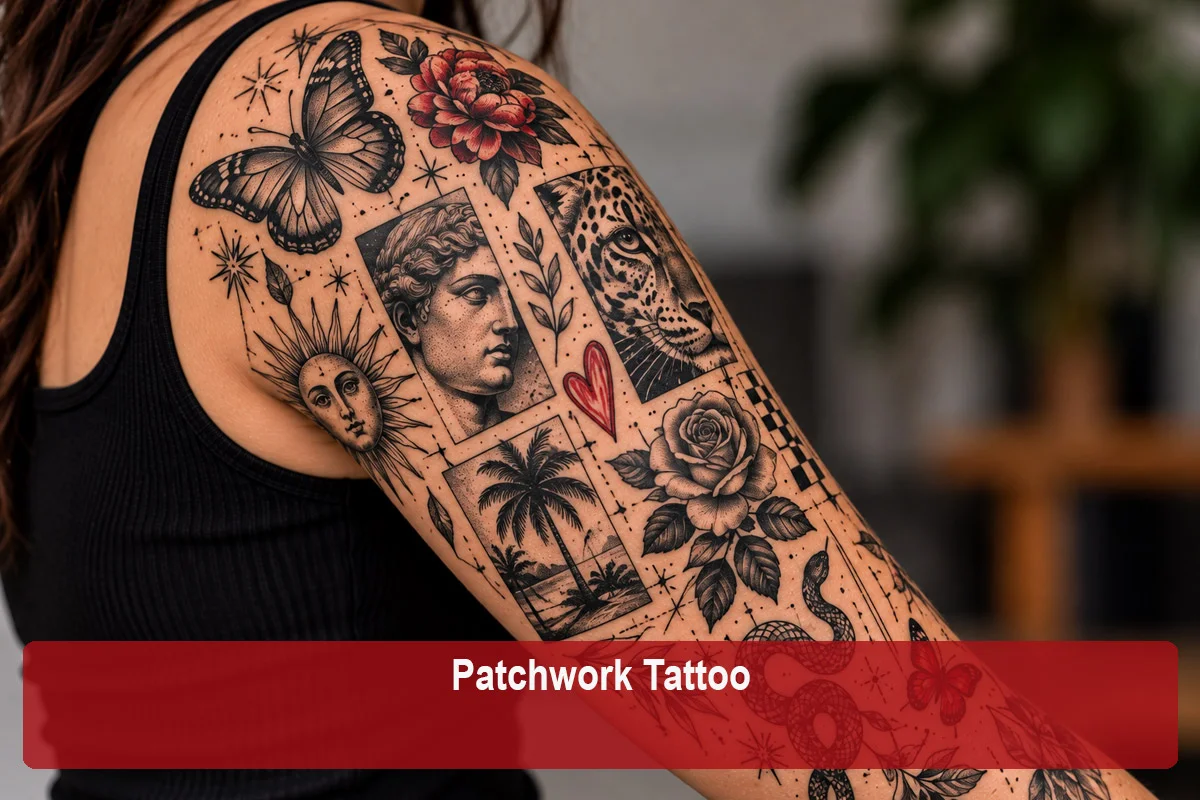
What Is a Patchwork Tattoo?
A patchwork tattoo collection consists of separate tattoos arranged across a body area with visible skin between individual designs. Instead of forming one continuous illustration, each tattoo remains recognizable as its own piece.
The approach is particularly popular for arm sleeves, but patchwork collections can also develop across the legs, chest, back, and other areas.
Patchwork describes the arrangement of tattoos rather than their application technique. Individual pieces may be American Traditional, Blackwork, Fine Line, Illustrative, or other styles.
A patchwork sleeve can be planned in advance or develop gradually over several years. The defining characteristic is the relationship between independent tattoos and the spaces surrounding them.
Patchwork Tattoos vs. Traditional Tattoo Sleeves
The difference between a patchwork sleeve and a continuous sleeve is primarily compositional.
A continuous sleeve typically uses a connected background or overarching scene. A patchwork sleeve retains separation between individual images.
| Feature | Patchwork Sleeve | Continuous Sleeve |
|---|
| Composition | Independent designs | Connected artwork or background |
| Negative space | Visible gaps between pieces | May be incorporated into a larger composition |
| Planning | Can evolve one tattoo at a time | Often planned as a larger project |
| Artists | May involve multiple artists | Often completed by one artist |
| Visual consistency | Established through spacing, scale, or style | Established through connected composition |
| Future additions | Possible where suitable space remains | May require integration into existing artwork |
Neither approach is inherently better. Patchwork is particularly suitable for people who enjoy collecting individual designs over time.
How to Plan a Patchwork Tattoo Sleeve
A patchwork sleeve may look spontaneous, but successful collections usually benefit from some planning. Each new tattoo changes the space available for future pieces.
1. Start With Your Largest or Most Important Tattoos
If you have a specific portrait, animal, flower, or other important design in mind, consider reserving an appropriate location for it before adding several smaller tattoos.
Large designs often need uninterrupted areas of skin. Filling those areas with tiny symbols first may limit your options later.
For example, a large eagle may fit naturally on the outer upper arm, while a vertical dagger might work along the forearm.
Smaller tattoos can then occupy surrounding areas without forcing the main subjects into unsuitable shapes.
2. Decide How Much Skin Should Remain Visible
Negative space is one of the defining features of patchwork tattoos.
Some people prefer generous gaps that make every design stand out. Others prefer closely arranged tattoos that create a denser collection.
There is no universal spacing measurement suitable for every patchwork sleeve.
A bold traditional rose and a delicate fine-line flower may require different visual separation because their outlines and black density differ.
Ask your artist to evaluate the gaps between designs at actual size on your body.
3. Consider the Entire Arm, Not Just One View
A tattoo may look balanced when viewed from the front but create an awkward arrangement when the arm rotates.
Patchwork planning should consider the outer arm, inner arm, and transitions around the sides.
The elbow, wrist, and shoulder also affect how individual designs are positioned.
Photographs or body templates can help with early planning, but final placement should be checked directly on the body.
4. Establish a Visual Connection
Patchwork tattoos do not need identical subject matter. However, a collection can look more cohesive when some visual characteristics repeat.
These might include similar black line weights, a limited color palette, recurring motifs, or consistent spacing.
For example, a sleeve containing a snake, rose, dagger, and bird may feel unified if each design uses bold outlines and comparable black shading.
Alternatively, a collection can intentionally mix different techniques while maintaining balance through placement and scale.
5. Leave Room for Future Tattoos
If you expect to continue collecting tattoos, avoid filling every available gap immediately.
A narrow opening might suit a small star, but a larger area could accommodate an important future design.
Discuss which spaces should remain available and which are suitable for small supporting pieces.
It is easier to add tattoos later than to recover an area already occupied by an unsuitable design.
Popular Patchwork Tattoo Ideas
Patchwork tattoos can include almost any subject. The strongest collections usually combine personal meaning with deliberate placement and a recognizable visual approach.
American Traditional Patchwork Tattoos
American Traditional designs are especially compatible with patchwork arrangements because their bold outlines and recognizable silhouettes help each piece stand independently.
Popular subjects include roses, swallows, daggers, panthers, anchors, hearts, and eagles.
These designs can be collected gradually while maintaining a consistent visual character.
Explore American Traditional tattoos for examples of bold flash-inspired artwork.
Fine Line Patchwork Tattoos
Fine line patchwork collections often feature small flowers, celestial symbols, delicate animals, lettering, and minimalist illustrations.
These designs can create a lighter overall appearance than bold blackwork or traditional tattoos.
However, fine lines still require appropriate spacing and scale. Placing many miniature designs close together may reduce their readability.
Explore Fine Line tattoos for more information about delicate linework.
Blackwork Patchwork Tattoos
Blackwork patchwork sleeves use solid black shapes, graphic illustrations, and strong contrast.
A collection might include animals, abstract symbols, botanical designs, and ornamental pieces.
Because large black areas carry substantial visual weight, placement is particularly important.
Several dense black tattoos grouped in one small area can make the collection feel unbalanced.
Explore Blackwork tattoos for additional design inspiration.
Minimalist Patchwork Tattoos
Minimalist patchwork collections use simplified symbols and restrained details.
Common subjects include stars, moons, hearts, small plants, simple animals, and geometric forms.
The challenge is avoiding a collection that looks accidental rather than deliberately arranged.
Consistent proportions, spacing, and thoughtful orientation can help establish a cohesive appearance.
Patchwork Tattoos With Personal Meaning
Some people use patchwork tattooing to document different stages of their lives.
A collection might include travel memories, family references, meaningful dates, favorite animals, and personal symbols.
Each tattoo can represent a separate experience without needing to fit into one continuous narrative.
If personal meaning is the priority, consider leaving room for future milestones rather than completing the entire collection immediately.
Mixed-Style Patchwork Tattoos
Patchwork sleeves can combine multiple artistic styles, including realism, illustrative artwork, traditional flash, and lettering.
However, mixing styles creates additional compositional challenges.
A highly detailed realistic portrait may appear visually heavier than several delicate linework tattoos.
Artists can balance this difference through scale, spacing, placement, and supporting designs.
Mixed-style collections benefit from reviewing the whole body area rather than choosing each tattoo in isolation.
Patchwork Tattoo Sleeve Ideas for Arms and Legs
Patchwork Arm Sleeves
The arm is a popular area for patchwork collections because individual tattoos can occupy different surfaces while remaining part of a larger arrangement.
A sleeve might begin with a prominent upper-arm design, continue with several medium-sized forearm pieces, and eventually incorporate smaller tattoos around the elbow and wrist.
Consider how each tattoo looks when the arm is relaxed, extended, and rotated.
Patchwork Half Sleeves
A patchwork half sleeve covers a portion of the arm rather than extending from shoulder to wrist.
It may focus on the upper arm or forearm.
Half sleeves can be a practical starting point for people who want a collection but are not ready to commit to an entire arm.
If a full sleeve is a future possibility, consider how the existing pieces might connect visually with later additions.
Patchwork Leg Sleeves
Leg patchwork tattoos can include larger illustrations on the thigh and calf, with smaller pieces arranged around them.
The thigh provides space for detailed subjects, while the calf often suits vertical compositions.
The knee, shin, and ankle require additional placement planning because of curvature, movement, and available space.
Patchwork Chest and Torso Tattoos
Patchwork arrangements can also develop across the chest, ribs, and torso.
These collections may feature separate symbols, lettering, animals, or illustrative designs.
Because the torso contains large changes in contour, an artist should evaluate how the pieces relate to the body's natural shape.
How Much Space Should You Leave Between Patchwork Tattoos?
There is no single correct distance between patchwork tattoos.
Spacing depends on the size, shape, line weight, and visual density of neighboring designs.
A small star may need less visual separation than a detailed portrait or large blackwork animal.
The goal is to preserve the identity of each piece while creating an intentional overall composition.
Why Equal Gaps Do Not Always Look Equal
Two tattoos may have the same physical distance between them but still appear crowded if both contain heavy black outlines.
Conversely, delicate designs may appear more separated because they occupy less visual space.
Evaluate the balance of the collection rather than relying on one fixed measurement.
What Happens When Patchwork Tattoos Are Too Close?
Closely arranged tattoos can compete visually, especially when neighboring edges contain dense shading or fine details.
As tattoos age, some lines may soften, potentially making narrow gaps less distinct.
Appropriate spacing helps preserve each design's silhouette and readability.
Can Patchwork Tattoos Have Large Gaps?
Yes. Large areas of visible skin can be an intentional part of a patchwork collection.
Not every opening needs to be filled.
Some people prefer an airy arrangement in which each tattoo remains clearly separated.
Others gradually reduce the gaps as their collection grows.
Patchwork Tattoo Fillers: What Works Between Larger Pieces?
Filler tattoos are small designs used to occupy spaces between larger pieces.
They can help balance a collection, but they should be added only when the remaining gaps are understood.
Stars, Sparkles, and Small Symbols
Stars, sparkles, dots, and simple symbols can fit into irregular spaces without dominating the surrounding artwork.
However, repeating the same filler everywhere may make the collection feel visually busy.
Small Flowers and Leaves
Botanical fillers can soften the transition between larger designs.
Leaves, small blossoms, and branches can be adapted to narrow or curved spaces.
Choose designs with enough internal separation to remain readable.
Small Animals and Insects
Butterflies, moths, bees, spiders, and other compact subjects can work as supporting pieces.
The available space should determine the level of detail.
A complicated insect illustration may require more room than a simple silhouette.
Geometric and Ornamental Fillers
Small geometric forms, decorative marks, and ornamental motifs can provide visual rhythm.
They work particularly well when the existing collection already includes similar shapes or linework.
Explore Ornamental tattoos for decorative patterns and composition ideas.
When Not to Add Filler Tattoos
Filler is not always necessary.
If an open area could accommodate a meaningful future tattoo, filling it with several small symbols may limit your options.
Before adding filler, ask whether it improves the collection or simply reduces empty space.
Can You Mix Color and Black and Grey in Patchwork Tattoos?
Yes. Patchwork tattoos can combine color and black and grey artwork.
However, color distribution affects the visual balance of the collection.
A single brightly colored design may become the dominant focal point when surrounded by smaller black tattoos.
This can be intentional, but it should be considered during placement.
Some people maintain a consistent palette across multiple pieces, while others prefer an eclectic collection with varied colors and styles.
There is no requirement for every patchwork tattoo to use identical colors.
Do Patchwork Tattoos Have to Match?
No. Patchwork tattoos can include unrelated subjects and different artistic styles.
However, a visual connection can help the collection feel intentional.
Consistency may come from similar line weights, comparable design sizes, recurring motifs, or balanced spacing.
For example, a collection of unrelated animals, flowers, and symbols may still look cohesive when each piece uses bold black outlines.
A collection can also embrace contrast and variation as part of its character.
The goal is not necessarily uniformity, but a layout that reflects your preferences.
How Much Does a Patchwork Tattoo Sleeve Cost?
The total cost of a patchwork sleeve depends on the number of tattoos, their dimensions, complexity, color, placement, and the artists involved.
Some shops charge by the hour, while others quote individual designs or use minimum appointment charges.
A collection completed over several years may involve different artists and pricing structures.
Small tattoos are not always inexpensive relative to their size because studio minimums and preparation time may apply.
Ask each artist for a quote based on the specific design and placement.
For a long-term collection, establish a realistic budget and avoid rushing into filler tattoos simply to make the sleeve appear finished.
Do Patchwork Tattoos Age Well?
Patchwork tattoos do not have one universal aging pattern because each piece may use different techniques, colors, and line weights.
A bold traditional tattoo may change differently from a delicate fine-line illustration.
Individual tattoos may also have been completed years apart, making differences in appearance more noticeable.
Appropriate design size, spacing, professional application, and aftercare can help maintain readability.
Will Older and Newer Tattoos Look Different?
Yes. A newly completed tattoo may appear darker and sharper than a piece that has been healed for several years.
Differences in ink, artistic technique, placement, and sun exposure can also affect appearance.
Some people appreciate this evolving character as part of their collection.
If visual consistency matters to you, discuss how new tattoos can complement older work without assuming they will look identical.
Can Patchwork Tattoos Be Reworked Later?
Some existing tattoos may be suitable for reworking, adding detail, or incorporating into a larger arrangement.
However, not every tattoo can be changed without affecting its original appearance.
Ask an experienced artist to evaluate the existing work before planning significant modifications.
Laser removal or lightening may be an option for some unwanted tattoos, but results vary and treatment carries risks.
Common Patchwork Tattoo Planning Mistakes
Filling the Best Placement Areas Too Early
Placing several small tattoos across the largest uninterrupted areas can make future large designs difficult to accommodate.
Reserve important locations for designs that need them.
Ignoring the Overall Collection
A tattoo may look excellent individually but create awkward gaps or imbalance when placed beside existing work.
Review the whole area before approving each new stencil.
Using Filler to Solve Every Gap
Small fillers can improve balance, but excessive filler may reduce the separation that defines patchwork tattooing.
Leave some negative space intentionally.
Mixing Styles Without Considering Visual Weight
A large blackwork design may dominate several nearby delicate tattoos.
Use scale and placement to balance pieces with different levels of contrast.
Choosing Designs Only for Their Size
A design should not be selected solely because it fits a particular gap.
Consider whether the subject is meaningful or visually appropriate and whether its details can be tattooed at that size.
How to Choose a Patchwork Tattoo Artist
Patchwork tattooing does not require every piece to be completed by one artist.
However, the artist adding a new tattoo should understand how it will interact with existing work.
1. Review Completed Patchwork Collections
Look for photographs showing full sleeves or body areas rather than only isolated close-ups.
Examine spacing, orientation, and overall visual balance.
2. Choose Artists for Their Individual Strengths
If you want a traditional panther, choose an artist experienced in American Traditional work.
If you want a delicate botanical illustration, look for an artist specializing in that approach.
The overall patchwork layout should not come at the expense of individual tattoo quality.
3. Discuss Existing Tattoos
Bring photographs of your current collection and explain which areas you want to develop.
The artist should consider existing pieces as permanent design constraints.
4. Evaluate Placement Before Tattooing
Ask to see the stencil alongside neighboring tattoos.
Check the placement from different angles and with the body in a natural position.
5. Look for Healed Work
Healed portfolios help demonstrate how an artist's lines, shading, and colors settle over time.
Compare examples using techniques similar to your intended design.
Patchwork Tattoo Aftercare and Safety
Every new tattoo requires appropriate aftercare, even when it is a small addition to an existing collection.
Follow the artist's instructions for cleaning and protecting the healing area.
Choose a professional studio that follows applicable state and local requirements and appropriate infection-control practices.
Tattooing can cause infections, allergic reactions, and other complications, including reactions to contaminated ink.
After healing, protect exposed tattooed skin from ultraviolet light. Broad-spectrum, water-resistant sunscreen with SPF 30 or higher can help protect the appearance of your tattoos.
If you experience spreading redness, worsening pain, pus, fever, or another concerning reaction, seek medical attention.
Find Patchwork Tattoo Artists Near You
Patchwork tattoo collections can be created by artists working in many different styles throughout the United States.
Some specialize in bold traditional flash, while others focus on fine line, blackwork, illustrative designs, or custom small tattoos.
Use TattooShopsNearYou.com to explore tattoo shops and artists by location and style. Compare available portfolios, examine completed patchwork sleeves, and identify artists whose work complements your existing tattoos.
Before booking, discuss your current collection, future plans, preferred spacing, and whether the new design should match or contrast with neighboring pieces.
A successful patchwork collection does not require every tattoo to look alike. It requires thoughtful decisions about how separate pieces share the same space.