Mandala Tattoos: Meaning, Placement & Artists Near You
A mandala tattoo grows outward from one point. Rings of petals, dots, and geometric shapes repeat in perfect balance around a center, creating a design that feels calm, complete, and hypnotic. It's one of the most enduring decorative tattoo styles, and one of the most technically unforgiving, because the eye instantly notices a ring that isn't quite round or a petal that's slightly out of line.
Mandalas also have deep roots in religious practice. Understanding where they come from helps you choose a design you'll feel good about, and understanding how they're built helps you choose the right artist. This guide covers both: the meaning and history of mandalas, how a mandala tattoo is constructed and placed on a curved body, how it ages, and how to find a mandala tattoo artist in our directory.
Mandala Tattoo Artists & Shops Near You
Browse 2 tattoo artists and shops featuring Mandala work. Compare portfolios and healed examples before you book.
"Mandala" is the Sanskrit word for "circle." Mandalas originated in Indian religions, and Hinduism, Buddhism, and Jainism use them as symbolic maps, representing deities or the cosmos, and as aids to meditation. A basic Hindu mandala, also called a yantra, is a square with four T-shaped gates enclosing a circle with a central point, the bindu.
In Tibetan Buddhism, monks create intricate mandalas from colored sand over days or weeks, then ritually sweep them away and pour the sand into running water as a lesson in impermanence. In the twentieth century, psychologist Carl Jung used the word for the circular drawings he and his patients made, which he saw as expressions of the Self and of wholeness. That idea has shaped how many people think of mandalas today: as personal symbols of balance, unity, and inner calm.
Anatomy of a Mandala Tattoo
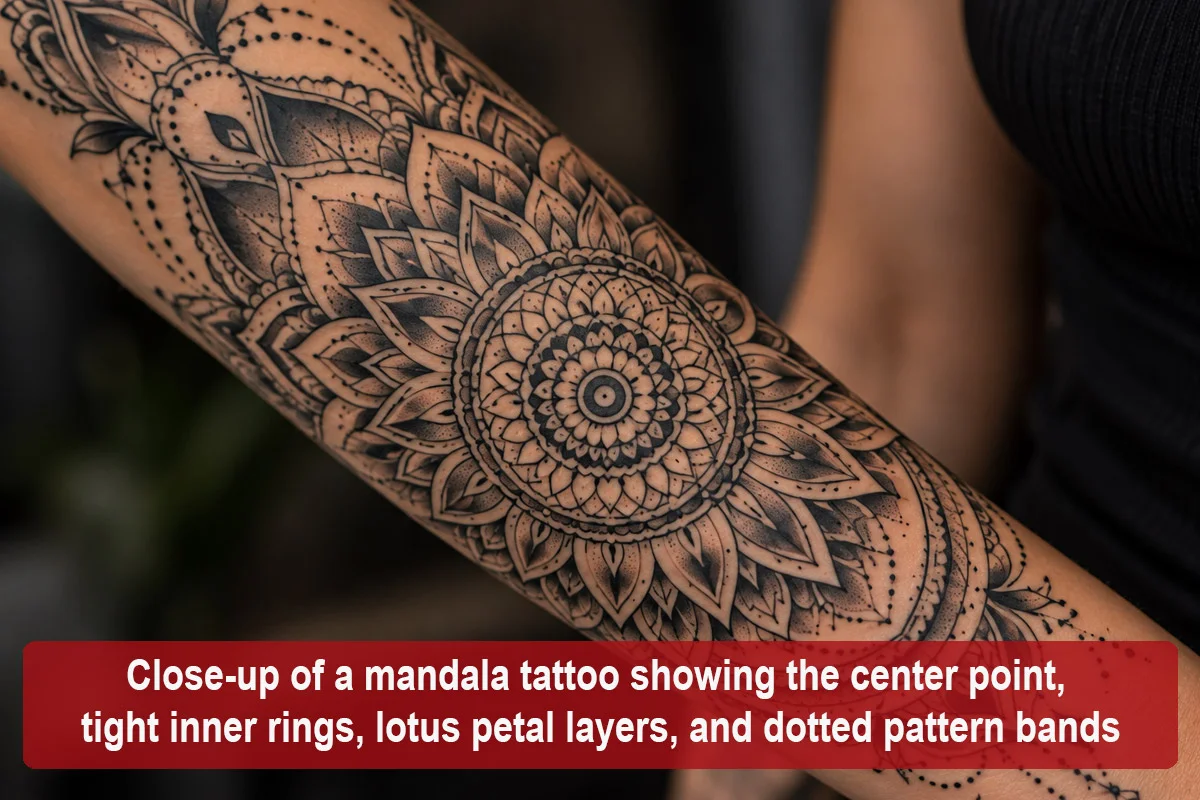
Most mandala tattoos share a common structure. Knowing the parts helps you describe the design you want.
The parts of a mandala tattoo
Element
What it is
Why it matters in a tattoo
Center point (bindu)
The origin the whole design radiates from
Its placement on your body decides how balanced the piece looks
Inner rings
Small, tight layers close to the center
Where detail is densest and most likely to blur if too small
Petal layers
Repeating lotus-like petals or pointed shapes
Give the mandala its flower-like rhythm
Pattern bands
Rings filled with dots, scallops, lines, or geometry
Add texture and separate the layers
Outer edge
Points, scallops, rays, or a hanging fringe
Defines the silhouette and how the mandala meets your skin
Center, rings, petals, and pattern bands repeat in perfect rotation.
Choosing a Mandala Respectfully
Many mandala tattoos are decorative designs inspired by the form, not copies of specific religious diagrams. That's widely accepted. Some designs are different, though. The Sri Yantra, for example, is the central object of worship in the Shri Vidya tradition of Hinduism, built from nine interlocking triangles around a bindu, surrounded by rings of lotus petals and a square frame with four gates. Specific deity mandalas in Buddhist and Hindu practice carry similar weight.
If you're considering a specific sacred design, learn what it represents first, and think about placement. Many people consider it disrespectful to place sacred imagery on the feet or lower body. If a religious mandala is personally meaningful to you, an artist familiar with the tradition can help you approach it with care. For figures like the Sri Yantra and the Flower of Life, see our Sacred Geometry guide.
Popular Types of Mandala Tattoos
Dotwork mandalas
The most classic approach: clean linework with petals and rings shaded by stippled dots, creating soft gradients and a textured, almost printed look. See our Dotwork guide.
Linework mandalas
Line only, with no shading. Light, delicate, and graphic, though fine lines need generous spacing to stay clear over time.
Lotus mandalas
The mandala grows from or inside a lotus flower, often associated with rebirth and resilience.
Half and partial mandalas
Only part of the circle is shown, flowing off an edge of the body, such as around the elbow, off the shoulder, or emerging from the sternum. These suit placements where a full circle won't fit.
Blackout and negative-space mandalas
The mandala is left as open skin within solid black, or tattooed in heavy black with bold contrast. See our Blackwork guide.
Hybrid mandalas
Mandalas combined with animals, skulls, moons, suns, or flowers, or set into Ornamental and Geometric compositions.
Half mandalas flow around joints and edges of the body.
The Hard Part: Perfect Circles on a Curved Body
Drawn on paper, a mandala is perfectly round and symmetrical. Placed on a shoulder, knee, or curved back, the same design can distort, with circles turning into ovals and rings looking uneven from the side. Skilled mandala artists handle this in a few ways:
Center on natural "domes": the shoulder cap, kneecap, elbow, and the center of the upper back are naturally rounded and suit radiating designs.
Align with the midline: sternum and spine mandalas must sit exactly on the body's center line, or the whole piece looks crooked.
Adjust for the viewing angle: artists may subtly reshape rings so they look round from the angle people usually see them.
Check the stencil from several angles and with the body in different positions before tattooing.
When you look at a portfolio, check photos from the side, not just straight on. If the mandala still looks balanced from different angles, the artist understands how to fit it to a body. See how placement affects design detail.
Best Placements for Mandala Tattoos
Shoulder cap: the classic placement. The dome shape is ideal for a full radiating design.
Elbow and knee: popular for mandalas centered on the joint, though both are painful and the skin moves a lot. See do knee tattoos hurt.
Sternum and chest: symmetrical full or half mandalas centered on the breastbone, often with hanging ornamental elements. See do chest tattoos hurt.
Upper back and between the shoulder blades: room for large, detailed mandalas.
Spine: a vertical column of small mandalas or a single mandala with extending linework. See do spine tattoos hurt.
Forearm and thigh: work well, with mandalas often combined into larger pieces or sleeves.
Hands, fingers, and feet: popular for small mandalas, but friction and fading wear down fine detail quickly.
Size and Detail
The number of rings and the amount of detail need to match the size. A small mandala packed with many tight rings will look impressive when fresh, but the innermost layers are where lines sit closest together, and they're the first to blur as the tattoo ages. For small mandalas, fewer rings and simpler petals hold up better. For intricate designs, go larger.
Mandalas are often the anchor of larger ornamental and geometric projects. A common approach is to place a mandala on the shoulder cap or elbow, then connect it to the rest of the arm with linework, geometric bands, dotwork gradients, or ornamental elements. Planning the full layout first ensures the mandala sits in the right spot for the whole composition.
Mandalas often anchor larger ornamental and geometric sleeves.
Because a mandala is built from repeating elements, it's easy to weave in personal details without breaking the design: a meaningful flower as the petal shape, a birth month bloom, a name or date hidden in a ring, a small symbol at the center, or elements tied to a place or person. These details make a widely loved design uniquely yours.
How Mandala Tattoos Heal and Age
Touch-ups are common. Fine linework and stippling can heal slightly unevenly, and many artists recommend a touch-up within the first year.
Dotwork softens. Over time, stippled shading blends into smoother grey. Many people like this softened look, but the crisp, grainy texture of fresh dotwork won't stay exactly the same.
The center blurs first. Tight inner rings are the most vulnerable to filling in.
Movement and exposure speed fading. Elbows, knees, hands, and feet need more maintenance than the shoulder or back. Sunscreen on healed tattoos helps keep lines crisp.
Mandala Tattoos on Darker Skin
Bold linework and solid black elements show well on darker skin. Light, sparse stippling and very fine lines carry less contrast and can look faint. Artists may suggest denser dotwork, bolder lines, more solid black, or a larger size. Blackout and negative-space mandalas are also a strong option. Ask to see healed mandala work on skin tones similar to yours.
Time and Cost
Mandalas are time-intensive because of their symmetry and detail, especially when shaded with dotwork. A small mandala may take a single session, while large shoulder, back, or sleeve mandalas often take several. Most artists price by the hour or session. Custom layout and fitting to your body are part of the work. See what to bring to a long tattoo session.
How to Choose a Mandala Tattoo Artist
Truly round circles and rings with consistent spacing.
Precise symmetry with every petal aligned around the center.
Clean, even line weight throughout the design.
Smooth dotwork gradients without blotches.
Balanced placement that looks right from several angles.
Healed work, ideally a year or more old, showing how their detail holds up.
Browse mandala tattoo artists and shops in our directory, then compare their symmetry, dotwork, and healed placements. Mandala specialists are often also tagged Dotwork, Ornamental, Geometric, or Sacred Geometry, so check those too. You can also compare all tattoo styles.
Frequently Asked Questions About Mandala Tattoos
"Mandala" means "circle" in Sanskrit. Mandalas come from Hindu, Buddhist, and Jain traditions, where they represent the cosmos or deities and support meditation. As tattoos, they're often associated with balance, wholeness, and inner calm.
Decorative mandalas inspired by the form are widely accepted. Specific sacred designs, such as the Sri Yantra or deity mandalas, carry religious meaning, so learn what they represent and avoid placements like the feet if you choose one.
The shoulder cap, elbow, knee, sternum, upper back, and spine are popular because the design can center on a natural point or line of the body. Hands and feet are possible but fade faster.
They age well when the size suits the detail. Tight inner rings and very fine lines blur first, and dotwork softens over time. A sensible size, a touch-up after healing, and sun protection help.
A half mandala shows only part of the circle, flowing off an edge of the body, such as around the elbow, off the shoulder, or from the sternum. It suits areas where a full circle won't fit.
Pain depends on placement. Elbow, knee, sternum, and spine mandalas are among the more painful, while the shoulder and outer thigh are usually more comfortable. Long dotwork sessions can also be tiring.
Mandalas are circular, radiating designs. Sacred geometry uses specific symbolic figures, such as the Flower of Life, Metatron's Cube, or Sri Yantra, that may or may not be circular.
Look for truly round circles, precise symmetry, smooth dotwork, and healed placements that look balanced from several angles. Compare artists tagged Mandala, Dotwork, and Ornamental in our directory.