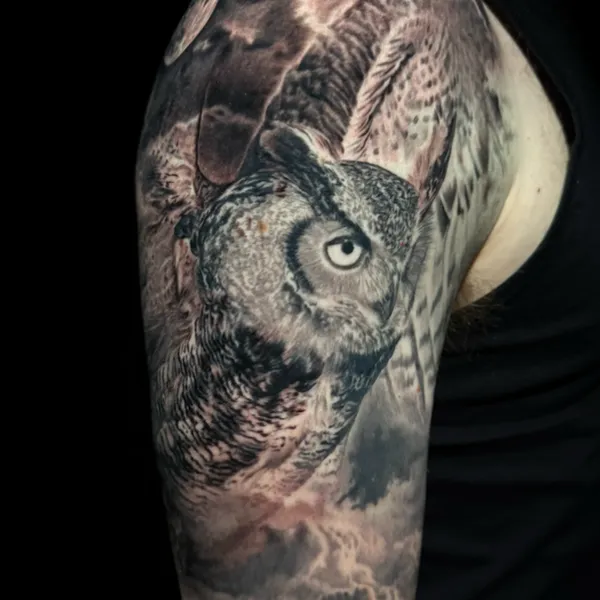
What Are Dark Art Tattoos?
Dark Art tattoos are tattoos built around unsettling, mysterious, macabre, or psychologically intense imagery. They may explore mortality, fear, transformation, isolation, folklore, the supernatural, or the relationship between beauty and decay.
Unlike tattoo categories defined by specific techniques, Dark Art describes the artistic direction and emotional character of the design. A Dark Art tattoo may be executed using blackwork, black and grey realism, illustrative linework, surrealism, or a combination of techniques.
A detailed skull, for example, is not automatically a Dark Art tattoo. Its composition, expression, surrounding imagery, and atmosphere determine whether it communicates a darker artistic concept.
Some Dark Art tattoos are dramatic and frightening. Others are quiet, symbolic, melancholic, or visually ambiguous.
The strongest examples usually have a recognizable subject, intentional visual hierarchy, and a clear relationship between the central image and its supporting elements.
What Makes a Dark Art Tattoo Different?
Dark Art tattooing is distinguished less by a fixed set of symbols and more by how the artist uses those symbols.
Atmosphere and Emotional Tension
Dark Art often creates a particular mood through composition, shadows, expression, and visual contrast.
A solitary figure surrounded by empty space may suggest isolation. A distorted face emerging from darkness may create psychological tension. A decaying flower beside a carefully rendered hand may communicate impermanence.
The subject does not need to be violent or graphic to produce an unsettling effect.
Contrast Between Beauty and Decay
Many Dark Art compositions combine visually attractive forms with disturbing or deteriorating elements.
Examples include flowers growing through skeletal remains, delicate ornament surrounding a skull, or a classical statue with fractured features.
These contrasts can create more visual interest than simply filling a tattoo with dark objects.
Symbolism Without Fixed Meanings
Skulls, ravens, moths, candles, mirrors, and shadowy figures may appear in Dark Art, but their meanings depend on context.
A skull can represent mortality, remembrance, or an interest in anatomical imagery. A broken mirror might suggest identity, fragmentation, or transformation.
A tattoo does not need a predetermined symbolic meaning. Personal interpretation and visual preference are equally valid reasons to choose a design.
Distortion and Unconventional Anatomy
Dark Art frequently uses altered proportions, fragmented bodies, impossible creatures, or unfamiliar combinations of recognizable forms.
However, deliberate distortion should not be confused with weak drawing skills.
An artist who intentionally changes anatomy should still understand the underlying structure well enough to control the effect.
Popular Dark Art Tattoo Designs and Ideas
Dark Art can accommodate a wide range of subjects, from recognizable symbolic imagery to highly personal surreal compositions.
Dark Art Skull Tattoos
Skulls are among the most familiar subjects in macabre artwork. They can be rendered realistically, simplified into graphic blackwork, or transformed through surreal elements.
A skull surrounded by roots may suggest decay and regeneration, while one combined with a clock or candle may reference the passage of time.
For a distinctive design, consider what the skull is doing within the composition rather than simply adding decorative shadows.
Strong skull tattoos require convincing structure, particularly around the eye sockets, cheekbones, jaw, and teeth.
Dark Art Portrait Tattoos
Dark portraits may depict fictional characters, anonymous figures, distorted faces, or classical sculptures altered through surreal imagery.
Artists may use unusual lighting, partially obscured features, fractured surfaces, or contrasting expressions to create tension.
For realistic portraits, the artist should demonstrate the ability to maintain facial proportions and recognizable features.
For intentionally distorted portraits, the composition should still make clear which elements are deliberate artistic choices.
See Portrait tattoos for guidance on reference quality, facial detail, and selecting a portrait specialist.
Dark Art Raven and Crow Tattoos
Ravens and crows can create strong silhouettes and support compositions involving mystery, folklore, or transformation.
A raven may be shown with spread wings, perched on architectural ruins, or partially dissolving into abstract marks.
Fine feather details should support the overall form rather than overwhelm it.
For smaller tattoos, a clear silhouette may communicate the subject more effectively than dense realistic texture.
Dark Art Moth and Insect Tattoos
Moths, beetles, spiders, and other insects are frequently used in dark illustrative work.
Their natural symmetry can support ornamental designs, while wings and segmented bodies offer opportunities for detailed linework.
A moth tattoo might incorporate a skull-like marking, architectural framing, or unusual botanical elements.
However, these additions should be planned carefully so the insect remains recognizable.
Dark Art Skeleton and Anatomical Tattoos
Skeletal hands, rib cages, anatomical hearts, and fragmented bones can form the basis of expressive Dark Art designs.
Some compositions emphasize anatomical accuracy, while others deliberately transform recognizable structures.
A skeletal hand holding a flower, for example, can create a visual contrast between fragility and life.
If anatomical realism matters, choose an artist with relevant drawing experience and carefully rendered portfolio examples.
Dark Art Creatures and Monsters
Imaginary creatures allow artists to develop original forms rather than reproduce familiar tattoo motifs.
Designs may combine animal anatomy, human features, skeletal structures, or surreal shapes.
The main challenge is maintaining a clear silhouette when several unfamiliar elements are combined.
Before adding complex textures, establish the creature's pose, focal point, and overall proportions.
Dark Art Religious and Mythological Imagery
Angels, demons, mythological figures, and historical religious imagery may appear in Dark Art tattoos.
These subjects can carry substantial cultural and personal significance.
When using an identifiable religious symbol or mythological figure, research its original context rather than assuming it has one universal meaning.
An artist can create an original interpretation while respecting the distinction between historical symbolism and modern fictional imagery.
Dark Botanical Tattoos
Wilted flowers, thorned branches, roots, poisonous-looking plants, and decaying botanical illustrations can create Dark Art compositions without relying on horror imagery.
For example, a flower with exposed roots and broken petals can suggest impermanence or transformation.
Botanical subjects are also useful for connecting larger figures or filling irregular spaces in a sleeve.
Maintain enough separation between overlapping stems and leaves to preserve readability.
Dark Art vs. Gothic, Horror, and Surrealism Tattoos
These categories share visual influences, but they are not interchangeable.
| Style |
Main Focus |
Common Characteristics |
| Dark Art |
Unsettling themes and expressive atmosphere |
Macabre imagery, psychological tension, symbolism |
| Gothic |
Historical and modern Gothic aesthetics |
Cathedral architecture, blackletter, dark romantic imagery |
| Horror |
Fear and horror-related subjects |
Monsters, frightening characters, cinematic imagery |
| Surrealism |
Dreamlike or impossible combinations |
Distorted forms, unexpected relationships, visual paradoxes |
| Blackwork |
Graphic use of black ink |
Solid black shapes, silhouettes, patterns, strong contrast |
Dark Art vs. Gothic Tattoos
Gothic tattoos often draw on medieval architecture, blackletter typography, religious iconography, and dark romantic aesthetics.
Dark Art is broader and may include contemporary psychological imagery, experimental illustration, and unsettling subjects without historical Gothic references.
A cathedral window may be Gothic without being particularly dark or disturbing. A distorted human portrait may be Dark Art without using any Gothic elements.
Explore Gothic tattoos for designs inspired by architecture, blackletter, and dark romantic imagery.
Dark Art vs. Surrealism Tattoos
Surrealism uses unexpected combinations, altered reality, and dreamlike imagery.
Dark Art may borrow these techniques to create unsettling compositions, but surreal tattoos do not need to be dark.
A floating eye surrounded by flowers may be surreal without being frightening. A shadowy figure with impossible anatomy may belong to both categories.
Explore Surrealism tattoos for additional examples of dreamlike visual composition.
Blackwork vs. Black and Grey Dark Art Tattoos
Blackwork Dark Art Tattoos
Blackwork relies on solid black shapes, strong silhouettes, and deliberate negative space.
It can be especially effective for shadowy figures, abstract creatures, bold skulls, and graphic compositions.
The artist must ensure that important features remain recognizable when surrounded by dense black areas.
Explore Blackwork tattoos for designs that emphasize black shapes and graphic contrast.
Black and Grey Dark Art Tattoos
Black and grey techniques allow artists to create atmospheric shadows, realistic textures, and subtle transitions between light and dark.
These qualities can support detailed portraits, skeletal anatomy, statues, and dramatic scenes.
However, excessive low-contrast shading can cause important features to disappear visually.
Artists should establish clear focal points and maintain sufficient tonal separation.
For a deeper comparison of the two approaches, read Blackwork vs. Black and Grey Tattoos.
Can Dark Art Tattoos Use Color?
Yes. Dark Art tattoos are not restricted to black ink.
Some artists use restrained red accents, muted colors, or selective highlights to emphasize particular elements.
A small red detail within a largely black composition may become a strong focal point.
However, color should serve the overall design rather than being added solely to make the tattoo more dramatic.
How to Create an Original Dark Art Tattoo
Dark Art provides substantial opportunities for original design because its subjects are not restricted to a fixed collection of symbols.
Start With a Concept Rather Than a Collection of Images
Instead of requesting a skull, raven, candle, and broken mirror simply because they look dark, identify the idea you want the artwork to communicate.
For example, a concept about memory might combine a damaged portrait with an object connected to a personal experience.
A concept about transformation could use a recognizable animal gradually changing into an unfamiliar form.
Choose One Main Subject
Strong Dark Art compositions usually benefit from a visual focal point.
The main subject might be a face, creature, anatomical form, or symbolic object.
Secondary imagery should support that subject rather than compete with it.
Use Negative Space Deliberately
Dark Art does not require every area to be filled with black shading.
Uninked skin can create highlights, separate overlapping elements, and direct attention toward important features.
A shadowy figure may appear more dramatic when surrounded by controlled negative space than when placed inside an entirely black background.
Adapt the Concept to the Body
A composition that looks effective as a rectangular illustration may not translate directly to an arm, chest, or calf.
The artist should adjust the proportions and direction of the artwork to suit the body.
For example, a vertical figure may suit the forearm, while a wide symmetrical composition may work better across the chest or upper back.
Best Placements for Dark Art Tattoos
Dark Art can work in many locations, but the amount of detail and the composition's proportions should guide placement.
| Placement |
Suitable Designs |
Key Consideration |
| Forearm |
Dark portraits, ravens, skeletal hands, vertical figures |
Orientation and available width |
| Upper Arm |
Skulls, creatures, detailed illustrations |
Curvature and visual balance |
| Chest |
Symmetrical moths, wings, ornamental compositions |
Body contours and symmetry |
| Back |
Large narrative scenes, creatures, surreal compositions |
Space for complex detail |
| Thigh |
Detailed portraits, anatomical artwork, large illustrations |
Room for shading and recognizable features |
| Calf |
Vertical figures, ravens, skeletal compositions |
Muscle curvature and orientation |
| Hand |
Simple symbols and bold silhouettes |
Friction, exposure, and limited detail space |
Dark Art Forearm Tattoos
The forearm is suitable for vertically arranged designs, including shadowy figures, ravens, and skeletal hands.
Consider whether the subject should face inward, outward, or toward the viewer when the arm is relaxed.
Complex scenes may need to be simplified to fit the available width.
For additional placement considerations, read Inner vs. Outer Forearm Tattoos.
Dark Art Chest Tattoos
The chest can accommodate symmetrical compositions and large central subjects.
Wings, ornamental frames, and abstract forms can follow the body's natural contours.
For a central portrait or figure, check that the design remains balanced when the body is relaxed.
Dark Art Back Tattoos
The back provides room for elaborate scenes, detailed creatures, and large surreal compositions.
However, a large area does not automatically justify adding more subjects.
Establish a clear hierarchy and plan how the composition will appear from a normal viewing distance.
Dark Art Tattoo Sleeves
A Dark Art sleeve can be created as one continuous composition or as several related pieces.
Some sleeves feature a central figure surrounded by atmospheric textures, while others combine skulls, creatures, flowers, and symbolic objects.
Building a Cohesive Sleeve
Begin with the most important image and identify the areas required for its placement.
Supporting imagery can then connect the main subject to the rest of the arm.
Use similar linework, shading, and contrast to create visual unity.
Avoiding Excessive Darkness
Large black areas can create drama, but they may also obscure neighboring details.
Plan highlights and negative-space openings before committing to extensive background shading.
The sleeve should remain readable as a complete composition rather than becoming an indistinct dark mass.
Combining Dark Art With Existing Tattoos
Dark Art can be integrated into an existing collection, but the artist should evaluate the visual weight of neighboring pieces.
A dense blackwork creature may overpower nearby fine-line tattoos unless the placement and scale are carefully balanced.
When adding a large Dark Art piece to a patchwork collection, preserve enough space for both designs to remain recognizable.
Can Dark Art Tattoos Be Small?
Yes. Small Dark Art tattoos can include simple skulls, shadowy silhouettes, small insects, or symbolic illustrations.
However, intricate scenes, realistic portraits, and detailed creatures usually need more space.
Why Small Dark Tattoos Can Lose Detail
Many Dark Art designs contain closely arranged shadows and narrow highlights.
At very small sizes, these details may become difficult to distinguish as the tattoo heals and ages.
A small design should emphasize its silhouette and most important features rather than attempting to preserve every texture.
When to Simplify a Design
Consider simplifying the artwork when several small subjects overlap, the main focal point is unclear, or essential details become difficult to recognize at actual tattoo size.
Removing secondary elements can strengthen the final composition.
Read Why Tattoo Artists Simplify Small Designs for more guidance.
Do Dark Art Tattoos Age Well?
Dark Art tattoos can retain strong visual impact when they use appropriate scale, contrast, and line spacing.
However, their longevity depends on the techniques used rather than the Dark Art category itself.
A bold blackwork silhouette may age differently from a detailed black and grey portrait or an intricate surreal composition.
Why Contrast Matters
Strong contrast helps separate the main subject from surrounding shadows.
If an image relies entirely on subtle differences between dark grey tones, important features may become less distinct over time.
Ask the artist how the composition will remain recognizable after the initial sharpness of a fresh tattoo changes.
What to Look for in Healed Dark Art Tattoos
Review healed examples of similar designs, particularly those containing dense black areas or detailed shading.
Look for recognizable faces, separated anatomical structures, and readable silhouettes.
Photographs taken several months after completion provide more useful evidence than fresh images alone.
For a detailed explanation, read Fresh vs. Healed Tattoo Photos: What to Look For.
How to Choose a Dark Art Tattoo Artist
Dark Art is a broad category, so finding the right artist requires evaluating their specific technical strengths.
1. Identify the Artist's Main Specialty
Some artists specialize in horror realism, while others create original creatures, macabre illustrations, or graphic blackwork.
Choose an artist whose portfolio demonstrates the technique and subject you want.
2. Evaluate Drawing and Composition
Look for convincing anatomy where appropriate, deliberate distortion, recognizable silhouettes, and balanced visual hierarchy.
Dark shading should support the artwork rather than conceal weak structure.
3. Examine Original Work
Original designs can demonstrate an artist's ability to develop a concept beyond reproducing an existing image.
If you want a custom creature or symbolic composition, prioritize artists who regularly create original artwork.
4. Compare Healed Tattoos
Check how the artist's blackwork, fine details, and atmospheric shading appear after healing.
Healed work is especially important for designs with subtle contrast or dense textures.
5. Review the Full Portfolio
Do not judge an artist solely by one impressive image.
Look for consistency across multiple completed tattoos.
Read How to Read a Tattoo Artist's Portfolio Before Booking for a practical evaluation checklist.
What to Discuss During a Dark Art Tattoo Consultation
Bring reference images that communicate the atmosphere, subject, and artistic technique you prefer.
Explain whether you want realistic horror imagery, symbolic macabre artwork, surreal distortion, or a more illustrative approach.
If your concept includes several elements, identify which one should be the focal point.
Discuss design dimensions, placement, black density, negative space, and the expected level of detail.
Ask whether the artist recommends simplifying certain elements or increasing the size.
For a custom design, explain your intended symbolism while allowing the artist room to create an original composition.
Before the appointment, review What Happens at a Tattoo Consultation.
Dark Art Tattoo Aftercare and Safety
Dark Art tattoos require the same professional safety practices and appropriate aftercare as other permanent tattoos.
Choose a professional studio that follows applicable state and local requirements and appropriate infection-control procedures.
Tattooing carries risks, including infection, allergic reactions, and scarring. Contaminated tattoo ink can cause complications even when other equipment is handled appropriately.
Follow the artist's aftercare instructions for cleaning and protecting the healing tattoo.
After healing, protect exposed tattooed skin from ultraviolet light. Broad-spectrum, water-resistant sunscreen with SPF 30 or higher can help protect the appearance of tattooed skin.
If you experience spreading redness, worsening pain, pus, fever, or another concerning reaction, seek medical attention.
Find Dark Art Tattoo Artists Near You
Dark Art tattoo artists work in studios throughout the United States, but their specialties vary considerably.
Some focus on realistic horror portraits, while others specialize in surreal imagery, original creatures, macabre illustration, or graphic blackwork.
Use TattooShopsNearYou.com to explore tattoo shops and artists by location and style. Compare portfolios, examine healed examples, and identify artists whose work matches the specific Dark Art approach you want.
Before booking, confirm the artist's experience with your subject, discuss the intended placement and size, and ask how the design will maintain clarity as it ages.
The best Dark Art tattoo is not necessarily the darkest or most complicated. It is one in which the concept, composition, and technical execution work together to create a distinctive image.