Fine Line Tattoos: How They Age, Designs & Artists Near You
Fine line is the most requested tattoo style of the last decade, and also the most misunderstood. The delicate stems, small script, and thin outlines that look perfect on Instagram are photographed minutes after tattooing. What matters is how those lines look after they heal, and how they look in ten years.
The honest version: a well-planned fine line tattoo by a skilled artist can age beautifully. A poorly planned one, too small, too detailed, or placed on the wrong body part, can blur into a grey smudge within a few years. This page explains the difference, so you can choose a design, placement, and artist that will still look good long after the photo is posted. Not sure fine line is the right fit? Compare all 44 tattoo styles.
Fine Line Tattoo Artists & Shops Near You
Browse 18 tattoo artists and shops featuring Fine Line work. Compare portfolios and healed examples before you book.
1502 W Camelback Rd Ste 1, Phoenix, Arizona, 85015
American Traditional, Neo-Traditional, Black & Grey
What "Fine Line" Actually Means
Fine line describes how a tattoo is made, not what it shows. The artist uses very small needle groupings, often a single needle or a tight cluster of three, to pull thin, precise lines. A traditional tattoo outline might use a grouping several times larger. That's why a fine line rose and an American Traditional rose can share a subject but look completely different.
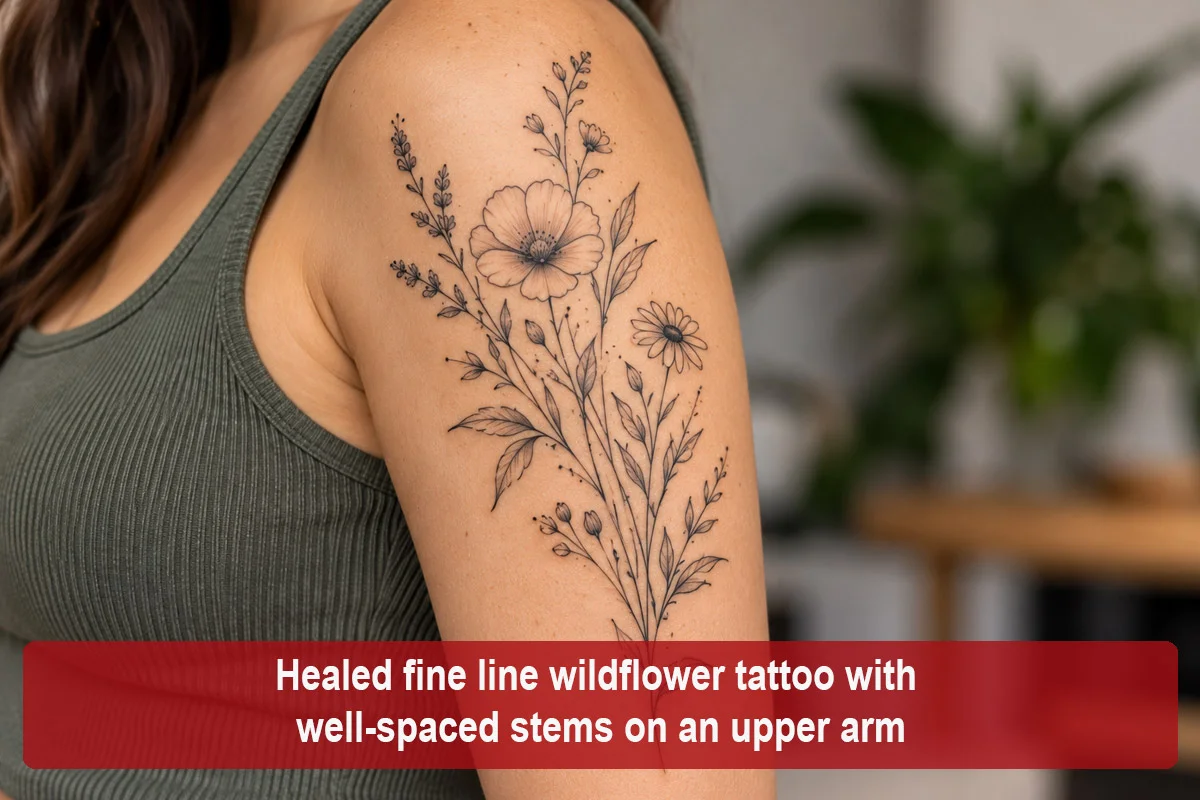
Open spacing between stems is what keeps botanical fine line readable.
Because it's a technique, fine line overlaps with several other styles. It's easy to mix them up when you're browsing portfolios:
Single line tattoos are drawn as one continuous line without lifting the pen. That's a design choice, not a needle size. See single line vs. single needle.
Minimalist describes how few elements a design has. A minimalist tattoo can use bold lines, and a fine line tattoo can be highly detailed. See fine line vs. minimalist.
Fine line has deep roots in Los Angeles. Mark Mahoney, widely regarded as a founding figure of black and grey single needle tattooing, built his reputation on delicate, fine detail at Shamrock Social Club on Sunset Boulevard in Hollywood. That single needle tradition grew out of the same LA black and grey and Chicano tattooing culture that shaped realism.
Mahoney's apprentice Brian Woo, known as Dr. Woo, brought the look to a global audience in the 2010s. His tiny, precise single needle pieces spread rapidly on Instagram, and he left Shamrock in 2016 to open his own studio. Fine line went from a specialist technique to one of the most requested styles in the world, which is also why so many artists now advertise it, with very different levels of skill.
What Happens to a Fine Line Over Time?
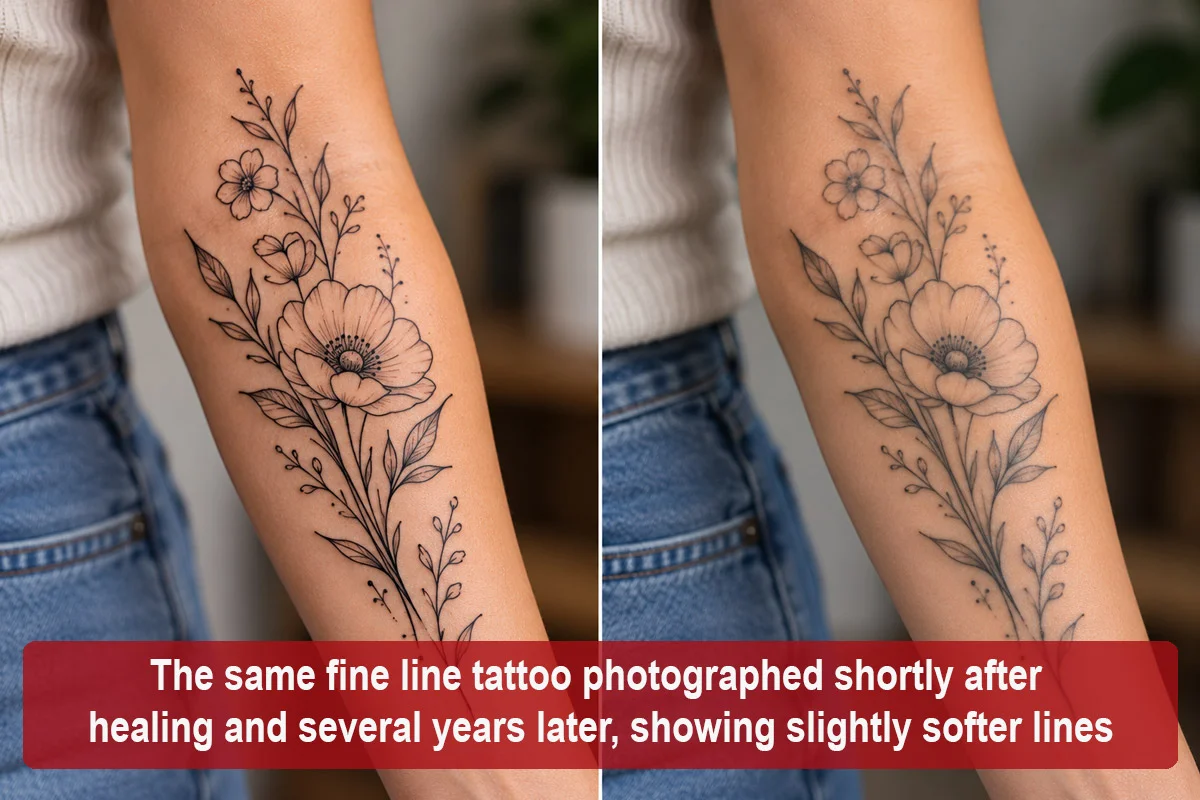
Every tattoo line spreads a little as it ages. Your immune system treats ink as foreign material, and immune cells slowly move tiny amounts of pigment, softening the edges of every line. Sun exposure breaks pigment down further, and skin loses elasticity as you age.
Bold tattoos hide this well. A thick line that grows slightly thicker still looks like a line. Fine line has almost no margin: a very thin line can roughly double in width over the years without anything having gone wrong. That's normal aging, not a bad tattoo. The problem comes when two fine lines started close together. As both widen, the gap between them closes, and the detail fills in.
Lines soften and widen with age. Generous spacing keeps the design readable.
The spacing rule that matters most
A useful way to judge any fine line design: look at the smallest gap between two lines, then imagine both lines growing to twice their width. If the gap would disappear, that part of the design is likely to blur. This is why experienced fine line artists enlarge designs, remove details, or open up spacing before tattooing, and why it's worth listening when they do. Read more about what happens when tattoo lines are too close together and why artists recommend making designs bigger.
Why Your Fine Line Tattoo Looks Lighter After Healing
A fresh fine line tattoo looks dark and crisp, partly because the skin is red and slightly swollen around each line. Once it heals, usually over a few weeks, lines often look softer, thinner, or more grey. That's expected, and it's why fresh photos are a poor guide to fine line work.
Fresh (left) and healed (right). Judge fine line artists by the right-hand photo.
Fine lines also carry less ink, so small gaps or light patches are more common than with bold work. Many artists offer a free or discounted touch-up after healing for exactly this reason. Ask about the touch-up policy before you book, not after.
Fine Line Blowouts: What They Are and Why They Happen
A blowout happens when ink is placed too deep or at the wrong angle and spreads under the skin, leaving a blurry, bluish haze along the line. Any tattoo can blow out, but fine line shows it most clearly, because a thin crisp line is exactly what a blowout ruins.
Blowouts are more likely on thin or delicate skin, such as the inner wrist, ankle, top of the foot, ribs, and inner arm. They usually show up within the first days to weeks of healing, not years later. A blowout is permanent, though an artist can sometimes disguise it by thickening the line or adding shading, and laser treatment can lighten it.
A blowout spreads ink beside the line. It is caused by depth, not aging.
The best protection is choosing an artist whose healed fine line work, on placements like yours, shows clean edges with no haze.
Designs That Suit Fine Line, and Designs That Fight It
Fine line rewards designs with open space and a clear silhouette. It struggles with anything that packs many marks into a small area.
Usually ages well
Often struggles
Botanical stems and wildflowers with open spacing
Dense bouquets with overlapping petals at a small size
Single words or short phrases at a readable size
Long sentences or very small script
Line-art animals and outlines
Tiny portraits with facial detail
Constellations with clearly spaced points
Many parallel lines placed very close together
Small symbols with simple shapes
Heavy shading packed into a small area
Black or dark grey linework
White ink or very pale colored lines
A note on small script
Lettering is one of the most popular fine line requests and one of the easiest to get wrong. In small cursive, letters with closed loops, such as "a," "e," "o," and "g," fill in first as lines widen. An artist may suggest a larger size, more spacing between letters, or a simpler font. For lettering-focused work, see our Script and Lettering guides.
Open loops and letter spacing help small script stay legible.
Placement affects fine line more than almost any other style, because friction, sun, thin skin, and movement all speed up blurring and fading.
Better choices: the outer forearm, upper arm, shoulder, upper back, thigh, and calf. These areas have steadier skin, less friction, and, apart from the forearm, less sun.
Proceed with caution: the inner wrist, ankle, top of the foot, and ribs, where thin skin raises the risk of blowouts and patchy healing. Plan for a touch-up.
Fine line can work on any skin tone, but contrast is the challenge. A thin line carries less ink, so on darker skin it has less visual weight, and pale grey shading may barely show. The same design that looks crisp on lighter skin can read as faint.
Experienced artists adjust by using a slightly heavier line, black rather than diluted grey, more open spacing, and a somewhat larger size. Ask to see healed fine line work on skin tones similar to yours. If an artist only shows fresh photos on light skin, you don't yet know how their work will look on you.
What a Fine Line Portfolio Should Show You
Fine line looks simple, which is exactly why it exposes weak technique. There is no shading or bold color to hide a shaky line. When you review a portfolio, look for:
Consistent line weight: A single line should stay the same thickness from start to finish, with no wobbles or thick spots.
Clean curves and joins: Circles close neatly, and lines meet without overlaps or gaps.
Healed work older than a year: The best fine line artists can show pieces well past the healing stage.
No haze along the lines: A blue-grey blur beside a line in a healed photo is a blowout.
Work on placements like yours: Healed ribs, wrists, or ankles are more telling than another forearm.
Fine line tattoos are usually quicker than bold or shaded work and cause less skin trauma, so many people find them easier to sit through. Placement still matters most for pain. A fine line rib piece will usually hurt more than a larger forearm tattoo. See do rib tattoos hurt and why tattoo pain varies.
On price, small fine line pieces often cost more than people expect, because most shops have a minimum charge that covers setup, sterile supplies, and design time, however small the tattoo. A tiny symbol may cost the same as something noticeably larger. Read what a tattoo shop minimum is before you book. Highly sought-after fine line specialists may also charge more and book well in advance.
Is Fine Line a Good First Tattoo?
It can be. Fine line is popular for first tattoos because it's subtle, relatively quick, and easy to place. Just go in with realistic expectations: choose a size your artist recommends, avoid hands and fingers for a first piece, and plan for a possible touch-up. Our guides on how big your first tattoo should be and whether your first tattoo should be small are a good next step.
Find Fine Line Tattoo Artists Near You
Because almost every studio now advertises fine line, the label alone tells you little. Use the listings to shortlist artists, then compare their healed work, placements, and line consistency before booking. Related styles worth comparing include Single Needle, Minimalist, Micro Realism, and Script, or you can browse all tattoo styles.
Frequently Asked Questions About Fine Line Tattoos
They often show aging sooner than bold tattoos, because thin lines carry less ink and have little room to soften before detail is lost. Good spacing, an appropriate size, a low-friction placement, and sun protection make a big difference.
All tattoo lines spread slightly over time, and a very fine line can roughly double in width over the years. That's normal. Blurring becomes a problem when lines start too close together, so ask your artist to size and space the design with aging in mind.
Fine lines carry little ink, so small gaps or light spots can appear as the skin heals. This is common and usually fixed with a touch-up once the tattoo has fully healed. Ask about the artist's touch-up policy before booking.
Single needle uses one needle for the finest possible detail. Fine line is a broader term for thin linework, which may use a single needle or a small cluster of needles. All single needle work is fine, but not all fine line work is single needle.
You can, but expect fading and blurring sooner, and likely touch-ups. Friction and frequent washing make hands and fingers some of the hardest places for fine line to last. Some artists will recommend a bolder approach or a different placement.
Yes, with adjustments. Solid black lines, more open spacing, and a slightly larger size help thin lines stay visible. Ask to see healed fine line work on skin tones similar to yours.
Fine line tattoos generally contain less ink than bold or heavily shaded work, which often makes them easier to cover with a new design or lighten with laser. Results still depend on the ink, depth, and placement, so get advice from a cover-up artist or laser specialist.