What Is a Single Needle Tattoo?
A single needle tattoo is created using a tattoo needle configuration containing one needle point, often identified by artists and suppliers as a 1RL, or one round liner.
Unlike conventional needle groupings that contain multiple points, a single needle allows an artist to create extremely delicate marks and precise details.
The technique is particularly associated with miniature portraits, fine botanical illustrations, small animals, delicate lettering, and detailed black and grey designs.
However, single needle tattooing does not describe one particular artistic style. It is a technical approach that can be used within several styles, including Fine Line tattoos, micro realism, minimalist artwork, and small illustrative compositions.
The quality of a single needle tattoo depends on more than the needle itself. Design scale, artist technique, pigment application, contrast, and placement all influence the finished result.
How Does Single Needle Tattooing Work?
Most modern single needle tattoos are created using a professional tattoo machine fitted with a single-point needle configuration.
The machine moves the needle repeatedly, allowing the artist to deposit pigment into the skin through controlled passes.
Because the configuration contains only one needle point, it can produce delicate marks and fine details that may be difficult to achieve with larger groupings.
However, the narrowness of the needle also presents challenges. The artist must carefully manage the consistency of each line and avoid relying on details that are too small to remain distinguishable after healing.
What Does 1RL Mean?
1RL is commonly used to identify a one-point round liner configuration.
In tattoo needle terminology, RL stands for round liner, a configuration generally intended for creating lines.
A 3RL typically contains three needle points arranged in a round liner grouping, while a 5RL generally contains five.
However, needle diameter, taper, manufacturer specifications, and configuration also influence the marks an artist can produce.
A single needle is not automatically the best option simply because a design requires delicate lines.
Does Single Needle Always Mean the Thinnest Line?
Not necessarily. Line appearance depends on the needle's physical specifications, tattoo machine settings, the artist's technique, and how the pigment settles in the skin.
A small, tightly grouped multi-needle liner may produce a visually delicate result while providing a different degree of line density.
For some designs, an experienced artist may recommend a small multi-needle grouping instead of a single needle to improve consistency and long-term readability.
The most useful question is not which needle sounds more precise, but which configuration is appropriate for the finished tattoo you want.
Single Needle vs. Fine Line Tattoos
Single needle and fine line are closely related terms, but they are not interchangeable.
Single needle describes the needle configuration used to apply the tattoo.
Fine line describes the visual appearance of artwork created with delicate, narrow lines.
A fine line tattoo can be produced using one needle or a small grouping of needles, depending on the artist's technique and the design.
| Feature |
Single Needle |
Fine Line |
| Definition |
Specific one-point needle configuration |
Visual style emphasizing delicate linework |
| Needle selection |
One needle point |
Single or small multi-needle configurations |
| Typical applications |
Miniature details, delicate textures, micro portraits |
Botanical artwork, lettering, symbols, illustrations |
| Visual appearance |
Can produce extremely fine marks |
Generally features narrow, refined lines |
| Long-term results |
Depend on application and design |
Depend on application and design |
A tattoo may be both single needle and fine line. However, a delicate-looking tattoo should not be labeled single needle unless its actual application method supports that description.
Single Needle vs. Hand-Poked Tattoos
Another common misconception is that single needle tattoos are always applied manually.
Single needle refers to needle configuration, while hand-poked describes how the needle is moved into the skin.
A single needle tattoo can be applied with a tattoo machine. A hand-poked tattoo is applied through manual punctures without a powered tattoo machine.
Some hand-poked artists use single-point configurations, but not all hand-poked tattoos are single needle tattoos.
Explore Hand-Poked tattoos for a detailed comparison of manual tattooing, equipment, and professional practices.
Popular Single Needle Tattoo Designs
Single needle tattooing is particularly useful for designs that depend on controlled fine detail rather than large areas of solid color.
However, a successful design must balance delicate execution with enough visual structure to remain readable.
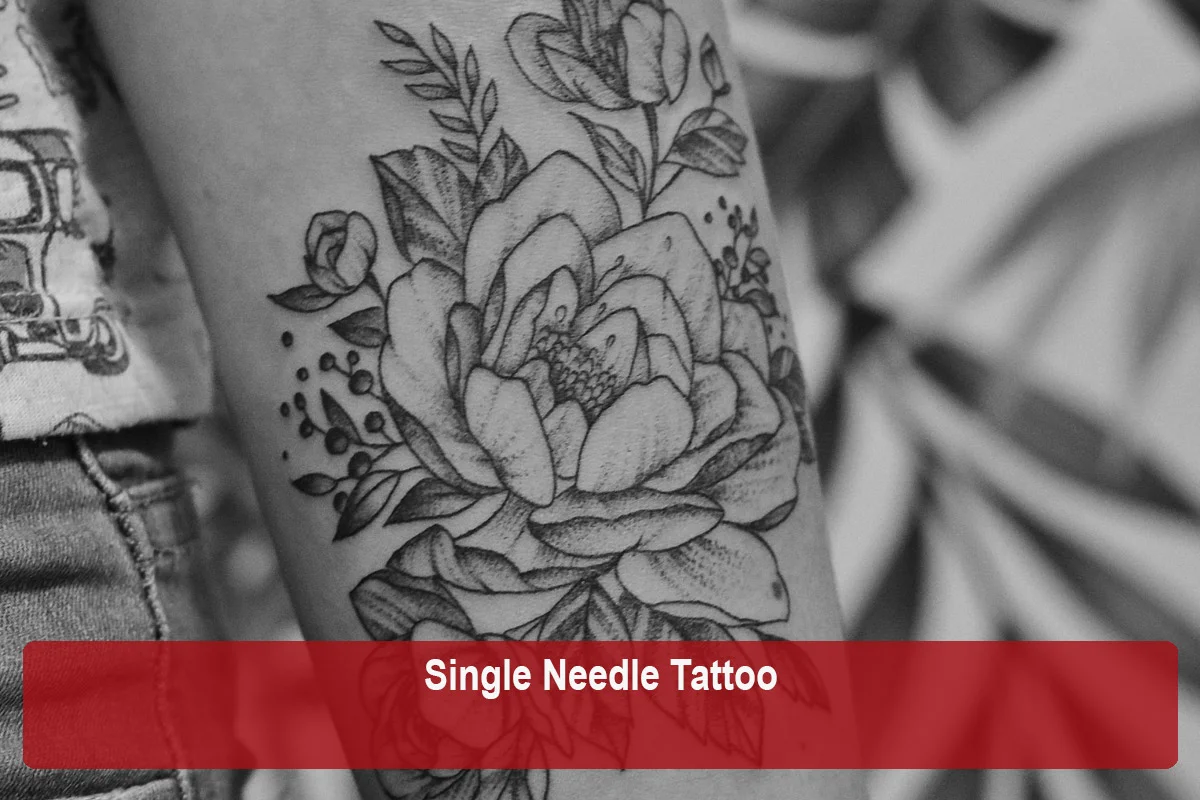
Single Needle Flower Tattoos
Flowers are a popular subject because their petals, stems, and leaves can be represented with delicate outlines and selective shading.
Roses, wildflowers, lilies, and small botanical arrangements can work well when the composition is not overcrowded.
For example, a small wildflower tattoo might use fine contours around the petals while preserving open space between overlapping leaves.
Complex flowers with many narrow petals may need additional size to maintain separation.
Single Needle Portrait Tattoos
Single needle techniques can be used to create miniature portraits and subtle facial details.
These designs require strong drawing skills because small changes in the eyes, nose, mouth, or facial proportions can affect likeness.
For a portrait of a specific person, the artist should begin with a suitable reference photograph and determine which features are essential for recognition.
Very small portraits may need simplification, especially when the reference contains detailed hair, complex lighting, or several faces.
Explore Portrait tattoos for guidance on reference photographs, likeness, and artist selection.
Single Needle Animal Tattoos
Small animals, birds, insects, and pet portraits can be adapted into single needle artwork.
Fine marks may suggest fur, feathers, whiskers, or other delicate textures.
However, the animal's overall shape and distinctive features should remain recognizable without relying entirely on tiny details.
For a pet tattoo, prioritize facial proportions, ear shape, markings, and expression.
A simplified illustration may be more suitable than an extremely small photographic reproduction.
Single Needle Lettering Tattoos
Names, initials, dates, and short words can be created with delicate single needle linework.
However, lettering presents a particular challenge because readability depends on maintaining openings inside and between characters.
Small cursive writing may contain closely arranged loops and connecting strokes that become less distinct over time.
Before approving the design, view the lettering at its intended size and confirm every character.
Explore Script tattoos for additional guidance on cursive lettering, handwriting, and placement.
Single Needle Geometric Tattoos
Small geometric patterns, circles, triangles, and delicate symmetrical designs can be created with fine linework.
These subjects require careful alignment because irregularities are especially noticeable in simple geometric shapes.
For repeating patterns, spacing is just as important as line thickness.
A geometric tattoo that looks balanced on a flat screen may need adjustment when placed on a curved body surface.
Single Needle Micro Realism Tattoos
Micro realism tattoos use realistic shading and recognizable subjects at relatively small dimensions.
Single needle configurations may be used for certain details, but micro realism does not require every part of the tattoo to be created with one needle.
An artist may combine different needle configurations to establish structure, shading, and contrast.
For this reason, the terms single needle and micro realism should not be treated as synonyms.
Explore Micro Realism tattoos to learn more about miniature realistic artwork and its long-term design limitations.
How Small Can a Single Needle Tattoo Be?
Single needle tattooing makes delicate details possible, but it does not eliminate the practical limitations of tattooing on living skin.
There is no universal minimum size that applies to every single needle design.
The appropriate dimensions depend on the subject, number of details, spacing, body placement, and artist's technique.
Why Smaller Is Not Always Better
A design may look exceptionally sharp when enlarged on a phone or computer screen.
However, the same artwork may become difficult to distinguish when reduced to its actual tattoo size.
For example, a miniature architectural illustration may contain windows, doors, bricks, and shadows that are individually recognizable in the digital reference.
When reduced, these details may become too closely arranged to retain their separation.
An experienced artist should identify which elements can be simplified without losing the subject's identity.
Why Line Spacing Matters
Fine tattoo lines can soften and appear wider over time.
If multiple lines are placed very close together, they may become less distinct as the tattoo ages.
This is especially relevant for miniature lettering, detailed faces, and densely textured illustrations.
Preserving enough space between important features can help maintain readability.
When a Larger Needle Grouping May Be Better
Sometimes a slightly stronger line can improve the long-term appearance of a delicate design.
For example, a botanical tattoo may benefit from more substantial primary stems while retaining very fine secondary details.
The artist may use a combination of needle configurations to create this hierarchy.
A technically appropriate design is more important than using a single needle for every mark.
Black and Grey vs. Color Single Needle Tattoos
Black and Grey Single Needle Tattoos
Black and grey is common in single needle work because it allows artists to build delicate outlines and subtle textures without introducing several colors.
Small portraits, animals, and botanical designs may use light shading to suggest depth.
However, excessive reliance on very pale grey can make important features less visible after healing.
A strong design should preserve enough contrast to communicate its main subject.
Color Single Needle Tattoos
Single needle configurations can also be used in color tattooing, particularly for fine details and small accents.
However, extensive color packing may be more practical with other needle configurations.
The artist should choose equipment according to the design rather than forcing every part of a color tattoo to be completed with one needle.
For a delicate color design, examine healed examples to see how the artist maintains separation between fine details.
Best Placements for Single Needle Tattoos
Placement can significantly affect the appearance and longevity of delicate artwork.
Areas with frequent friction, movement, or environmental exposure may present additional challenges for fine details.
| Placement |
Suitable Designs |
Important Considerations |
| Forearm |
Botanical illustrations, small portraits, lettering |
Orientation and sun exposure |
| Upper Arm |
Detailed illustrations, animals, micro realism |
Curvature and available space |
| Inner Bicep |
Small symbolic artwork and fine illustrations |
Skin movement and sensitivity |
| Thigh |
Detailed portraits, botanical compositions |
Space for complex designs |
| Calf |
Vertical animals, flowers, decorative illustrations |
Muscle curvature and orientation |
| Wrist |
Simple symbols, initials, short words |
Limited space and frequent exposure |
| Ribs |
Small flowers, script, delicate illustrations |
Body movement and sensitivity |
Are Single Needle Finger Tattoos a Good Idea?
Finger tattoos require particular consideration because the area experiences frequent washing, movement, friction, and environmental exposure.
Fine details may heal unevenly or become less distinct.
Some artists decline to perform highly detailed single needle tattoos on fingers because the expected result may not meet their quality standards.
If you want a finger tattoo, ask for healed examples from that exact placement rather than relying on fresh photographs from other body areas.
Do Single Needle Tattoos Fade Faster?
Single needle tattoos are not automatically temporary or guaranteed to fade quickly.
However, extremely delicate designs can be more sensitive to changes in line definition because they have less visual weight than bold tattoos.
The appearance of a tattoo over time depends on pigment application, design size, contrast, placement, healing, and sun exposure.
A well-planned single needle tattoo may remain recognizable for years, while an overly intricate miniature design may lose some clarity.
Why Some Single Needle Tattoos Look Faint After Healing
Some single needle tattoos use intentionally subtle linework and light shading.
As the skin heals, the appearance of these delicate marks may differ from the sharp contrast visible in fresh photographs.
Uneven pigment retention, application issues, and healing complications can also affect the result.
A faint healed appearance does not necessarily mean the tattoo was created incorrectly, but it should be evaluated against the intended design.
Do Single Needle Tattoos Blur Over Time?
Fine tattoo lines may soften over time, and closely arranged details can become less distinct.
For a miniature portrait, this might affect separation between facial features. For lettering, it may affect small loops or spaces between characters.
Appropriate sizing, clear primary features, and adequate spacing can help reduce the risk of losing important detail.
Will a Single Needle Tattoo Need a Touch-Up?
Some single needle tattoos may benefit from touch-ups after healing, but touch-ups are not automatically required.
The need depends on pigment retention, placement, the artist's technique, and the appearance of the healed design.
Ask the artist about their touch-up policy and wait until the tattoo has healed sufficiently before considering additional work.
Do Single Needle Tattoos Hurt More?
Single needle tattooing is sometimes described as less painful because the artist is using a smaller needle configuration.
However, pain is subjective, and needle count alone does not determine how a tattoo feels.
Placement, session duration, individual sensitivity, tattooing technique, and the amount of work performed can all affect discomfort.
A single needle tattoo may require repeated passes to build particular details, while another design may involve relatively little tattooing.
There is no reliable basis for promising that single needle tattoos always hurt less than tattoos created with larger needle groupings.
Are Single Needle Tattoos Safe?
Single needle tattooing carries the same general categories of risk as other permanent tattooing methods, including infection, allergic reactions, and scarring.
Using only one needle point does not remove these risks.
Choose a professional artist who follows appropriate infection-control procedures and applicable state or local requirements.
What Should You Check Before Booking?
- Professional equipment: The artist should use appropriate sterile, single-use tattoo needles or cartridges.
- Hygiene practices: The studio should follow proper hand hygiene, glove use, and work-surface cleaning procedures.
- Ink handling: Tattoo pigments should be handled appropriately, with no reuse of ink intended for another client.
- Relevant experience: The artist should demonstrate completed single needle work, not only digital illustrations.
- Healed results: Ask to see tattoos after healing, particularly for very small or detailed designs.
- Aftercare guidance: The artist should provide instructions for protecting the tattoo and recognizing possible complications.
Even professionally manufactured tattoo ink can be contaminated, so appropriate studio practices reduce risk without guaranteeing that complications cannot occur.
How to Choose a Single Needle Tattoo Artist
Single needle tattooing requires technical precision and an understanding of how delicate designs translate onto skin.
When choosing an artist, prioritize evidence of successful healed work over claims about using the smallest possible needle.
1. Look for Healed Single Needle Tattoos
Fresh tattoos may look exceptionally sharp in close-up photographs.
Healed examples provide better evidence of line consistency, pigment retention, and detail separation.
Look for tattoos photographed several months after completion and, where possible, older examples.
2. Check Experience With Your Subject
An artist who specializes in tiny botanical designs may not have equivalent experience creating recognizable human portraits.
Choose someone whose portfolio demonstrates both the technique and subject matter you want.
3. Evaluate Design Readability
Ask to see the proposed artwork at its intended tattoo dimensions.
Important features should remain recognizable without enlarging the image.
If the artist recommends increasing the size or simplifying details, ask how those changes will improve the design.
4. Ask About Needle Selection
If you specifically want a single needle tattoo, confirm whether the artist plans to use a one-point configuration.
Some artists may recommend combining needle configurations for better structure or longevity.
Discuss the reasoning rather than assuming one technique is always superior.
5. Compare Full-Placement Photographs
Close-up images can make tiny tattoos appear more detailed than they look in everyday life.
Review photographs showing the complete tattoo on the body.
This helps you understand its actual scale, placement, and visual impact.
What to Discuss During a Single Needle Tattoo Consultation
Bring clear reference images and explain which details are most important to you.
If the tattoo represents a specific person, animal, or place, identify the features that must remain recognizable.
Ask whether the proposed dimensions are suitable and whether a slightly larger design would improve long-term readability.
Discuss placement, needle configuration, shading, expected session duration, and the artist's experience with similar healed tattoos.
For lettering, confirm every character and review the spacing at actual size.
The consultation should establish a realistic balance between delicate appearance and a design that remains visually understandable.
Single Needle Tattoo Aftercare and Healing
Follow your tattoo artist's aftercare instructions during the initial healing period.
Keep the tattoo appropriately clean, avoid picking at healing skin, and protect it from unnecessary friction or contamination.
Once healed, protect exposed tattooed skin from ultraviolet light. The American Academy of Dermatology recommends broad-spectrum, water-resistant sunscreen with SPF 30 or higher.
Sun protection is especially useful for tattoos that depend on subtle shading and delicate linework.
If you experience spreading redness, increasing pain, pus, fever, or another concerning reaction, seek medical attention.
Find Single Needle Tattoo Artists Near You
Single needle tattoo artists can be found throughout the United States, but their specialties vary considerably.
Some focus on miniature portraits and micro realism, while others specialize in botanical illustrations, fine lettering, small animals, or minimalist artwork.
Use TattooShopsNearYou.com to explore tattoo shops and artists by location and style. Compare single needle portfolios, examine healed examples, and identify artists experienced in the design you want.
Before booking, confirm the artist's technique, discuss your preferred dimensions and placement, and ask whether the design needs adjustments for long-term readability.
The right single needle tattoo artist should understand not only how to create delicate marks, but also when a different needle configuration or larger design may produce a better result.