Japanese Tattoos (Irezumi): Meanings, Sleeves & Artists Near You
A Japanese tattoo is not a dragon or a koi on its own. It's a composition: a main subject, the elements that traditionally accompany it, and a background of water, clouds, or wind that ties everything together and wraps around the body. That is what separates traditional Japanese tattooing, known as irezumi, from a Japanese-themed image tattooed in another style.
It's also a commitment. Traditional Japanese work is usually large, often a full sleeve, back piece, or more, and it's built over many sessions. This guide covers what the classic motifs mean, how they're paired, how coverage is planned, and what to look for when you search our directory for a Japanese tattoo specialist. Still comparing styles? See all 44 tattoo styles.
Japanese Tattoo Artists & Shops Near You
Browse 11 tattoo artists and shops featuring Japanese work. Compare portfolios and healed examples before you book.
4255 N Winfield Scott Plaza, Scottsdale, Arizona, 85251
American Traditional, Black & Grey, Realism
The Three Layers of a Japanese Tattoo
Most traditional Japanese tattoos are built in three layers. Understanding them will help you talk to an artist and judge portfolios.
The main subject: a dragon, tiger, koi, phoenix, hannya mask, deity, or hero from folklore. This is the focal point.
The companion element: what traditionally appears with that subject, such as flowers, flames, rocks, or a particular plant. It adds meaning and often signals a season.
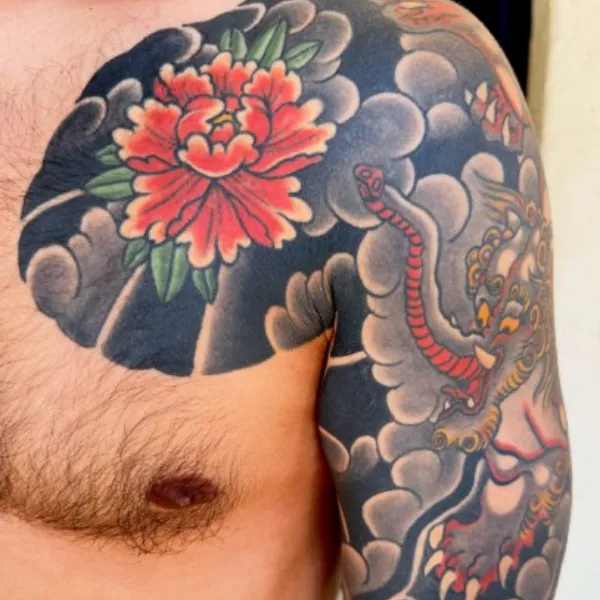
The background: water, clouds, and wind bars, usually shaded in black and grey. The background isn't filler. It controls flow, frames the subject, and connects one part of the body to the next.
When a Japanese tattoo looks "off" to a trained eye, it's usually because one of these layers is missing or doesn't fit: a koi floating with no water, a background that doesn't follow the arm, or flowers from the wrong season placed side by side.
A koi, its seasonal blossoms, and a wave background working as one composition.
A Short History of Irezumi
Decorative tattooing flourished in Japan during the Edo period, and woodblock prints drove much of its imagery. The first Japanese edition of the Chinese novel Suikoden appeared in 1757, and its illustrations of heroes covered in dragons, tigers, and other figures created demand for similar tattoos. Some woodblock artists also became tattooers, carrying the same visual language into skin.
Tattooing was outlawed at the start of the Meiji period and legalized again in 1948, but it kept a strong association with criminality and, later, the yakuza. That stigma still exists: many public baths, hot springs, gyms, and pools in Japan restrict entry to people with tattoos. In 2020, Japan's Supreme Court ruled that tattooing can be performed by people who are not licensed medical professionals, a landmark decision for tattoo artists there.
Traditional artists, known as horishi, often train through long apprenticeships and receive a professional name, frequently beginning with "Hori," meaning "to engrave."
Classic Japanese Motifs, Their Meanings, and What They're Paired With
Motifs in Japanese tattooing carry associations drawn from folklore, religion, and theater. Meanings can vary between artists and sources, so treat these as traditional associations rather than fixed rules, and ask your artist about their own interpretation.
Motif
Often paired with
Traditional associations
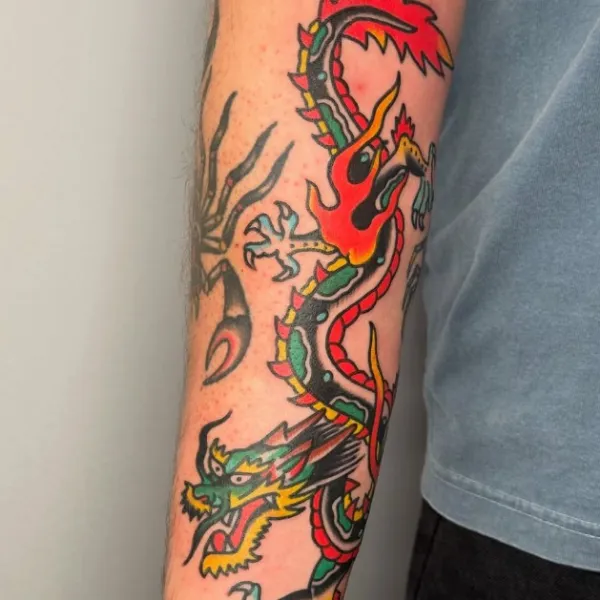
Dragon (ryū)
Clouds, water, waves
Wisdom, strength, protection; linked with water and sky
Tiger (tora)
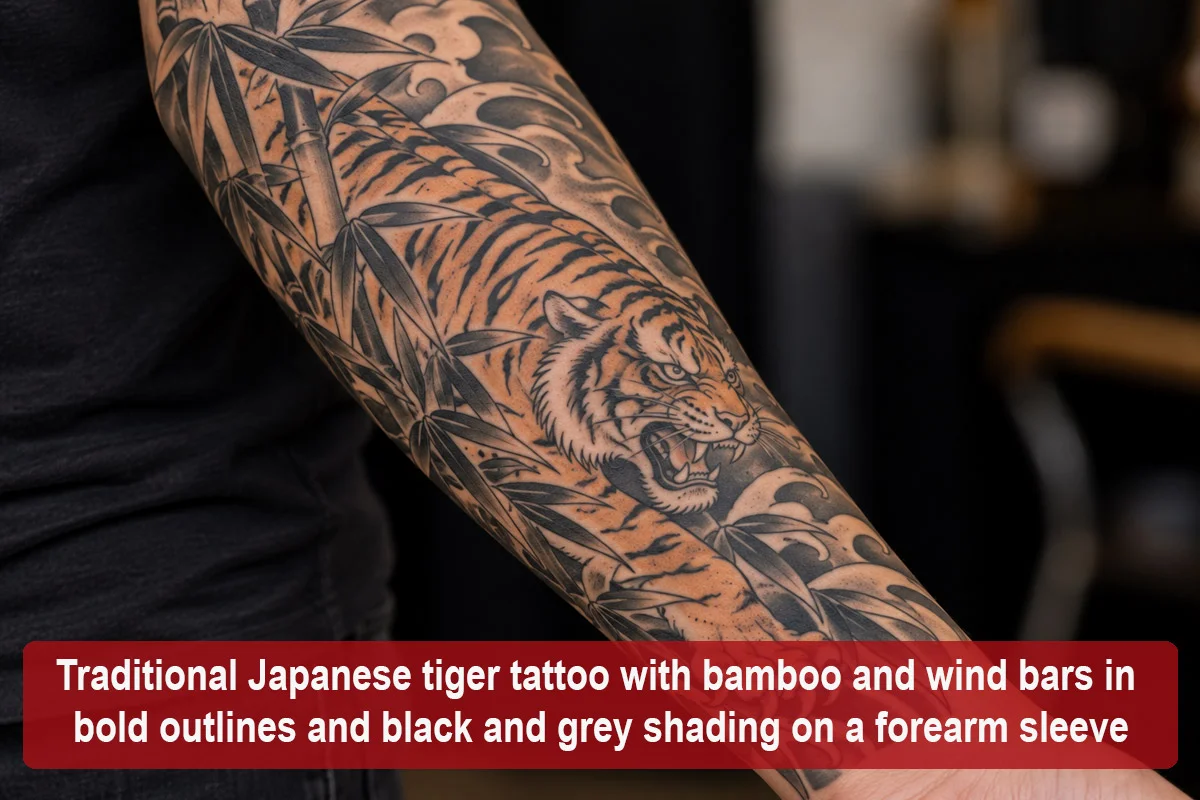
Bamboo, wind, rocks
Courage, strength, warding off evil
Dragon and tiger
Shown together or on opposite sides
Balance of opposing forces
Koi
Water, waves, waterfalls, blossoms or maple leaves
Perseverance; the legend of a koi climbing a waterfall to become a dragon
Phoenix (hōō)
Paulownia (kiri) leaves, flames
Rebirth, good fortune
Foo dog / lion (karajishi)
Peonies
Protection; the peony-and-lion pairing is a classic combination
Hannya mask
Peonies, cherry blossoms, snakes
From Noh theater; a woman transformed by jealousy or rage
Snake (hebi)
Flowers, rocks, waves
Protection, transformation, good luck
Peony (botan)
Lions, hannya, as a supporting flower
Wealth, boldness
Cherry blossom (sakura)
Koi, wind, as a supporting flower
The beauty and brevity of life
Chrysanthemum (kiku)
Koi, as a supporting flower
Longevity, nobility
Keep the season consistent
Many traditional artists keep flowers and leaves within one season: cherry blossoms with other spring elements, maple leaves with autumn. Mixing seasons in a single composition can look wrong to people familiar with Japanese art. Ask your artist how they handle seasonal elements.
The tiger is traditionally paired with bamboo and wind.
Treat religious figures with respect
Buddhist deities and figures such as Fudō Myōō or Kannon are classic subjects, but they carry real religious meaning. Many traditional artists have conventions about where these figures can be placed, often avoiding the lower body. If you want a deity, choose an artist who understands the figure and listen to their advice on placement.
Japanese tattooing has its own vocabulary for coverage. You don't need to use these terms, but knowing them helps when an artist starts talking about your long-term plan.
Term
What it covers
Gobu
A sleeve that stops above the elbow
Shichibu
A three-quarter sleeve to the mid-forearm
Nagasode
A full sleeve to the wrist
Hikae
A chest panel covering the pectorals, usually connecting to the sleeves
Munewari
A chest design with an open, untattooed strip down the middle
Sōshinbori
A full body suit
Hanzubon
Tattooed "shorts" covering the upper legs
Why this matters even for one sleeve: the edge of a Japanese sleeve is designed with its future in mind. If there's any chance you'll add a chest panel or back piece later, tell your artist at the first consultation. They can shape the background so it connects later instead of ending in a hard line that's difficult to extend. See whether you should plan a full sleeve before starting.
A back piece designed to connect with the sleeves and chest panel.
Tebori: Japanese Hand Tattooing
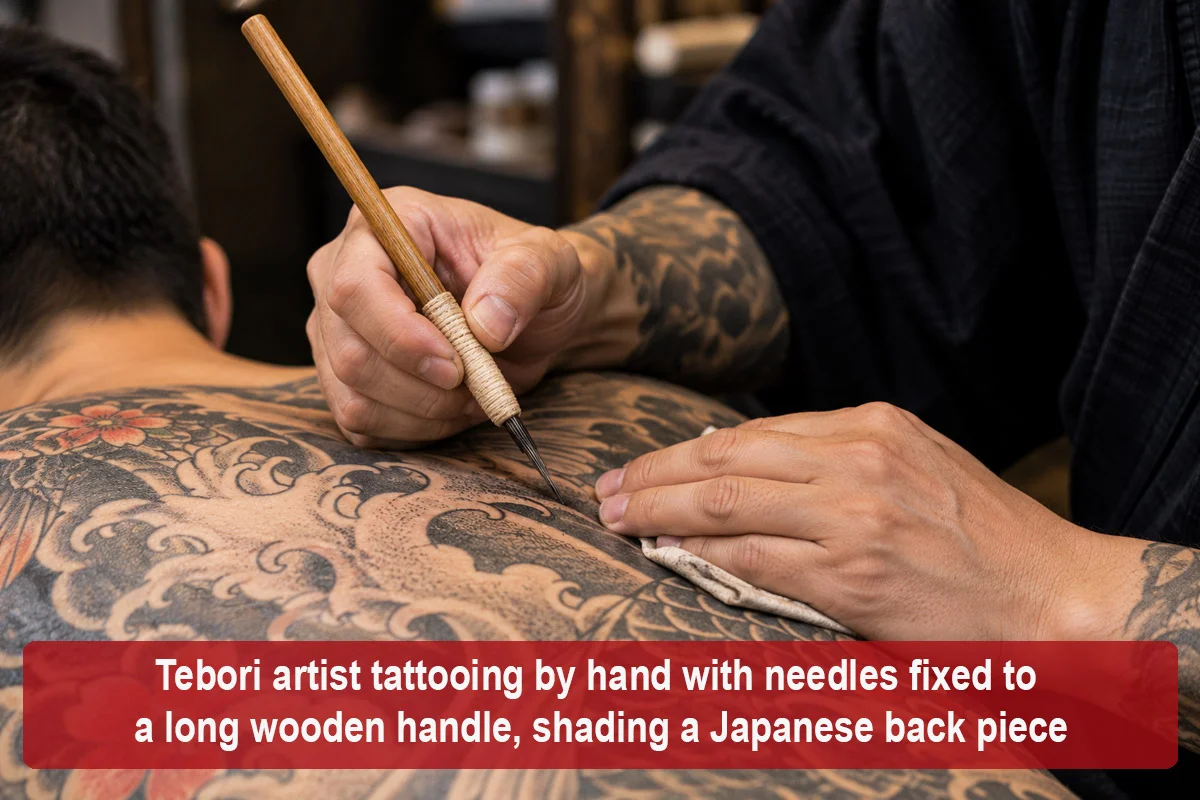
Tebori means "to carve by hand." Instead of a machine, the artist uses needles attached to a wooden or metal handle and pushes ink into the skin with a rhythmic hand motion. It's the traditional method for irezumi and is especially associated with smooth shading.
Tebori is done by hand with needles fixed to a handle.
Most Japanese-style artists in the United States work with a machine, and tebori specialists are relatively rare. Some combine both, using a machine for outlines and tebori for shading. Neither is automatically better. What matters is the artist's skill with their chosen method. If tebori is important to you, ask directly, and expect sessions to be slower. Read more in hand-poked vs. machine tattoos and our Hand-Poked guide.
Traditional Japanese, Neo-Japanese, or Japanese-Inspired?
When you search for "Japanese tattoo" artists, you'll find three different approaches. Knowing which one you want saves time when you browse listings.
Traditional Japanese: classic motifs, established pairings, black and grey backgrounds, bold outlines, and compositions built around the body.
Neo-Japanese: Japanese subjects and composition with contemporary color, rendering, or stylization.
Japanese-inspired work in another style: for example a Neo-Traditional dragon or a Realism koi, drawn as a standalone image without the traditional background.
All three are valid, but they need different specialists. An excellent Neo-Traditional artist who draws dragons isn't necessarily the right person for a traditional sleeve.
Time, Sessions, and Cost
Japanese tattoos are among the biggest projects in tattooing. A full sleeve is typically completed over many sessions, often spread across months or more, and a back piece or body suit can take years. Artists usually begin with the outline of the whole composition, then fill in the background and color over later sessions.
Most artists who specialize in large-scale Japanese work charge per session or per day rather than per piece, and many take a deposit to secure your dates. In-demand specialists may have long waiting lists, and some clients travel to see a particular artist. When you budget, think in terms of the total project rather than a single appointment. See why tattoo shops require deposits.
Traditional Japanese tattooing suits a wide range of skin tones, because so much of it depends on bold black outlines and dark backgrounds rather than pale color. The black and grey water, clouds, and wind bars that frame the subject stay highly visible.
The colors that need the most care are the pale ones, such as light blue water, pink cherry blossoms, and pale flesh tones, which can appear muted on darker skin. An experienced artist may deepen the palette or rely more on contrast with the background. Ask to see healed Japanese work on skin tones similar to yours.
How to Recognize a Strong Japanese Tattoo Portfolio
Because Japanese work is large and planned, look at entire pieces rather than close-ups.
Completed sleeves and back pieces: not just individual motifs. Ask to see work that has been finished and healed.
Background flow: wind bars, clouds, and water should move with the body and lead the eye around the arm or torso.
Correct pairings: subjects with their traditional companions, and consistent seasons.
Clean, even black: large background areas should be smooth and saturated, without patchiness.
Readable from a distance: a good Japanese tattoo works from across a room as well as up close.
A finished sleeve shows how well an artist handles flow and background.
If you have visible tattoos, be aware that many onsen (hot springs), public baths, pools, and gyms in Japan restrict entry for tattooed guests, even though attitudes are slowly changing. Some venues allow small tattoos covered with skin-colored patches, and some are fully tattoo-friendly. It's worth checking each venue's policy before you go.
Find a Japanese Tattoo Artist Near You
Use the listings to shortlist artists, then look specifically for completed sleeves and back pieces in their portfolios. If you're planning large-scale work, it's often worth traveling for the right specialist, so widen your search beyond your own city. Related styles to compare include Neo-Japanese, Neo-Traditional, and Black & Grey, or browse all tattoo styles.
Frequently Asked Questions About Japanese Tattoos
Irezumi is a Japanese word for tattooing, commonly used in English to describe traditional Japanese tattoos. The term horimono, meaning "carved object," is also used for traditional decorative work.
Yes. Traditional Japanese tattoos are worn by people around the world, and many Japanese and Western artists tattoo clients of every background. Approach the imagery with respect, learn what your chosen motifs mean, and work with an artist who knows the tradition.
Koi are traditionally associated with perseverance, drawing on the legend of a koi that swims up a waterfall and becomes a dragon. Koi are usually shown with water and waves, often with seasonal flowers or leaves.
A full traditional sleeve usually takes many sessions, often spread across months. The exact time depends on the design, the artist's pace, and how quickly you heal between sessions. Ask your artist for an estimate at the consultation.
You can, but traditional Japanese work is designed for scale, and small standalone pieces lose the background that defines the style. If you'd like to start smaller, a half sleeve (gobu) planned to extend later is often a better starting point than a small isolated motif.
Not necessarily. Tebori is the traditional hand method and is valued for its shading, but skilled machine work can be equally strong. Choose an artist based on their healed, completed work rather than the method alone.
Yes. Tattooing was banned during the Meiji period and legalized in 1948. In 2020, Japan's Supreme Court ruled that tattooing can be performed by people without a medical license. Social restrictions, such as bans at some baths and gyms, still exist.