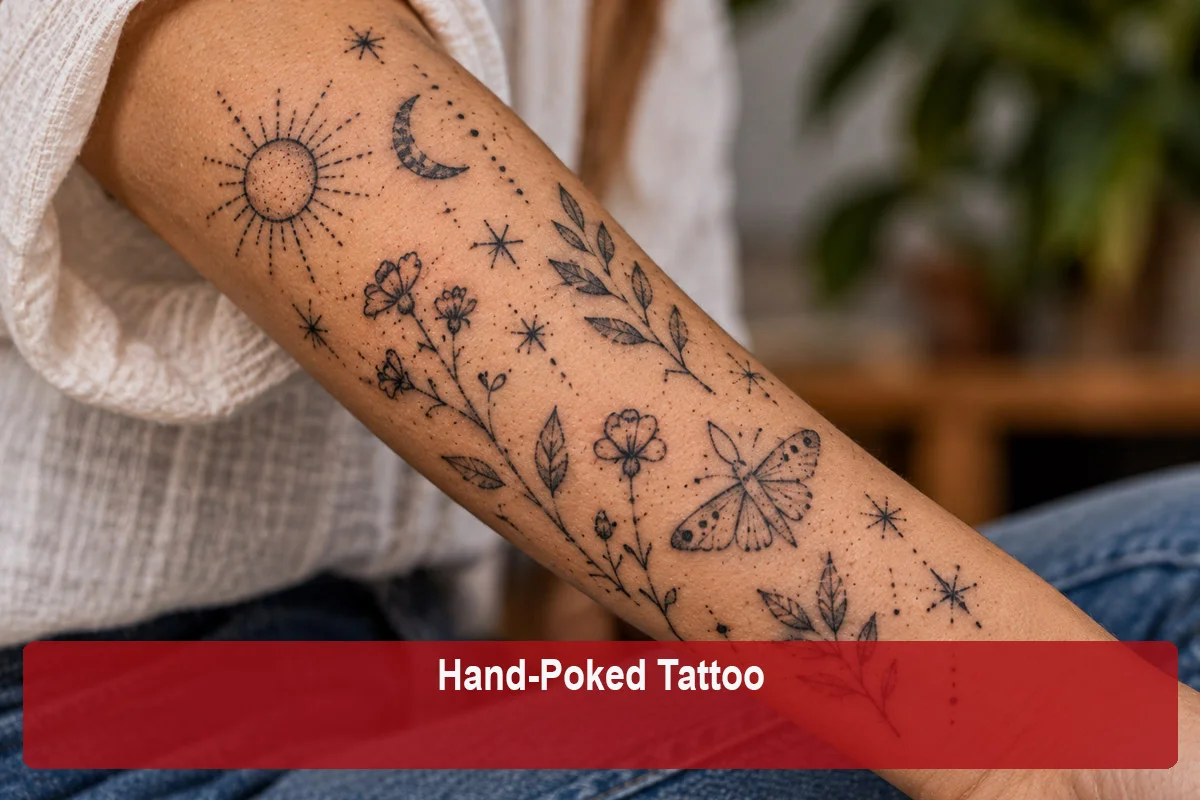
What Is a Hand-Poked Tattoo?
A hand-poked tattoo is created by manually placing tattoo pigment into the skin through individual needle punctures. Unlike machine tattooing, the needle is moved by the artist's hand rather than an electrically powered mechanism.
Artists build lines by placing punctures close together. They can also create shading through controlled arrangements of dots or repeated marks.
Hand-poked tattooing is a method of application, not a single visual style. A hand-poked tattoo can feature minimalist symbols, detailed botanical illustrations, geometric patterns, lettering, or decorative ornamentation.
Although many contemporary handpoke tattoos have a delicate or slightly textured appearance, professional artists can produce different line weights and visual effects.
The quality of the result depends on the artist's technical ability, design decisions, and application rather than the absence of a tattoo machine.
The History of Hand-Poked Tattooing
Manual tattooing techniques existed long before the development of electric tattoo machines. Different cultures developed their own methods using locally available tools, pigments, and artistic traditions.
These methods included hand-poking, hand-tapping, skin-stitching, and other techniques. They should not all be treated as identical.
Hand-poking involves manually puncturing the skin to introduce pigment. Hand-tapping may involve striking a tattooing tool with another implement, while skin-stitching uses a different method involving needle and thread.
Traditional tattooing practices also carried meanings extending far beyond decoration. Depending on the community, tattoos could communicate identity, relationships, cultural knowledge, achievements, or spiritual significance.
Traditional Hand Tattooing and Indigenous Cultures
Hand-applied tattooing has been practiced by Indigenous communities in different parts of the world, including North America and the Pacific.
However, the methods, tools, symbols, and cultural protocols vary substantially between communities.
Contemporary hand-poked tattooing should not automatically be presented as an authentic continuation of a particular Indigenous tradition.
If you want a culturally specific tattoo, seek information from knowledgeable practitioners connected to that tradition and respect restrictions surrounding particular designs.
Modern Professional Handpoke Tattooing
Contemporary hand-poked tattooing is practiced by professional artists who may use sterile, single-use tattoo needles, commercial tattoo pigments, and appropriate infection-control procedures.
Some artists specialize exclusively in machine-free tattooing, while others offer both hand-poked and machine tattoos.
The method is especially associated with smaller illustrative designs, dotwork, and fine-line artwork, but its possibilities are not limited to these categories.
Professional hand-poked tattooing should be distinguished from improvised home tattooing using household needles or unsuitable inks.
Hand-Poked vs. Machine Tattoos: What Is the Difference?
Both methods create permanent tattoos by depositing pigment into the skin. Their main distinction is how the needle is operated.
| Feature |
Hand-Poked Tattoo |
Machine Tattoo |
| Application |
Needle moved manually by the artist |
Needle driven by an electric tattoo machine |
| Working rhythm |
Individual controlled punctures |
Rapid repeated needle movement |
| Sound |
Generally quiet without machine vibration |
Machine sound and vibration vary by equipment |
| Common applications |
Dotwork, linework, small illustrations, ornamental designs |
Linework, shading, color packing, large and small designs |
| Session duration |
Can take longer for dense or extensive designs |
Often more efficient for large fills and shading |
| Permanence |
Permanent when pigment is successfully deposited |
Permanent when pigment is successfully deposited |
| Safety |
Requires professional hygiene and appropriate equipment |
Requires professional hygiene and appropriate equipment |
Neither method is automatically better. The appropriate choice depends on the intended artwork, the artist's specialty, and your preferences.
Are Hand-Poked Tattoos Less Painful?
Some clients describe hand-poked tattooing as a series of distinct pricks rather than the continuous sensation associated with machine tattooing.
Others may find repeated manual punctures uncomfortable, particularly during longer appointments.
There is insufficient evidence to guarantee that hand-poked tattoos are consistently less painful than machine tattoos.
Pain varies with placement, session duration, individual sensitivity, and the artist's technique.
Are Hand-Poked Tattoos Slower?
Hand-poked tattooing can take longer because the artist creates each puncture manually.
For a small symbol or simple linework design, the difference may not be especially important.
For a large composition requiring extensive solid fills or smooth gradients, machine tattooing may be more practical.
Ask the artist to estimate the session duration based on your actual design rather than assuming that all handpoke tattoos take the same amount of time.
Do Hand-Poked Tattoos Heal Faster?
Some artists and clients report a gentler initial healing experience with certain hand-poked designs.
However, this does not establish that all hand-poked tattoos heal faster or cause less tissue injury than machine tattoos.
Healing depends on the extent of the tattoo, technique, placement, individual skin response, and aftercare.
Both methods create a wound in the skin and require appropriate healing care.
Popular Hand-Poked Tattoo Designs
Hand-poked tattooing can support many different subjects. The most suitable designs take advantage of the artist's strengths rather than assuming that every handpoke tattoo must be small or intentionally imperfect.
Minimalist Hand-Poked Tattoos
Small stars, hearts, moons, flowers, abstract symbols, and simple geometric forms are common choices.
Minimalist designs may appear straightforward, but their limited detail makes line consistency and proportion especially noticeable.
A simple circle, for example, requires careful spacing and alignment to appear balanced.
Explore Minimalist tattoos for guidance on simplifying designs without losing their meaning or visual character.
Hand-Poked Botanical Tattoos
Flowers, leaves, stems, and small botanical illustrations can work well with manual linework.
Some artists use delicate outlines, while others build texture through small clusters of dots.
For a botanical tattoo, pay attention to the spacing between petals and leaves. Designs with many closely arranged details may need additional room.
The artist should also consider how the plant's shape follows the chosen body placement.
Hand-Poked Dotwork Tattoos
Dotwork is particularly compatible with hand-poked tattooing because both involve building an image through individual marks.
However, dotwork describes the appearance of the artwork, while hand-poking describes the application method.
Dotwork can also be produced using a tattoo machine.
Hand-poked dotwork may feature gradients, decorative patterns, geometric forms, or detailed illustrations.
Explore Dotwork tattoos to compare designs built around the density and arrangement of individual dots.
Hand-Poked Ornamental Tattoos
Ornamental hand-poked designs may include decorative bands, symmetrical motifs, flowing patterns, and geometric arrangements.
These compositions require careful alignment and consistent spacing.
For example, a decorative wrist band needs to be evaluated around the full circumference of the wrist rather than only from one viewing angle.
Symmetrical designs should also be checked while the body is relaxed and in motion.
Explore Ornamental tattoos for additional examples of decorative compositions.
Hand-Poked Lettering and Script Tattoos
Names, dates, meaningful words, and short handwritten messages can be created using hand-poked techniques.
The main challenge is preserving readable letter shapes and appropriate spacing.
Small cursive letters may contain narrow openings and overlapping strokes that require careful sizing.
Ask the artist to show the lettering at its intended tattoo dimensions before approving the design.
Explore Script tattoos for guidance on handwriting, cursive forms, and long-term legibility.
Hand-Poked Animal and Pet Tattoos
Small animals, birds, insects, and pet-inspired illustrations can be created through manual linework or dot shading.
For a recognizable pet, the artist should preserve distinctive features such as ear shape, facial markings, and proportions.
A simplified illustration may work better than attempting to reproduce a highly detailed photograph at miniature size.
Choose an artist with relevant examples of the animal or illustration style you want.
Hand-Poked vs. Stick and Poke Tattoos
The terms hand-poked, handpoke, and stick and poke are frequently used interchangeably.
They generally refer to tattooing without an electrically powered machine, using manually applied needle punctures.
However, the term stick and poke is sometimes associated with informal or DIY tattooing, while hand-poked may be used by professional artists describing their work.
This distinction is based on common usage rather than a different underlying tattoo mechanism.
A professional stick-and-poke tattoo can be created with the same care and hygiene standards expected of professional hand-poked tattooing.
Conversely, calling a tattoo hand-poked does not automatically establish that the artist uses safe practices.
Explore Stick and Poke tattoos for related terminology, design approaches, and practical considerations.
Hand-Poked vs. Single Needle Tattoos
Hand-poked and single needle describe different characteristics of tattooing.
Hand-poked refers to the method used to move the needle into the skin.
Single needle generally describes tattooing with a configuration containing one needle point rather than a grouping of multiple points.
A single-needle tattoo may be created using a machine, while a hand-poked tattoo may use different professional needle configurations.
The terms should not be treated as synonyms.
Explore Single Needle tattoos to understand how needle configuration affects fine detail and linework.
How Small Can a Hand-Poked Tattoo Be?
Hand-poked tattoos are often associated with small designs, but the minimum practical size depends on the subject, line spacing, placement, and artist's technique.
A small star or simple symbol may remain recognizable at a compact size.
A detailed animal, miniature portrait, or complicated lettering design may need additional space.
Why Small Does Not Always Mean Simple
A tiny tattoo may require fewer punctures overall, but it can demand considerable precision.
Small gaps between letters, narrow shapes, and closely arranged dots leave little room for error.
The artist should explain which details can be retained and which should be simplified.
Can Hand-Poked Tattoos Have Bold Lines?
Yes. Hand-poked tattooing is not limited to extremely thin or delicate lines.
Artists can create different line weights using appropriate professional techniques and equipment.
However, producing large solid fills or very bold outlines manually may require more time.
Choose an artist whose portfolio demonstrates the line weight and finish you want.
Best Placements for Hand-Poked Tattoos
Hand-poked tattoos can be placed on many body areas, subject to the artist's experience, the design's dimensions, and applicable studio policies.
| Placement |
Suitable Designs |
Important Considerations |
| Forearm |
Botanical illustrations, animals, linework, symbols |
Orientation and available space |
| Upper Arm |
Ornamental motifs, medium-sized illustrations |
Body curvature and design direction |
| Wrist |
Small symbols, simple lettering, decorative marks |
Limited space and frequent exposure |
| Ankle |
Small flowers, symbols, minimalist designs |
Footwear friction during healing |
| Thigh |
Detailed dotwork, larger illustrations, ornamental designs |
Space for complexity and shading |
| Calf |
Vertical botanical designs, animals, decorative patterns |
Muscle curvature and orientation |
| Chest |
Symmetrical motifs, symbolic compositions |
Body movement and placement balance |
Hand-Poked Finger and Hand Tattoos
Finger and hand tattoos require particular consideration because these areas experience frequent movement, washing, friction, and environmental exposure.
Small details and fine lines may become less distinct or heal unevenly.
Not every hand-poked artist offers finger or hand placements.
Ask for healed examples specifically from these areas rather than assuming that success on the forearm predicts the same result on a finger.
Do Hand-Poked Tattoos Last?
Professionally applied hand-poked tattoos are permanent tattoos. They do not automatically disappear after a few months or years.
However, their appearance can change over time, just as machine tattoos can.
Longevity depends on appropriate pigment placement, design structure, body location, healing, sun exposure, and individual skin characteristics.
Some poorly executed DIY tattoos may fade unevenly or lose pigment, but this should not be treated as a defining characteristic of professional hand-poked tattooing.
Why Some Hand-Poked Tattoos Look Patchy
Patchiness may result from inconsistent pigment placement, healing complications, unsuitable design details, or other application-related factors.
It is not proof that all hand-poked tattoos are inherently less durable.
Before booking, review healed photographs showing whether the artist's lines and dotwork remain consistent after the initial healing period.
Do Hand-Poked Tattoos Need Touch-Ups?
Some tattoos may benefit from a touch-up after healing, but this is not unique to hand-poked work.
The need for additional work depends on the tattoo's appearance, placement, and healing outcome.
Do not assume a touch-up is required or schedule one before the skin has healed sufficiently for a professional assessment.
Are Hand-Poked Tattoos Safe?
Professional hand-poked tattooing involves puncturing the skin and therefore carries risks, including infection, allergic reactions, and scarring.
The absence of a tattoo machine does not remove these risks.
In the United States, tattoo businesses and practitioners are subject to state and local requirements that vary by jurisdiction.
Choose a professional who follows applicable regulations and appropriate infection-control procedures.
What Hygiene Practices Should You Check?
- Sterile needles: The artist should use appropriate sterile, single-use tattoo needles and dispose of used sharps safely.
- Hand hygiene and gloves: The artist should follow proper handwashing and glove-use practices.
- Clean work surfaces: Equipment and contact surfaces should be appropriately cleaned, disinfected, or protected with barriers.
- Professional tattoo pigments: Ask about the inks used and how they are handled.
- Ink handling: Ink intended for one client should not be returned to shared containers or reused for another client.
- Aftercare guidance: The artist should explain how to care for the tattoo and recognize possible complications.
Even sealed tattoo ink can be contaminated. Good studio hygiene reduces risk but does not guarantee that a tattoo will be free of complications.
Why DIY Hand-Poked Tattoos Are Risky
Improvised tattooing with household needles, unsuitable inks, or unclean equipment can expose the skin to avoidable risks.
Infections may result from contaminated equipment, pigment, water, or surfaces.
Professional tattooing also requires knowledge of skin anatomy, pigment application, and safe working practices.
If you want a hand-poked tattoo, choose a qualified professional rather than attempting to reproduce the technique with household materials.
How to Choose a Professional Hand-Poked Tattoo Artist
Finding a suitable artist requires more than identifying someone who advertises machine-free tattooing.
The artist should demonstrate technical consistency, appropriate hygiene practices, and experience with the kind of artwork you want.
1. Look for Healed Hand-Poked Tattoos
Fresh tattoos can appear crisp in close-up photographs. Healed examples help show how lines, dots, and shading settle.
Look for work photographed several months after completion and, where available, older tattoos.
Check for consistent line density, recognizable shapes, and appropriate separation between details.
2. Evaluate the Artist's Specialty
Some hand-poked artists specialize in minimalist symbols, while others focus on ornamental designs, botanical illustrations, or complex dotwork.
Choose someone with demonstrated experience in your preferred visual style.
3. Verify Professional Practices
Ask about applicable licensing or registration requirements, hygiene procedures, and studio policies.
Because regulations differ across the United States, check the relevant state or local health authority rather than assuming every jurisdiction follows identical rules.
4. Review Design Size and Placement
Ask whether the artist recommends adjustments to the design's size, spacing, or level of detail.
A thoughtful artist should be willing to explain why some miniature features may not translate reliably onto skin.
5. Discuss the Appointment Process
Confirm the estimated session duration, whether the design will be applied using a stencil or freehand approach, and what aftercare instructions the artist provides.
If you have concerns about pain, placement, or healing, raise them before the appointment.
What Happens During a Professional Hand-Poked Tattoo Appointment?
The appointment generally begins with a discussion of the design, placement, and intended size.
The artist may prepare a stencil or draw the design directly onto the skin, depending on the artwork and their working method.
After preparing the work area and following appropriate hygiene procedures, the artist applies the tattoo through controlled manual punctures.
The experience is typically quieter than machine tattooing because there is no motor operating near the skin.
For detailed work, the artist may build lines and shading gradually.
Once the tattoo is completed, the artist cleans and protects the area as appropriate and explains the aftercare process.
Hand-Poked Tattoo Aftercare and Healing
Hand-poked tattoos require appropriate aftercare because they involve punctures through the skin.
Follow the artist's instructions for cleaning, dressing, and protecting the tattoo.
During healing, avoid picking at scabs or peeling skin. Protect the tattoo from unnecessary friction and avoid exposing the healing area to potentially contaminated water.
After the tattoo has healed, protect exposed skin from ultraviolet light. The American Academy of Dermatology recommends broad-spectrum, water-resistant sunscreen with SPF 30 or higher.
Some redness, tenderness, and mild swelling can occur after tattooing. However, spreading redness, worsening pain, pus, fever, or other concerning symptoms may indicate a complication requiring medical attention.
Find Hand-Poked Tattoo Artists Near You
Professional hand-poked tattoo artists work in tattoo studios and other appropriately regulated professional settings throughout the United States.
However, not every tattoo shop offers machine-free tattooing, and not every hand-poked artist specializes in the same designs.
Use TattooShopsNearYou.com to explore tattoo shops and artists by location and style. Compare hand-poked portfolios, examine healed work, and identify artists experienced in the technique and artwork you want.
Before booking, confirm that the individual artist offers hand-poked tattooing, discuss the proposed design, and ask about hygiene practices, appointment requirements, and aftercare.
The best choice is an artist who combines manual tattooing skill with thoughtful design decisions and professional safety practices.