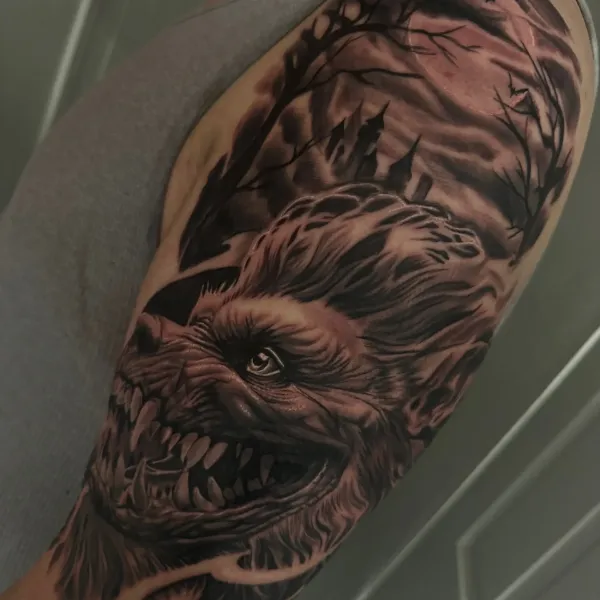
What Is a Gothic Tattoo?
A Gothic tattoo draws from artistic traditions associated with medieval Gothic architecture, decorative lettering, religious imagery, dark romantic literature, and contemporary Gothic culture. Its appearance may be architectural, symbolic, ornamental, realistic, or illustrative.
Unlike tattoo styles defined by a particular needle technique, Gothic describes an aesthetic and collection of influences. A Gothic tattoo might use bold blackwork, delicate linework, detailed black and grey shading, or selective color.
Not every Gothic tattoo needs to feature skulls or frightening imagery. A stained-glass rose window, an ornate cathedral arch, or a carefully designed blackletter inscription can communicate the aesthetic without relying on horror-related subjects.
The most successful designs identify a specific visual influence rather than combining unrelated dark symbols without a clear composition.
The Origins of Gothic Art and Its Influence on Tattoos
Gothic art emerged in medieval Europe during the twelfth century and continued developing over several centuries. The style became especially associated with ambitious cathedral architecture, pointed arches, elaborate stonework, and stained-glass windows.
The Metropolitan Museum of Art identifies the pointed arch as a defining feature of Gothic architecture, which developed around Paris before spreading through much of Europe.
These architectural characteristics remain useful sources of inspiration for contemporary tattoo artists.
Medieval Gothic Architecture
Gothic architecture introduced dramatic vertical compositions, ribbed vaulting, pointed arches, tracery, and increasingly expansive stained-glass windows.
These features can be translated into tattoos through symmetrical linework, architectural framing, ornamental details, and structured negative space.
For example, a cathedral-window tattoo might use a pointed arch as its outer silhouette and a simplified tracery pattern to create the internal composition.
The artist should preserve the recognizable architectural structure without attempting to reproduce every small stone detail.
Gothic Revival and Dark Romanticism
The Gothic Revival movement later renewed interest in medieval architectural forms. Gothic literature and Romantic art also helped establish associations with mystery, ruins, mortality, supernatural themes, and emotional intensity.
These later cultural influences contributed to the modern Gothic aesthetic, but they should not be confused with the original medieval architectural movement.
A tattoo inspired by a ruined castle or a dark romantic figure may be Gothic in a modern literary sense without reproducing historical Gothic art.
Contemporary Gothic Tattoo Aesthetics
Modern Gothic tattoos often combine historical references with contemporary blackwork, realism, ornamental patterns, and dark illustration.
Some artists emphasize precise architecture and typography, while others create dramatic figures, ravens, skulls, and symbolic compositions.
Because the category is broad, choosing an artist based on the specific subject and technique is more useful than choosing someone who simply advertises Gothic tattoos.
Popular Gothic Tattoo Designs and Ideas
Gothic tattoo designs range from small symbolic pieces to elaborate sleeves and back compositions. The appropriate approach depends on the subject's visual complexity, meaning, and intended placement.
Gothic Cathedral Tattoos
Cathedrals are among the most recognizable subjects associated with historical Gothic art.
A cathedral tattoo may feature a complete facade, a pointed arch, a tower, a rose window, or an architectural detail.
Large compositions can accommodate elaborate tracery, columns, and decorative stonework. Smaller designs generally benefit from focusing on one recognizable feature.
For example, a cathedral facade with multiple towers and hundreds of windows may need to be simplified into a stronger silhouette with selective architectural details.
Look for tattoo artists who understand perspective, symmetry, and architectural drawing rather than relying exclusively on dark shading.
Gothic Cross Tattoos
Gothic cross tattoos can feature ornate metalwork, pointed architectural shapes, decorative flourishes, or stone-carving effects.
Some designs carry personal religious meaning, while others are selected for their historical or visual appearance.
When creating an elaborate cross, the artist should distinguish the main silhouette from surrounding ornamentation.
Very small crosses with numerous internal details may lose definition over time.
Gothic Raven Tattoos
Ravens are commonly associated with Gothic literature, mystery, and dark symbolism.
A raven tattoo may use realistic feather textures, dramatic black silhouettes, or illustrative linework.
Some compositions place the bird alongside architectural ruins, moons, flowers, or lettering.
For smaller designs, a clear raven silhouette can be more effective than attempting to reproduce every feather.
The bird's posture can influence the mood of the design, from calm and contemplative to dramatic and expressive.
Gothic Skull Tattoos
Skulls can represent mortality, remembrance, impermanence, or a preference for dark artistic imagery.
In Gothic compositions, they may be combined with candles, roses, cathedral details, or ornamental frames.
A skull does not automatically make a tattoo Gothic. The surrounding artistic treatment often determines whether the result resembles Gothic illustration, realism, or another style.
For detailed skull tattoos, examine the artist's ability to create convincing anatomy, depth, and readable shadows.
Gothic Angel and Fallen Angel Tattoos
Angels are another important subject in Gothic-inspired tattooing.
Designs may feature sculptural figures, folded wings, architectural niches, or dramatic compositions inspired by religious art.
Fallen angel imagery may communicate rebellion, loss, conflict, or personal transformation, depending on the wearer's interpretation.
Large designs provide room for detailed faces, feathers, drapery, and surrounding architecture.
For smaller tattoos, a simplified winged figure or sculptural silhouette may be more practical.
Gothic Rose Tattoos
Roses can introduce a softer organic element into a Gothic composition.
Black roses, thorned stems, wilted flowers, and roses surrounding ornate frames are common visual approaches.
The symbolism may involve love, loss, remembrance, or beauty, but no single meaning applies to every rose tattoo.
For a Gothic rose, contrast between the petals and dark surrounding elements is particularly important.
A heavily shaded background should not obscure the flower's shape.
Gothic Castle and Ruins Tattoos
Castles, abandoned buildings, towers, and ruins connect strongly with Gothic fiction and Romantic imagery.
These subjects can create a dramatic atmosphere through silhouettes, clouds, moonlight, and architectural details.
However, elaborate architectural scenes require careful control of perspective and contrast.
Choose a clear focal point rather than attempting to include every building, tree, and background detail in a small tattoo.
Gothic Bat and Moth Tattoos
Bats and moths can work as individual Gothic-inspired designs or as supporting elements in larger compositions.
A bat silhouette may suit bold blackwork, while a moth can accommodate intricate wing patterns and ornamental symmetry.
These subjects are particularly useful for chest, sternum, upper arm, and back placements where their wings can follow the body's natural shape.
Check that internal wing details remain distinguishable at the intended size.
Gothic Lettering and Blackletter Tattoos
Gothic lettering is one of the most recognizable elements of contemporary Gothic tattoo design.
Blackletter typography uses dense strokes, angular forms, and decorative details associated with medieval manuscript and later printing traditions.
However, not all blackletter forms come from the same historical period, and the word Gothic can describe several related typographic traditions.
Modern tattoo artists often adapt these letterforms for names, dates, meaningful words, and short phrases.
Blackletter vs. Gothic Calligraphy
Blackletter generally refers to a family of historical letterforms, including Textura, Fraktur, and related styles.
Gothic calligraphy may describe handwriting inspired by these forms, while Gothic tattoo lettering often includes contemporary adaptations.
The artist should choose letterforms that are visually consistent and readable rather than mixing decorative elements without a clear typographic structure.
Why Gothic Lettering Requires Careful Spacing
Blackletter contains narrow openings, closely arranged strokes, and decorative terminals.
When reduced to a very small tattoo, these details may become crowded.
Letters that appear distinct in a digital font preview can become harder to distinguish at actual tattoo size.
Before tattooing, confirm the spelling, capitalization, punctuation, and letter shapes.
For longer phrases, a larger placement may be necessary.
Explore Lettering tattoos for more guidance on typography, spacing, and choosing an artist.
Gothic Tattoos vs. Dark Art Tattoos
Gothic and Dark Art tattoos often overlap, but they are not identical.
Gothic designs may emphasize architecture, typography, historical ornament, religious symbolism, or dark romantic themes.
Dark Art is a broader contemporary category that can include horror, surrealism, disturbing imagery, and other unsettling subjects.
A cathedral window or blackletter inscription may be Gothic without being frightening. Conversely, a realistic horror portrait may qualify as Dark Art without incorporating Gothic visual references.
| Style |
Primary Characteristics |
Common Subjects |
| Gothic |
Historical architecture, ornate typography, dark romantic imagery |
Cathedrals, blackletter, ravens, angels, crosses |
| Dark Art |
Dark atmosphere, unsettling themes, horror and surreal imagery |
Monsters, distorted figures, macabre illustrations |
| Blackwork |
Bold black ink, silhouettes, graphic contrast |
Abstract shapes, symbols, ornamental designs |
| Black & Grey |
Monochromatic shading and tonal depth |
Portraits, statues, animals, architecture |
| Ornamental |
Decorative patterns, symmetry, flowing arrangements |
Filigree, decorative frames, geometric motifs |
Explore Dark Art tattoos if you prefer horror-inspired or surreal dark imagery.
Blackwork vs. Black and Grey Gothic Tattoos
Blackwork Gothic Tattoos
Blackwork uses solid black shapes and strong graphic contrast.
It can be particularly effective for Gothic lettering, bat silhouettes, crosses, architectural frames, and bold ornamental compositions.
Negative space becomes essential when black shapes contain intricate internal patterns.
Explore Blackwork tattoos for designs built around solid black ink and graphic structure.
Black and Grey Gothic Tattoos
Black and grey shading is useful for Gothic statues, angels, cathedral interiors, realistic ravens, and architectural ruins.
Artists can create depth through tonal transitions, allowing sculptural details and dramatic lighting to emerge.
However, excessive dark shading may obscure the main subject.
Look for artists who maintain recognizable forms even in compositions with strong shadows.
Can Gothic Tattoos Use Color?
Yes. Gothic tattoos are not restricted to black ink.
Stained-glass designs can use reds, blues, greens, and other colors, while roses or ornamental elements may incorporate selective accents.
A limited color palette can create a focal point without overwhelming the composition.
For stained-glass-inspired tattoos, the artist should establish clear boundaries between the colored areas so the design retains its window-like structure.
Gothic Tattoo Meanings and Symbolism
Gothic tattoos can carry personal, religious, historical, literary, or purely aesthetic meanings.
There is no universal meaning attached to every Gothic design.
| Design |
Possible Associations |
Important Context |
| Cathedral |
Faith, history, artistic admiration, transcendence |
May reference a specific building or architectural tradition |
| Raven |
Mystery, intelligence, memory, literary symbolism |
Meanings vary across cultures and individuals |
| Skull |
Mortality, remembrance, impermanence |
Can also be selected for visual reasons |
| Angel |
Protection, faith, grief, transformation |
Religious meaning depends on the design and wearer |
| Rose |
Love, loss, beauty, remembrance |
Color and surrounding imagery may change interpretation |
| Blackletter |
Personal identity, names, dates, statements |
Meaning depends on the actual text |
If symbolism is important, explain your intended meaning to the artist rather than relying on generic interpretations found online.
For religious or historically significant imagery, verify the original source and any relevant cultural context before incorporating it into a tattoo.
Best Placements for Gothic Tattoos
Placement should reflect the subject's proportions and the amount of detail required.
Architectural designs often benefit from vertical space, while symmetrical ornamentation may work better across broader body areas.
| Placement |
Suitable Gothic Designs |
Design Considerations |
| Forearm |
Blackletter, crosses, ravens, cathedral windows |
Orientation and available width |
| Upper Arm |
Angels, skulls, ornamental frames, Gothic figures |
Curvature and viewing angles |
| Chest |
Symmetrical wings, ornate crosses, large lettering |
Balance across body contours |
| Back |
Cathedral facades, angels, large narrative compositions |
Space for architecture and detailed shading |
| Thigh |
Detailed statues, castles, ravens, architectural scenes |
Room for intricate artwork |
| Calf |
Vertical cathedral designs, towers, Gothic figures |
Muscle curvature and orientation |
| Hand |
Simple symbols or lettering |
Frequent exposure, movement, and limited detail space |
Gothic Forearm Tattoos
The forearm is well suited to vertical designs such as cathedral windows, ornate crosses, and blackletter inscriptions.
However, long words and architectural subjects should be evaluated from different viewing angles.
A design that wraps too far around the arm may become difficult to appreciate as one complete image.
Gothic Chest Tattoos
The chest can accommodate symmetrical compositions, including wings, decorative crosses, and ornamental arrangements.
For lettering, the artist should consider how the words follow the natural contours of the chest.
Symmetry should be checked with the body in a relaxed position.
Gothic Back Tattoos
The back offers space for detailed architecture, large angels, and complex narrative scenes.
For a cathedral tattoo, this area can accommodate a recognizable facade with towers, windows, and architectural ornament.
Large designs should be planned as a complete composition before the first session.
Gothic Tattoo Sleeves: Planning a Cohesive Design
A Gothic sleeve can combine several related subjects or form one continuous architectural or illustrative composition.
For example, a sleeve might feature a central angel, cathedral arches, ravens, roses, and blackletter inscriptions.
However, including too many symbols can weaken the composition.
Choose a Main Focal Point
Begin with the most important subject, such as a statue, cathedral window, or large raven.
Supporting elements should reinforce the focal point rather than compete with it.
Use Architecture to Connect the Sleeve
Pointed arches, stone tracery, and ornamental frames can connect separate images.
These elements may provide more stylistic unity than simply filling empty areas with dark shading.
Balance Dark Areas and Negative Space
Gothic sleeves often contain substantial black shading.
Without enough negative space, architectural details and individual subjects may become difficult to distinguish.
Plan areas of visual rest between dense compositions.
Consider Future Additions
If you intend to build the sleeve over multiple sessions or years, reserve suitable areas for larger subjects.
Small fillers should not occupy spaces needed for important future artwork.
How Small Can a Gothic Tattoo Be?
Small Gothic tattoos are possible, but the appropriate size depends on the complexity of the design.
A simple black cross, bat silhouette, or short word may work at a compact size.
A cathedral facade with multiple towers, detailed stonework, and stained-glass windows generally requires more room.
Why Architectural Details Need Space
Gothic architecture often contains narrow openings, repeated arches, decorative tracery, and small structural elements.
When these features are reduced too far, the tattoo may lose the visual distinctions that make the architecture recognizable.
An experienced artist may simplify secondary details, enlarge important openings, or strengthen the main silhouette.
Why Small Blackletter Can Become Difficult to Read
Blackletter uses dense vertical strokes and narrow internal spaces.
At very small sizes, adjacent strokes may become difficult to distinguish as the tattoo ages.
For important names, dates, or phrases, prioritize legibility over the smallest possible dimensions.
Do Gothic Tattoos Age Well?
Gothic tattoos can retain strong visual impact when their design uses suitable scale, contrast, and spacing.
However, longevity depends on the specific technique rather than the Gothic label.
A bold blackwork bat may age differently from a detailed cathedral window or a realistic angel portrait.
Fine architectural lines, dense blackletter, and narrow negative-space openings may become less distinct over time.
What to Look for in Healed Gothic Tattoos
Review healed photographs showing similar subjects and techniques.
For architectural tattoos, examine whether window tracery and decorative elements remain separate.
For lettering, check whether individual characters are still readable.
For black and grey figures, look for recognizable facial features and sufficient separation between shadows.
Full-placement photographs are particularly useful because they show how the design reads at a normal viewing distance.
How to Choose a Gothic Tattoo Artist
Gothic tattooing can involve very different technical specialties.
An artist skilled in Gothic lettering may not have the same experience with realistic statues or complex cathedral architecture.
Choose an artist based on the actual work you want rather than the general aesthetic alone.
1. Match the Artist to Your Gothic Subject
For cathedral tattoos, prioritize portfolios demonstrating architectural accuracy and controlled linework.
For blackletter, look for typography, spacing, and consistent letterforms.
For angels and statues, examine anatomical accuracy and black and grey shading.
2. Review Healed Examples
Fresh tattoos may appear extremely sharp in photographs.
Healed examples help show whether fine details remain readable and whether dark areas retain useful separation.
3. Check the Artist's Composition Skills
A Gothic tattoo should have a clear visual hierarchy.
Look for designs where the main subject remains recognizable despite decorative detail and atmospheric shading.
4. Verify Lettering and Historical References
If your design includes blackletter or a historical symbol, confirm that the artist can reproduce the intended forms accurately.
For historical architecture, identify the building or reference tradition when accuracy matters.
5. Discuss Long-Term Readability
Ask whether the artist recommends changes to line spacing, design dimensions, or shading.
An experienced artist should be able to explain why certain intricate details may not translate effectively at a small scale.
Common Gothic Tattoo Design Mistakes
Using Too Many Unrelated Symbols
Combining skulls, ravens, roses, crosses, castles, and lettering into one small tattoo can create a crowded composition.
Choose a main subject and use supporting elements selectively.
Copying Architecture Without Simplification
Detailed photographs of cathedrals may contain more information than can be reproduced clearly in a tattoo.
Preserve the most recognizable architectural features rather than copying every small detail.
Choosing Unreadable Blackletter
Highly decorative lettering may look attractive but become difficult to read.
Check the text at its actual tattoo size and verify every character.
Making Every Area Equally Dark
Excessive black shading can obscure the main subject.
Use negative space and contrast to separate important forms.
Ignoring Cultural and Religious Context
Some Gothic-inspired imagery carries historical or religious significance.
Research the meaning of specific symbols and avoid assuming that all medieval-looking imagery is interchangeable.
Gothic Tattoo Aftercare and Safety
Gothic tattoos require the same professional safety practices and appropriate aftercare as other permanent tattoos.
Choose a professional studio that follows applicable state and local tattooing requirements and appropriate infection-control procedures.
Tattooing carries risks, including infections, allergic reactions, and scarring. Contaminated tattoo ink can cause complications even when equipment is handled carefully.
Follow your artist's instructions for cleaning and protecting the tattoo during healing.
After healing, protect exposed tattooed skin from ultraviolet light. The American Academy of Dermatology recommends broad-spectrum, water-resistant sunscreen with SPF 30 or higher.
If you experience spreading redness, increasing pain, pus, fever, or another concerning reaction, seek medical attention.
Find Gothic Tattoo Artists Near You
Gothic tattoo artists can be found throughout the United States, but their specialties vary.
Some focus on cathedral architecture and blackletter typography, while others create dark illustrative compositions, ornamental blackwork, or realistic angels and statues.
Use TattooShopsNearYou.com to explore tattoo shops and artists by location and style. Compare available Gothic portfolios, examine healed work, and identify artists experienced in your preferred subject.
Before booking, discuss your references, intended symbolism, placement, design size, and the artist's approach to maintaining readable detail.
The right Gothic tattoo artist should be able to translate historical or contemporary inspiration into an original composition that works on the body rather than simply reproducing a complicated reference image.