Micro Realism Tattoos: Designs, Longevity & Artists Near You
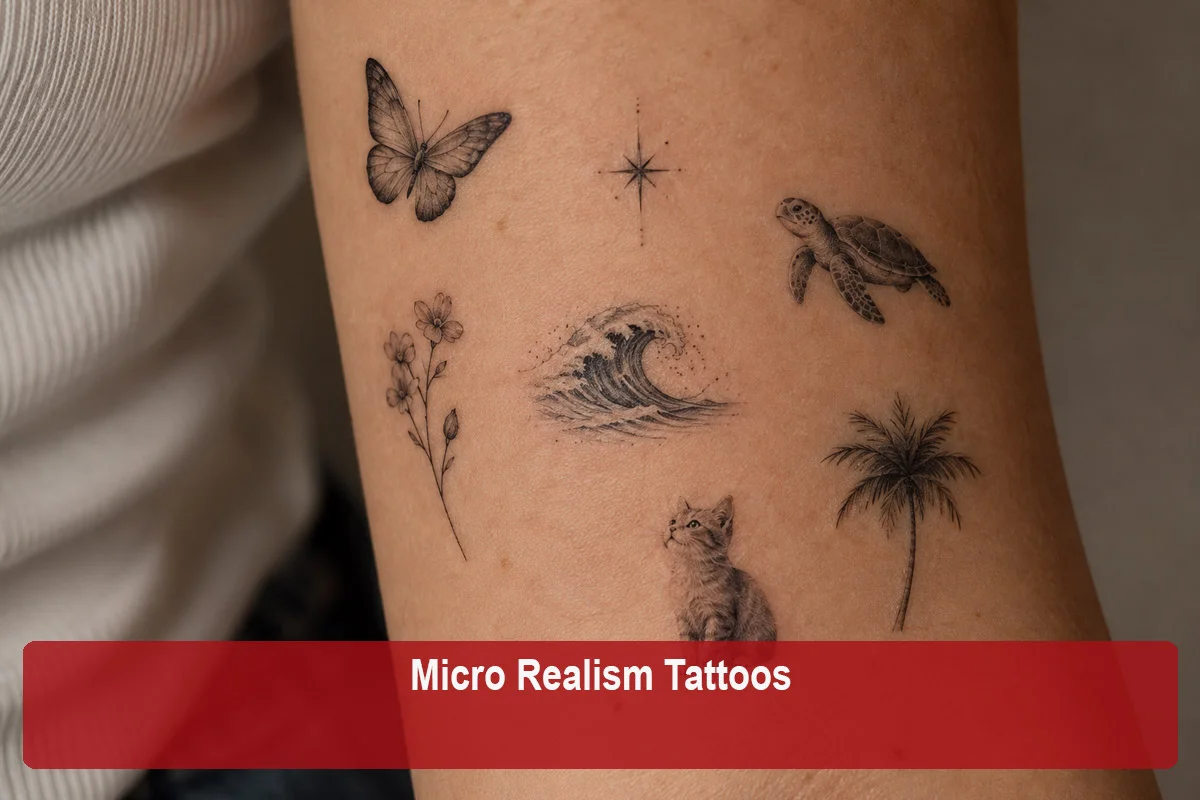
Micro realism tattoos recreate lifelike subjects at a miniature scale, using precise shading, delicate details, and carefully controlled contrast. From tiny pet portraits and realistic flowers to miniature landscapes and architectural designs, these tattoos offer intricate artwork without requiring a large area of skin. But smaller does not always mean simpler. The limited space makes subject selection, placement, and an artist's experience especially important.
Explore micro realism tattoo artists and shops across the United States. Compare portfolios, look for healed examples, and find specialists who understand how to preserve realistic details in small tattoos.
Micro Realism Tattoo Artists & Shops Near You
Browse 2 tattoo artists and shops featuring Micro Realism work. Compare portfolios and healed examples before you book.
Micro realism is a tattoo style that reproduces recognizable subjects with realistic shading, depth, and texture in a relatively small area of skin. The subject might be a pet's face, a human portrait, a flower, a building, or a landscape. Unlike a simple miniature outline, micro realism attempts to preserve the visual qualities that make the subject appear lifelike.
The style borrows from larger Realism tattoos, but working at a smaller scale introduces different technical challenges. There is less room for transitions between light and shadow, individual features must be simplified carefully, and minor changes in healed detail can affect the overall image.
There is no universally agreed size that defines micro realism. A tattoo measuring a few inches may be considered micro realism when it contains unusually intricate realistic detail for its dimensions. The important distinction is the relationship between the subject's complexity and the space available to reproduce it.
Micro realism fits lifelike shading and depth into a small area of skin.
The Real Challenge: Making a Miniature Tattoo Readable
A realistic image can contain thousands of visual details, but skin is not photographic paper. Tattoo pigment is deposited into living tissue, and the appearance of lines and shading changes as the tattoo heals and ages.
For micro realism, the artist must decide which details are essential and which can be removed without losing the subject's identity.
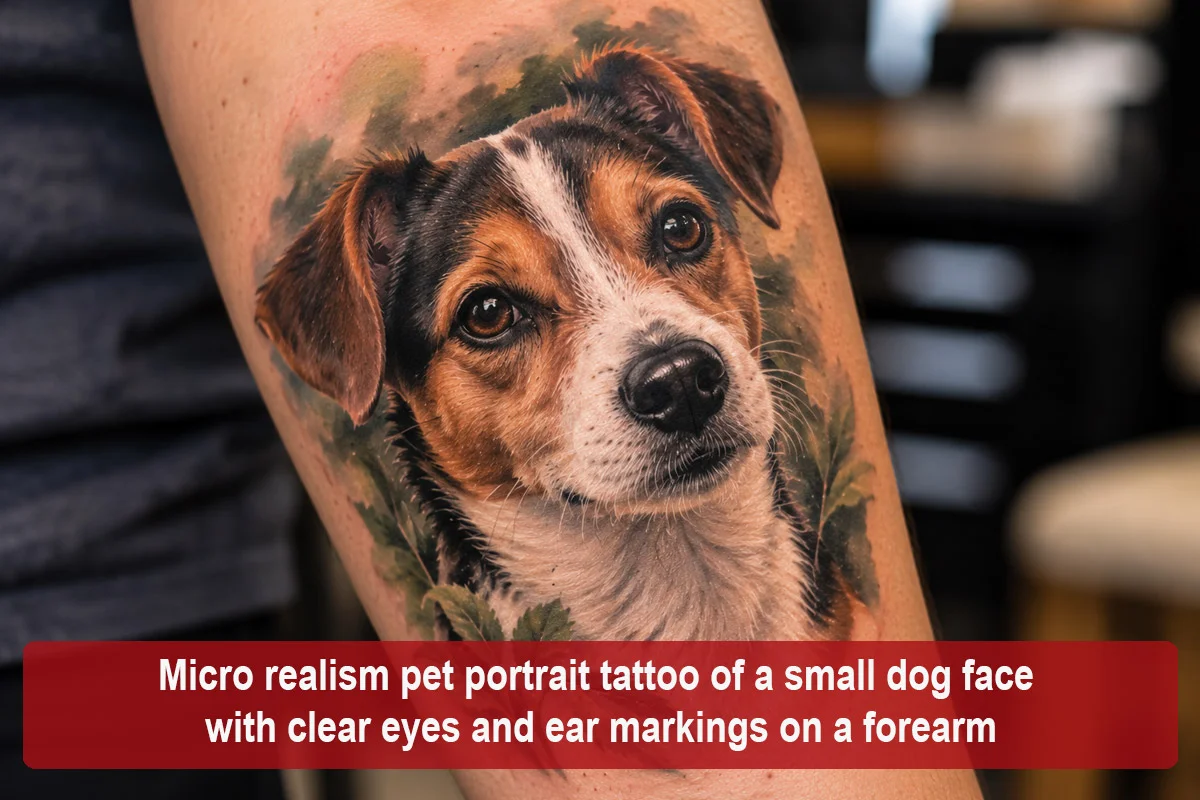
Consider a small portrait of a dog. The shape of the ears, position of the eyes, nose, and distinctive facial markings may be essential for recognition. Reproducing every strand of fur may be less important and could make the finished tattoo unnecessarily crowded.
Successful micro realism often depends on selective simplification rather than reproducing every pixel of the reference photograph.
Why Contrast Matters More Than Maximum Detail
Realistic depth comes from differences between dark, middle, and light values. In a large tattoo, an artist has enough space to develop gradual shading transitions. In micro realism, those transitions must fit into a much smaller area.
If every part of a miniature tattoo is rendered in similar light grey tones, important features may become difficult to distinguish as the pigment settles.
Strong focal points, appropriately placed dark areas, and open highlights can help preserve readability. This does not mean every micro realism tattoo needs heavy black outlines. It means the artist should establish a clear tonal structure before adding delicate textures.
Micro Realism vs. Fine Line, Single Needle, and Traditional Realism
These tattoo styles often overlap, but they describe different aspects of the artwork or application process.
Style
Primary Characteristic
What to Look For
Micro Realism
Small-scale lifelike imagery with realistic shading
Thin, delicate outlines and restrained visual weight
Consistent line quality and appropriate spacing
Single Needle
A tattooing technique using a single-needle configuration
Controlled application and healed line quality
Realism
Lifelike imagery at various scales
Depth, anatomy, proportion, and tonal accuracy
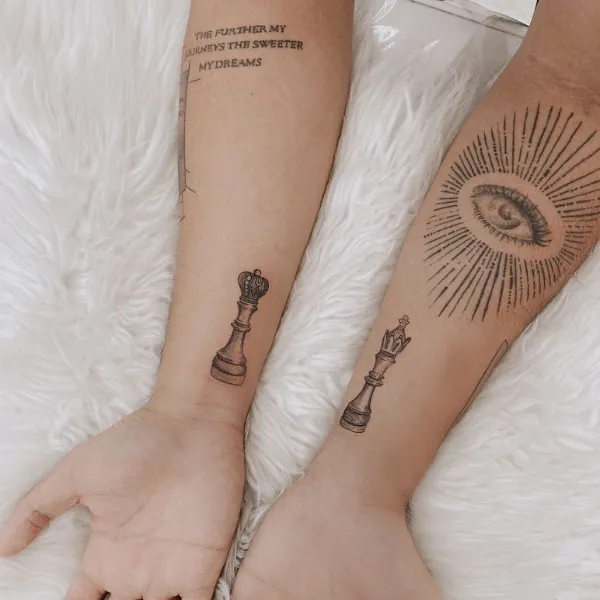
A micro realism artist may use techniques associated with Fine Line tattoos or Single Needle tattoos, but neither technique automatically produces realistic artwork.
When selecting an artist, prioritize examples of completed miniature realistic subjects rather than relying only on the techniques listed in their profile.
Micro Realism Tattoo Ideas That Work at a Small Scale
Not every photograph or illustration is equally suitable for micro realism. Subjects with distinctive silhouettes, identifiable features, and clear lighting often provide a better starting point than visually crowded images.
Micro Realism Pet Portraits
Pet portraits are a meaningful application of micro realism because they can capture the recognizable features of an individual animal without requiring a large tattoo.
However, recognition depends on more than reproducing fur texture. Ear position, facial proportions, markings, and expression are often more important.
For a very small pet portrait, a close-up reference with clear lighting may work better than a full-body photograph taken from a distance. Ask the artist which features can realistically be preserved at your preferred size.
Ears, eyes, and markings matter more than every strand of fur.
Miniature Human Portraits
Human faces are among the more demanding micro realism subjects. Small differences in eye position, nose shape, or facial proportions can change the likeness.
A photograph containing multiple faces may need to be enlarged or simplified. Extremely small portraits can lose recognizable features when subtle shading transitions soften.
Review healed miniature portrait examples before commissioning a memorial portrait or another design where an accurate likeness is especially important.
Micro Realism Flowers and Botanical Tattoos
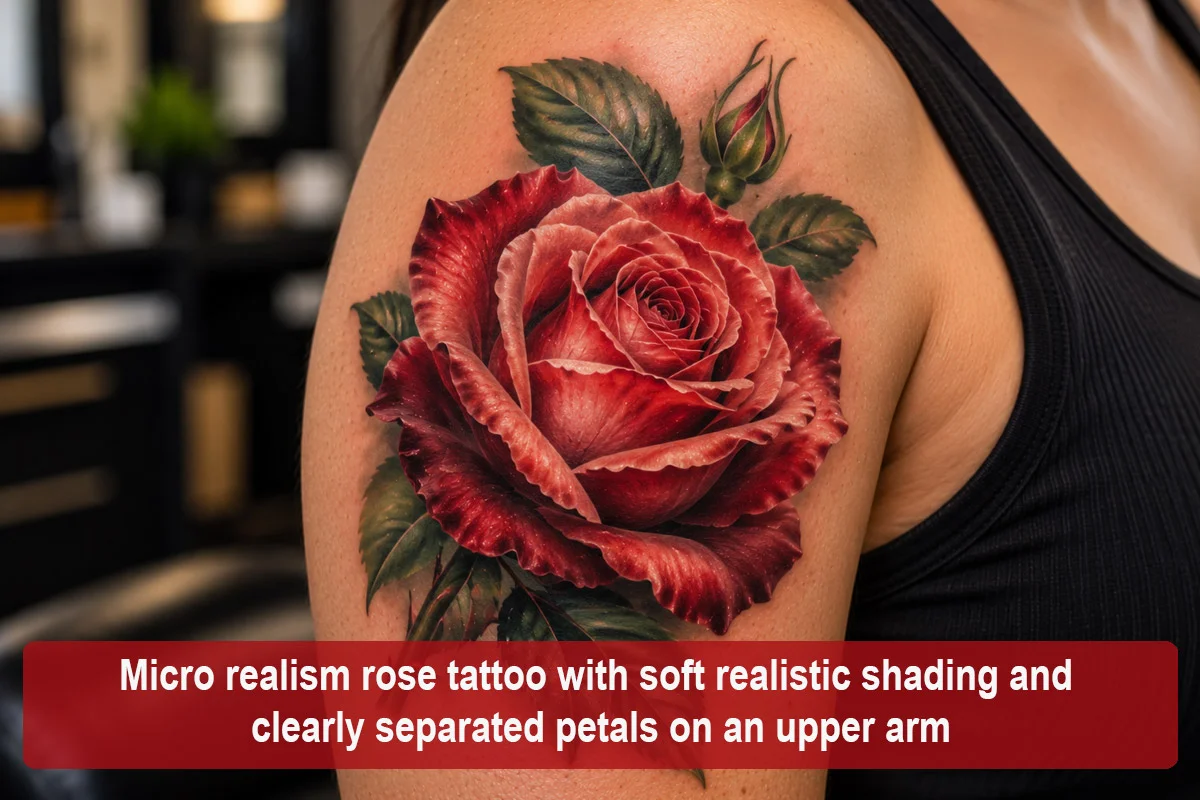
Flowers, leaves, and botanical subjects can translate well into micro realism because their shapes remain identifiable even when some surface texture is simplified.
A single rose, orchid, or detailed leaf may offer more visual clarity than a dense miniature bouquet.
A single flower often reads more clearly than a dense miniature bouquet.
For clients who prefer a less photographic appearance, Illustrative tattoos may offer an alternative that emphasizes drawn textures and deliberate linework rather than lifelike shading.
Miniature Landscapes and Architecture
Small landscapes can capture meaningful places, such as a mountain range, coastline, or recognizable building. The difficulty lies in reducing complex scenery to a few essential visual elements.
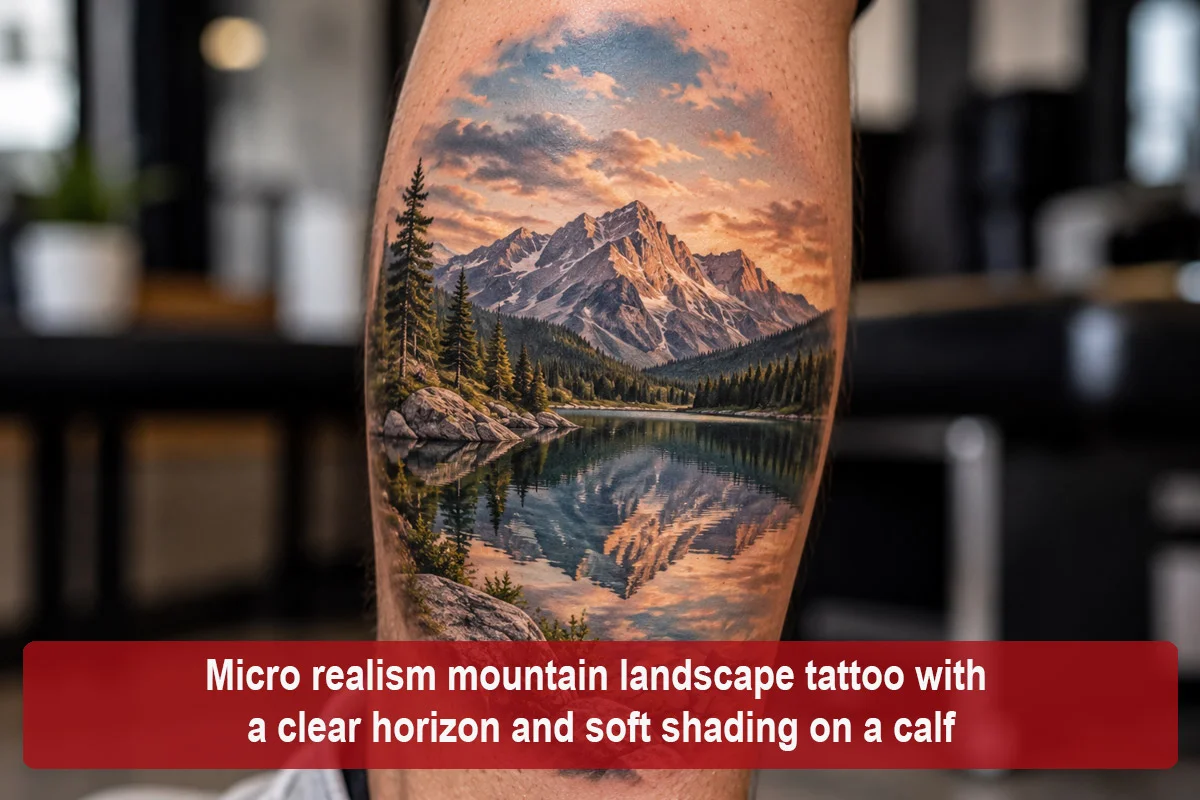
A landscape with a clear horizon and dominant focal point may be easier to reproduce than a crowded city scene containing numerous tiny windows, vehicles, and figures.
Architectural micro realism requires particular attention to perspective. Straight edges and recognizable building proportions can make small inaccuracies more noticeable.
Landscapes work best with a clear horizon and one dominant focal point.
Micro Realism Objects and Personal Symbols
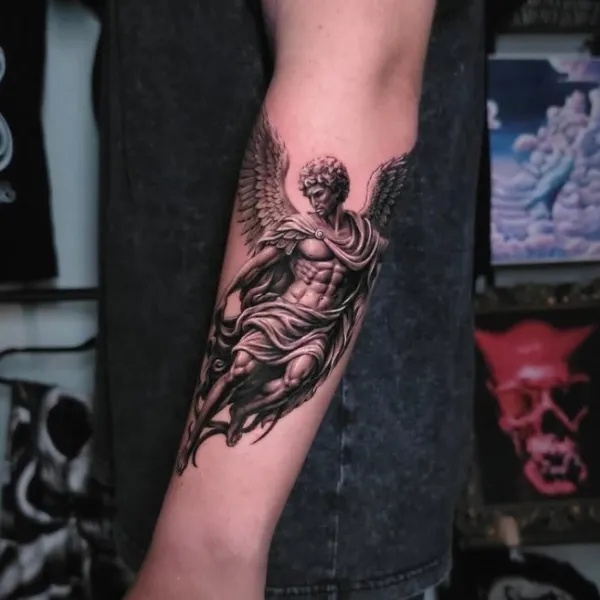
Watches, cameras, musical instruments, sculptures, and personal keepsakes can become distinctive micro realism tattoos.
These subjects are often more practical when photographed against a simple background. The artist can then concentrate on the object's defining shape, material, and lighting.
For highly detailed objects, consider whether the tattoo needs to reproduce every mechanical feature or simply communicate the item's recognizable form.
How Small Can a Micro Realism Tattoo Be?
There is no reliable minimum size that works for every micro realism design. A simple object with a strong silhouette may remain readable at a smaller scale than a portrait containing several faces.
The appropriate dimensions depend on the number of essential details, the amount of contrast, the chosen placement, and the artist's technique.
Instead of asking an artist to reproduce a reference at an exact size, ask for the smallest version they believe can retain the subject's important features after healing.
A Practical Test Before Approving the Design
View the proposed artwork at its actual tattoo size rather than only on an enlarged phone screen.
Then consider the following questions:
Can you recognize the subject immediately without zooming in?
Are the eyes, lettering, or other essential details distinguishable?
Does the design still work when minor textures are removed?
Is there enough contrast between the focal subject and its background?
Has the artist explained which details may soften over time?
This is a useful screening exercise, not a guarantee of how the tattoo will heal. An experienced artist should make the final recommendation about size and feasibility.
The forearm, upper arm, thigh, and calf are common areas to discuss for small realistic tattoos. They can provide relatively broad surfaces for detailed artwork, although individual anatomy and skin characteristics still matter.
Forearm and Upper Arm
These areas can accommodate miniature portraits, animals, flowers, and objects while allowing the design to be viewed without extreme distortion.
The exact orientation matters. A portrait placed across a strongly curved area may appear different from one positioned along a flatter section of the arm.
Thigh and Calf
The thigh and calf may provide additional room for realistic detail while allowing clients to control when the tattoo is visible.
They can be useful options when an artist recommends making a design slightly larger than originally planned.
Wrist, Finger, and Hand
These placements are popular for small tattoos, but they can be less forgiving for intricate realism. Frequent movement, washing, friction, and limited space can affect the clarity of delicate features.
A simple object may be more appropriate for these locations than a detailed miniature portrait. Ask for healed examples of comparable work on the same body area before deciding.
Do Micro Realism Tattoos Age Well?
Micro realism tattoos can remain attractive and recognizable for years, but their fine details may become less distinct as the tattoo settles and ages. The outcome varies considerably between designs, placements, artists, and individuals.
The main concern is not that every micro realism tattoo will disappear. It is that a small amount of softening can have a greater visual impact when important features are separated by very little space.
For example, a miniature animal portrait may retain its overall silhouette while losing some separation between fine fur textures. A tiny architectural tattoo may remain recognizable even if individual windows become less defined.
Strong contrast, sufficient spacing, appropriate size, and careful application can improve the chances of maintaining readability, but no artist can guarantee that every fine detail will remain unchanged.
Why Healed Photos Matter More Than Fresh Photos
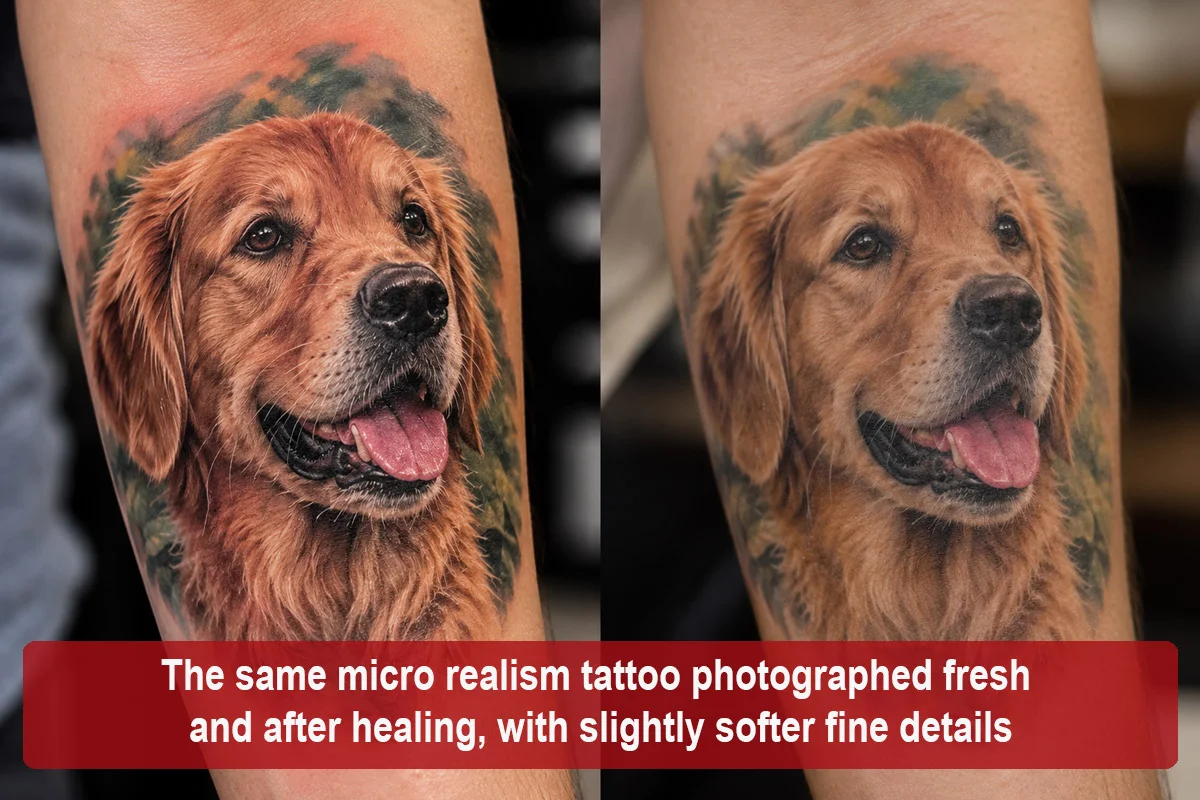
Fresh micro realism tattoos often look exceptionally crisp in close-up photographs. Temporary skin effects, lighting, camera sharpening, and image enlargement can make details appear more pronounced than they will after healing.
Healed photographs allow you to evaluate how the artist's shading and linework have settled.
Ideally, look for examples photographed several months after tattooing and, when available, pieces that are one or more years old. Compare similar subjects and sizes rather than relying on unrelated examples.
Check whether the main subject remains recognizable, whether darker areas still provide structure, and whether delicate features have retained useful separation.
Fresh (left) and healed (right): fine details soften as the tattoo settles.
Can Micro Realism Tattoos Be Touched Up?
Some micro realism tattoos can benefit from carefully planned touch-ups, but additional ink cannot always restore lost detail.
If small features have visually merged, adding more pigment may make the area darker without improving its clarity. A qualified artist should examine the fully healed tattoo before recommending further work.
Do not assume that regular touch-ups are automatically necessary or that they can preserve every miniature detail indefinitely.
Black and Grey vs. Color Micro Realism
Micro realism can use black and grey shading or carefully selected colors. The choice changes how the artist establishes depth and separates details.
Black and grey micro realism relies on tonal contrast, subtle gradients, and the natural skin tone for highlights. It is often used for miniature portraits, animals, statues, and photographic subjects.
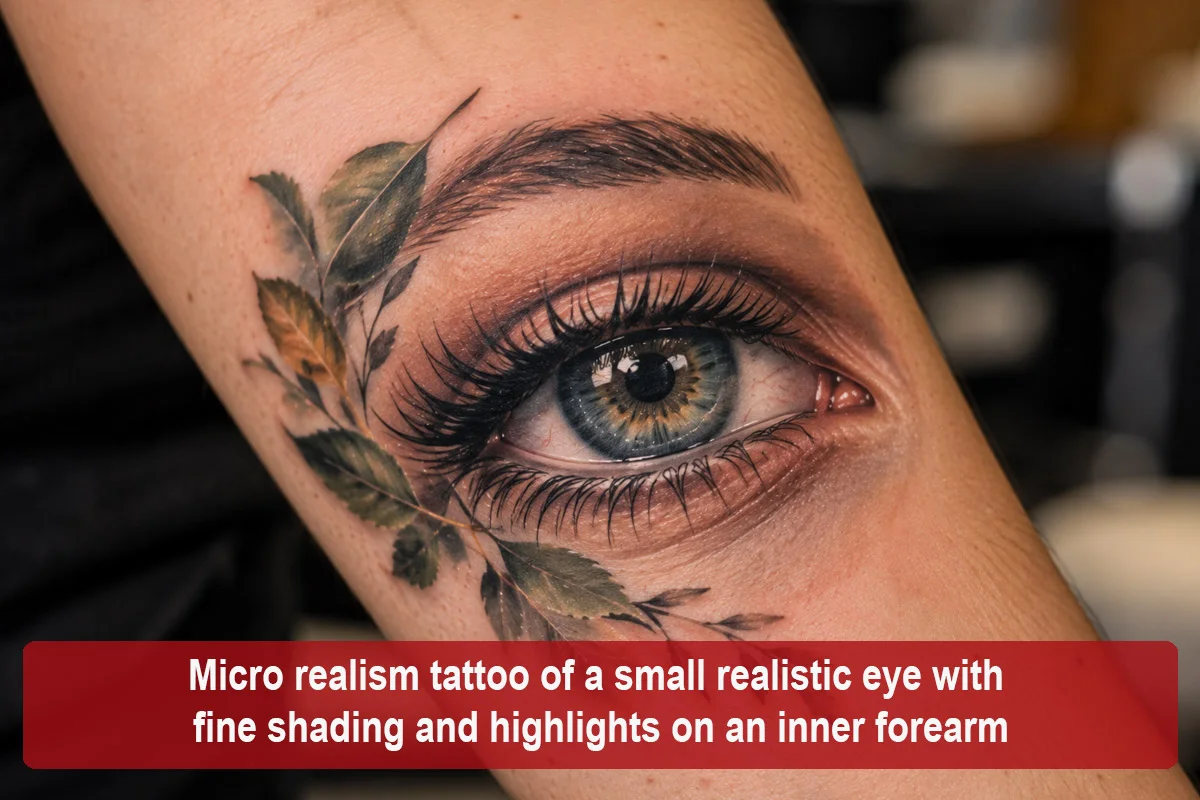
Color micro realism introduces additional possibilities for flowers, wildlife, and objects with distinctive coloration. However, the artist must balance color variation with enough contrast to preserve recognizable shapes.
Micro realism requires a combination of drawing ability, tattoo application control, realistic shading, and judgment about what can remain readable at a small size.
An artist who produces impressive large-scale portraits may not necessarily specialize in miniature realistic work.
When comparing artists, examine evidence that relates directly to your intended design.
Healed miniature tattoos: Look for work photographed after the initial healing period, preferably with longer-term examples.
Subject specialization: A strong pet portrait portfolio is more relevant to a pet memorial than unrelated miniature floral work.
Contrast and readability: Evaluate whether the subject remains identifiable without enlarging the photograph.
Design judgment: Look for artists willing to simplify details or recommend a larger size when necessary.
Placement experience: Compare tattoos completed on body areas similar to your intended location.
Questions Worth Asking Before Booking
During a consultation, ask whether your reference photograph is suitable for micro realism and which details are most important to preserve.
Request examples of healed tattoos with similar subjects and dimensions. Discuss the proposed placement, whether the design needs simplification, and how the artist approaches long-term readability.
For a memorial portrait or another highly personal image, confirm how the artist handles reference photographs and design approval before the appointment.
An artist who recommends increasing the size or simplifying the composition may be demonstrating useful technical judgment rather than an inability to perform detailed work.
Caring for a Micro Realism Tattoo
During healing, follow the aftercare instructions provided by your tattoo artist. Avoid picking at healing skin or exposing the tattoo to unnecessary friction and contamination.
Once healed, protect the tattoo from excessive ultraviolet exposure. The American Academy of Dermatology recommends broad-spectrum, water-resistant sunscreen with SPF 30 or higher on tattooed skin exposed to sunlight.
Do not apply sunscreen to an open or actively healing tattoo unless a healthcare professional specifically advises it. Follow appropriate healing guidance first.
If you experience spreading redness, increasing pain, pus, fever, or another concerning reaction, seek medical advice.
Find Micro Realism Tattoo Artists Near You
When searching for micro realism tattoo artists in the United States, start with the subject you want and the evidence available in each artist's portfolio.
A specialist who regularly creates miniature animal portraits may be a better match for a pet memorial than an artist whose portfolio primarily features large realistic sleeves. Likewise, detailed architectural or botanical designs may require different strengths.
Use TattooShopsNearYou.com to explore tattoo shops and artists by location and style. Compare individual portfolios, check whether artists offer micro realism, and contact suitable studios to discuss your reference image, preferred size, and placement.
The goal is not simply to find someone who can tattoo a very small image. It is to find an artist who can translate that image into a readable tattoo designed with healing and long-term appearance in mind.
Frequently Asked Questions About Micro Realism Tattoos
Micro realism focuses on reproducing lifelike subjects at a small scale using realistic shading, contrast, and texture. Fine line describes artwork made with thin, delicate lines and may include subjects that are not realistic. A micro realism tattoo can incorporate fine line techniques, but the two styles are not interchangeable.
Micro realism tattoos can gradually soften or lose some fine detail as they age. Because the designs are small, changes in closely spaced lines or subtle shading can affect readability. Results depend on the artist's technique, design size, placement, healing, and sun exposure. Well-planned micro realism can remain recognizable for years, but exact detail retention cannot be guaranteed.
There is no universal minimum size. A simple realistic object may work at a smaller scale than a detailed human portrait or complex landscape. The artist should evaluate the reference image, essential features, contrast, and placement before recommending dimensions that provide enough room for the design.
They can be, because miniature realism may require detailed reference preparation, precise shading, and specialized experience. Pricing varies by artist, design complexity, location, and appointment requirements. A small tattoo is not necessarily a quick or inexpensive tattoo. Request a project-specific quote from the artist.
Yes. Micro realism tattoos can use black and grey shading or color. Color may be useful for subjects such as flowers, animals, and recognizable objects, but the design still needs sufficient contrast and spacing. An experienced artist can recommend whether color or black and grey will work better for the subject and size.
Look for artists with portfolios showing miniature realistic tattoos similar to the subject you want. Prioritize healed photographs, confirmed tattoo dimensions, clear shading, and recognizable details. Ask about reference preparation, minimum practical size, placement, and design adjustments before booking. The best choice is an artist whose demonstrated work matches your specific project.