What Is a Surrealism Tattoo?
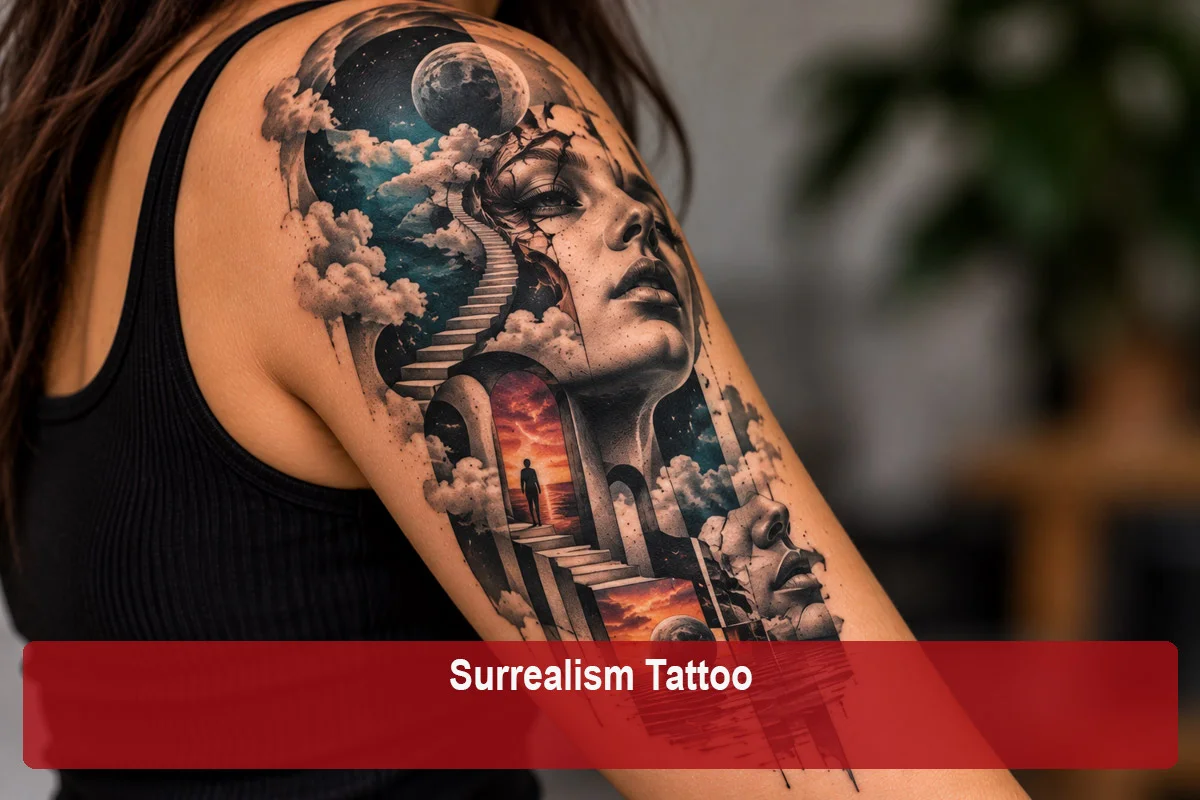
A surrealism tattoo combines recognizable imagery with impossible situations, unexpected transformations, or dreamlike relationships. The artwork might show a portrait dissolving into birds, a doorway opening inside a human silhouette, or a landscape suspended within an ordinary object.
The defining feature is not simply that the tattoo looks strange. Surrealism challenges the viewer's expectations about reality by bringing together elements that would not ordinarily coexist.
Some surrealism tattoos appear almost photographic. Others use distorted anatomy, floating objects, symbolic figures, or abstract shapes. Both approaches can belong to the same artistic tradition when the composition creates an imaginative reality beyond ordinary observation.
This distinguishes surrealism from conventional Realism tattoos, where the primary goal is usually to represent a subject convincingly. A surrealist composition may use equally realistic shading while presenting a scene that could never exist.
How Surrealist Art Influenced Modern Tattoo Design
Surrealism emerged as a literary and artistic movement during the early twentieth century. André Breton's 1924 Surrealist Manifesto helped establish its interest in dreams, unconscious thought, and creative processes that challenged rational expectations.
Artists such as Salvador Dalí, René Magritte, Max Ernst, Joan Miró, and Leonora Carrington explored different approaches to imagination and reality. Their work ranged from meticulously painted impossible scenes to spontaneous drawings, mysterious figures, and unconventional combinations of everyday objects.
Modern surrealism tattoos draw from this broader visual tradition, although contemporary tattoo artists also incorporate influences from photography, illustration, digital collage, fantasy art, and personal symbolism.
The most useful lesson from surrealist art is that unexpected imagery becomes more powerful when the relationship between its elements feels intentional.
Dalí-Inspired Surrealism Tattoos
Salvador Dalí is associated with precisely rendered dream imagery, distorted objects, and unsettling combinations of familiar subjects. His paintings demonstrate how convincing visual technique can make impossible scenes appear believable.
A tattoo inspired by this approach might feature a distorted clock, an unusual landscape, or an object behaving in a physically impossible way.
Rather than reproducing a famous painting without modification, consider developing an original composition that uses similar principles of transformation, scale, or unexpected relationships.
Magritte-Inspired Conceptual Tattoos
René Magritte frequently used ordinary objects in unfamiliar contexts. His work demonstrates that a simple visual contradiction can be more effective than an extremely complicated scene.
For tattoo design, this approach may involve a familiar object revealing something unexpected, a silhouette containing an impossible landscape, or an image that questions what the viewer is actually seeing.
These concepts can work without excessive decorative detail, provided the central visual idea remains clear.
Dream Imagery and the Unconscious
Dreams played an important role in the development of surrealist art. Unusual combinations of places, people, animals, and objects can create emotional associations that do not follow ordinary logic.
For a personal surrealism tattoo, a recurring dream or vivid memory may provide a starting point. The design does not need to reproduce every detail of the dream.
Instead, identify the two or three images that carry the strongest emotional significance and ask how they can interact within one composition.
Surrealism Tattoo Ideas That Go Beyond Common Symbols
Popular surrealism tattoo ideas include melting clocks, floating eyes, fragmented faces, unusual landscapes, and impossible architecture. These subjects can be visually effective, but their originality depends on how they are combined and interpreted.
Surrealist Portrait Tattoos
Surrealist portraits begin with a recognizable human face and introduce an unexpected transformation. The subject might merge with a mountain range, open into a night sky, or appear divided between two different realities.
The main challenge is preserving facial recognition while allowing the surreal elements to become part of the composition.
If the tattoo depicts a specific person, the artist should establish the likeness before introducing distortion. Otherwise, the result may appear imaginative but fail to resemble the intended subject.
Explore Portrait tattoos for additional guidance on reference photographs, facial proportions, and evaluating artist portfolios.
Surreal Eye Tattoos
Eyes can serve as focal points in surrealist compositions because they immediately attract attention and suggest perception, observation, or inner experience.
A surreal eye tattoo might contain a miniature landscape, reflect an impossible scene, or appear as part of an unfamiliar object.
However, eyes do not have one universal symbolic meaning. The interpretation depends on the composition and the person wearing it.
For a small design, consider whether the eye and the secondary image will remain distinguishable without magnification.
Melting Clocks and Distorted Time
Distorted clocks are closely associated with surrealist imagery, particularly Dalí's artistic legacy. In tattoos, they may be used to explore personal ideas about memory, time, change, or impermanence.
A stronger design may incorporate a personally meaningful date, place, or object rather than relying on a familiar melting clock alone.
For example, a clock could merge into the architecture of a childhood home or transform into a landscape connected to an important memory.
When including numbers or clock hands, confirm whether their exact positions carry meaning before approving the design.
Surreal Animals and Nature
Animals can become part of surreal compositions through transformations, unusual proportions, or combinations with natural environments.
A bird may dissolve into clouds, a whale may float above a city, or an animal's silhouette may contain a forest.
These designs work best when the animal remains identifiable and the secondary imagery contributes to the concept.
Combining too many unrelated objects may create visual complexity without adding meaning.
Impossible Architecture and Dream Landscapes
Doorways, staircases, windows, and buildings are useful surrealist elements because they suggest movement between different spaces or realities.
An architectural tattoo might feature a staircase leading into an open sky, a room suspended inside a portrait, or a landscape with conflicting perspectives.
These compositions require careful perspective and spatial planning. Even deliberately impossible architecture needs a consistent visual structure to communicate the intended illusion.
Surrealism Tattoos About Identity and Transformation
Surreal imagery can be used to explore personal themes such as change, memory, uncertainty, or identity.
A face divided into different environments might represent contrasting experiences. An object transforming into another could suggest personal development or a transition between life stages.
These are possible interpretations, not fixed symbolic definitions.
The strongest personal designs often emerge from discussing the intended meaning with the artist rather than selecting a symbol from a generic tattoo meaning chart.
Surrealism vs. Abstract, Illustrative, and Dark Art Tattoos
Surrealism overlaps with several tattoo styles, but each emphasizes different artistic characteristics.
| Style |
Primary Focus |
How It Differs From Surrealism |
| Surrealism |
Dreamlike imagery, impossible relationships, unexpected transformations |
Uses recognizable or abstract elements to challenge ordinary reality |
| Abstract |
Shape, movement, texture, color, and nonrepresentational composition |
Does not require recognizable objects or dreamlike narratives |
| Illustrative |
Drawing-inspired linework, texture, and stylized imagery |
Describes a visual approach rather than a surreal concept |
| Dark Art |
Ominous, unsettling, macabre, or emotionally intense imagery |
Can be surreal, but does not have to challenge reality |
Explore Abstract tattoos if you prefer expressive shapes and visual movement without a clearly identifiable subject.
For artwork resembling drawings, engravings, or imaginative illustrations, Illustrative tattoos may offer another direction.
If your preferred imagery is unsettling or macabre, compare Dark Art tattoos to understand the difference between an eerie visual atmosphere and a specifically surreal concept.
Black and Grey vs. Color Surrealism Tattoos
Surrealism is not limited to one color palette. Both black and grey and full-color approaches can create convincing impossible scenes.
Black and Grey Surrealism
Black and grey surrealism uses tonal contrast to establish depth, lighting, and separation between overlapping subjects.
It is particularly suitable for photographic compositions, fragmented portraits, architectural illusions, and scenes that depend on realistic shading.
Because multiple subjects may occupy the same visual space, the artist must ensure that dark areas do not merge into an indistinct composition.
Color Surrealism
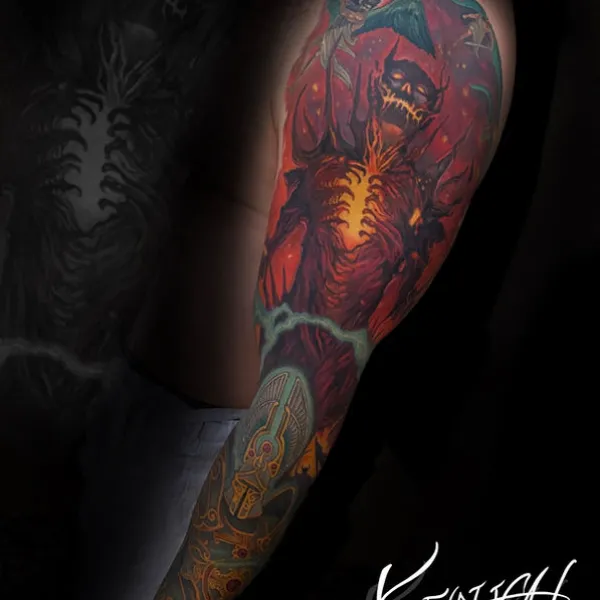
Color can distinguish different environments, emphasize impossible lighting, or create dramatic transitions between unrelated objects.
For example, a realistic portrait might transition into a vividly colored underwater landscape, creating a clear separation between two visual worlds.
However, additional colors do not automatically improve the composition. A successful color surrealism tattoo still needs clear focal points and sufficient contrast.
Ask the artist to explain how the design will remain readable if subtle color transitions soften over time.
How to Turn a Surreal Tattoo Idea Into an Original Design
One of the most common problems with surrealism tattoo planning is beginning with too many disconnected images.
A client may want a clock, an eye, a staircase, a galaxy, and a portrait in one tattoo. Each element may be visually interesting, but placing them together does not automatically create a coherent surrealist composition.
A better approach is to establish one central relationship that gives the artwork its identity.
Step 1: Identify the Central Concept
Begin with a personal memory, dream, emotion, or philosophical idea.
For example, the concept might involve feeling connected to two places, remembering someone through a familiar landscape, or experiencing time differently during an important life event.
The concept does not need to be explained literally within the tattoo. It simply provides direction for the imagery.
Step 2: Choose Two Strong Visual Elements
Select subjects that can communicate the concept through an unexpected relationship.
For a design about memory and place, a portrait combined with a recognizable landscape may be more effective than several unrelated symbolic objects.
For a design about change, one object gradually transforming into another can establish a clear visual narrative.
Step 3: Decide How the Images Interact
Surrealist compositions often use transformation, substitution, unusual scale, impossible perspective, or unexpected placement.
A doorway might replace part of a face. A natural landscape could emerge from an everyday object. A familiar subject might appear in an environment where it could not ordinarily exist.
The interaction should be visually understandable even if its meaning remains open to interpretation.
Step 4: Simplify the Background
Not every area needs equal detail. Open space, controlled shading, and selective texture can help the central illusion stand out.
If the background competes with the focal subject, the design may become difficult to interpret from a normal viewing distance.
Step 5: Test the Design at Actual Tattoo Size
View the proposed design at its intended dimensions rather than relying only on an enlarged digital illustration.
Check whether the main objects remain recognizable and whether the transition between them is clear.
For highly detailed designs, ask whether a larger placement would allow the composition to retain its essential visual relationships.
Can Surrealism Tattoos Work as Small Designs?
Yes, but small surrealism tattoos generally benefit from simpler concepts.
A single object containing an unexpected image may work more effectively at a small scale than a detailed scene involving several figures and environments.
For example, a small doorway opening into a star-filled sky may be easier to read than a miniature city floating inside a human eye.
Designs requiring photographic detail, subtle facial expressions, or multiple overlapping textures may need additional space.
If you want a highly detailed miniature composition, review Micro Realism tattoos for guidance on detail limits, sizing, and long-term readability.
Best Placements for Surrealism Tattoos
Placement should support the direction, scale, and visual structure of the artwork. Because surrealism tattoos often involve multiple connected subjects, the shape of the available skin can influence the composition.
| Placement |
Suitable Designs |
Design Considerations |
| Forearm |
Vertical surreal portraits, transformations, dreamlike objects |
Keep the focal point readable as the arm rotates |
| Upper Arm |
Portrait combinations, symbolic scenes, medium-sized realism |
Account for the curvature of the shoulder and arm |
| Thigh |
Detailed landscapes, large surreal portraits, complex compositions |
Allows more room for multiple subjects and tonal transitions |
| Calf |
Vertical architectural illusions and surreal figures |
Perspective should work with the shape of the leg |
| Chest |
Symbolic compositions and large central imagery |
Balance the design across the chest's natural contours |
| Back |
Large dream landscapes, elaborate surrealist scenes |
Plan the complete composition before individual sessions |
Surrealism Tattoo Sleeves
A surrealism sleeve can connect several images through transformations, repeated visual themes, or a continuous dreamlike environment.
Rather than filling every section with a separate symbol, consider how one subject transitions into the next.
A portrait might gradually become architecture, which then transforms into a landscape. This approach can create continuity without relying on excessive background shading.
Plan major focal points before beginning the sleeve. Adding unrelated images later can make the overall design feel fragmented.
Do Surrealism Tattoos Age Well?
The long-term appearance of a surrealism tattoo depends on the techniques used to create it.
A bold illustrative surrealist design may age differently from a miniature black and grey composition containing detailed facial features and subtle shading.
For realistic surrealism, small changes in contrast can affect how clearly two objects appear to merge or separate.
For example, a portrait transitioning into a landscape may lose some visual definition if both areas rely on closely arranged grey tones.
Clear focal points, sufficient spacing, appropriate scale, and well-planned contrast can help maintain the composition's readability.
What to Look for in Healed Surrealism Tattoos
Fresh tattoo photographs can emphasize fine detail, but healed examples are more useful when evaluating how complex compositions settle.
Look for tattoos photographed several months after completion and, when available, older examples.
Check whether the main visual illusion remains understandable, whether overlapping subjects retain separation, and whether the central imagery is still recognizable at a normal viewing distance.
For designs involving realistic faces, also examine facial proportions and expression after healing.
How to Choose a Surrealism Tattoo Artist
Surrealism requires both artistic imagination and technical ability. An artist may be excellent at copying realistic photographs but have limited experience inventing original compositions.
Likewise, a strong illustrator may create imaginative concepts without demonstrating the tattoo application skills needed for detailed realistic shading.
The best artist for your project should show evidence of both concept development and the technique required by your design.
Look for Original Compositions
Review whether the artist's portfolio contains imaginative designs that go beyond reproductions of familiar surrealist paintings or popular online tattoo references.
Original compositions should demonstrate deliberate relationships between subjects rather than simply combining unrelated images.
Evaluate Technical Consistency
If the artist specializes in realistic surrealism, examine shading, perspective, anatomy, and contrast.
For illustrative surrealism, look at line quality, shape construction, composition, and consistent visual style.
Compare multiple tattoos rather than relying on one impressive example.
Ask About the Design Process
Explain the concept behind your tattoo and ask how the artist would translate it into a visual composition.
A thoughtful artist may recommend removing elements, changing the scale, or adjusting the placement to improve the overall design.
These recommendations can indicate an understanding of composition rather than a reluctance to follow your ideas.
Review Healed Portfolio Examples
Look for healed tattoos using techniques similar to your intended design.
A healed black and grey surreal portrait is more relevant to a photographic dream composition than an unrelated fresh geometric tattoo.
Ask whether the artist can show the tattoo's approximate size and placement so you can evaluate the work realistically.
Common Mistakes When Planning a Surrealism Tattoo
- Combining too many symbols: A crowded design can weaken the central concept and reduce visual clarity.
- Copying famous artwork without adaptation: A painting's proportions and details may not translate effectively to skin.
- Choosing an excessively small size: Miniature details may become difficult to distinguish after healing.
- Ignoring the body shape: Curved placement can distort faces, architecture, or perspective-based illusions.
- Using insufficient contrast: Overlapping subjects may visually merge when their shading values are too similar.
- Choosing an artist solely for realism: Technical skill does not automatically demonstrate strong surrealist composition.
The most effective surrealism tattoos are not necessarily the most complicated. A clear, unexpected relationship between two subjects can create a stronger impression than a large collection of unrelated imagery.
Surrealism Tattoo Aftercare and Long-Term Protection
Follow your tattoo artist's aftercare instructions during healing. Avoid picking at healing skin and protect the area from unnecessary friction or contamination.
After the tattoo has healed, protect exposed skin from ultraviolet light. The American Academy of Dermatology recommends broad-spectrum, water-resistant sunscreen with SPF 30 or higher.
Sun protection is particularly important for designs that depend on subtle shading or color differences, because fading can affect the clarity of detailed compositions.
If you experience spreading redness, worsening pain, pus, fever, or another concerning skin reaction, seek medical advice.
Find Surrealism Tattoo Artists Near You
Surrealism tattoo artists can be found throughout the United States, but their creative approaches and technical specialties vary considerably.
Some focus on realistic black and grey dream imagery, while others create colorful surreal illustrations, abstract transformations, or elaborate optical illusions.
Use TattooShopsNearYou.com to explore tattoo shops and artists by location and style. Compare original surrealist designs, examine available healed work, and identify artists whose portfolios reflect the type of composition you want.
Before booking, discuss your concept, reference images, preferred placement, practical size, and the artist's design process.
The right surrealism tattoo artist should be able to transform an unusual idea into a coherent composition that works both as imaginative artwork and as a permanent tattoo.