Blackwork Tattoos: Designs, Techniques & Artists Near You
Blackwork tattoos use bold black ink, strong contrast, and carefully planned negative space to create striking designs without relying on color. From illustrative flowers and gothic artwork to geometric patterns, traditional motifs, and full blackwork sleeves, the style offers many possibilities. The right artist depends on the technique you want, whether that's precise linework, detailed ornamentation, or large areas of solid black.
Explore blackwork tattoo shops and artists across the United States. Compare portfolios, examine healed tattoos, and find specialists whose work matches your preferred design, placement, and level of detail.
Blackwork Tattoo Artists & Shops Near You
Browse 8 tattoo artists and shops featuring Blackwork work. Compare portfolios and healed examples before you book.
American Traditional, Neo-Traditional, Black & Grey
What Makes Blackwork Tattoos Different?
Blackwork tattoos are built around black pigment, deliberate contrast, and the relationship between tattooed and untattooed skin. The style includes everything from small graphic symbols to elaborate illustrations and large areas of solid black. What connects these designs is how black ink becomes the primary element of the composition.
Unlike black and grey realism, which uses gradual tonal transitions to create depth, blackwork often relies on silhouettes, solid shapes, line variation, stippling, and negative space. Some blackwork artists incorporate limited grey shading, but the overall appearance remains predominantly black.
Not every tattoo made with black ink is automatically blackwork. A realistic portrait rendered entirely in black and grey may belong more naturally to realism, while a bold ornamental design with solid black shapes is a clearer example of blackwork.
This distinction matters when selecting an artist. Someone experienced in delicate illustrative blackwork may not specialize in blackout tattoos or complex geometric sleeves.
Why Negative Space Matters More Than Ink Coverage
One of the most important decisions in blackwork tattoo design is determining which areas should remain untouched by ink. These areas are known as negative space, and they can be just as important as the black shapes surrounding them.
Negative space may separate flower petals, define an animal's facial features, create geometric patterns, or form decorative lines through large black sections. Without sufficient spacing, intricate details can become difficult to distinguish as the tattoo ages.
Consider a blackwork rose. If the petals are separated by narrow openings, the flower may look highly detailed immediately after tattooing. As the tattoo settles and its edges soften over time, those openings may become less distinct.
A well-planned design accounts for this possibility before the tattoo is applied. When evaluating artwork, consider whether the main subject remains recognizable at normal viewing distance and whether important details have enough room to remain visually separate.
Blackwork Tattoo Techniques and Design Approaches
Blackwork is not a single technique. Artists use different methods to achieve contrast, texture, movement, and depth. Understanding these approaches makes it easier to identify the right specialist for a particular tattoo.
Illustrative Blackwork Tattoos
Illustrative blackwork takes inspiration from drawing, engraving, printmaking, and graphic illustration. Common subjects include snakes, ravens, moths, skulls, flowers, architectural details, and mythical creatures.
Illustrative blackwork borrows from drawing and printmaking.
Artists may combine bold outlines with fine internal lines, stippling, or textured shading. The challenge is maintaining a clear visual hierarchy so the primary subject remains recognizable without relying on excessive detail.
When reviewing illustrative blackwork portfolios, examine how the artist handles small textures and transitions between heavily inked and open areas. A design that looks impressive in an enlarged photograph should also be readable at its actual size.
Geometric Blackwork Tattoos
Geometric blackwork uses repeated shapes, symmetrical arrangements, angular forms, and precisely spaced patterns. Designs may feature circles, triangles, interlocking lines, tessellations, or larger compositions that follow the body's contours.
Precision is especially important because small inconsistencies can become noticeable when similar elements repeat across a large area.
A geometric pattern that appears perfectly symmetrical on paper may require adjustment when placed around a curved shoulder, elbow, or forearm. Look for artists who demonstrate an understanding of body anatomy rather than simply transferring flat patterns onto skin.
Ornamental Blackwork Tattoos
Ornamental blackwork focuses on decorative arrangements such as filigree, lace-inspired patterns, floral ornamentation, and architectural motifs. These tattoos often use repeated elements, symmetry, and open spaces to create a balanced appearance.
Popular placements include the sternum, shoulders, back, thighs, and forearms. Placement affects how the design flows and whether its decorative elements remain visually balanced when the body moves.
For ornamental tattoos, compare portfolio photographs taken from several angles. A straight-on image alone may not reveal how well the design follows the body's shape.
Traditional Blackwork Tattoos
Traditional blackwork combines recognizable elements of American Traditional tattooing with a black-dominant palette. Roses, daggers, panthers, eagles, skulls, and nautical subjects are common examples.
These designs typically emphasize strong outlines, simplified shapes, and recognizable silhouettes. Rather than relying on traditional color combinations, artists create separation through solid black areas and untouched skin.
Good traditional blackwork should remain recognizable without requiring close inspection. Look for confident outlines, balanced black distribution, and enough open space to distinguish the subject's important features.
Abstract and Gothic Blackwork Tattoos
Abstract blackwork uses irregular shapes, fragmented patterns, flowing forms, and nonrepresentational compositions. These designs may follow the natural movement of the body instead of depicting a recognizable subject.
Gothic blackwork often incorporates dark botanical imagery, medieval architectural influences, dramatic lettering, religious iconography, or elaborate illustrative subjects.
Although the visual approaches differ, both benefit from careful planning. Abstract tattoos need a deliberate composition, while intricate gothic artwork requires enough separation between detailed elements to preserve readability.
Heavy Blackwork and Blackout Tattoos
Heavy blackwork involves substantial areas of saturated black pigment. Blackout tattoos extend this approach by covering large sections of skin with solid black.
These tattoos require experience with consistent ink saturation, managing skin trauma, and planning larger projects over appropriate sessions.
Blackout tattoos are sometimes considered for covering older artwork, but they are not suitable for every cover-up situation. Existing tattoo darkness, skin texture, and the desired result should be assessed during a consultation.
Because large black sections can significantly limit future design choices, clients should consider the long-term implications before committing to extensive coverage.
Small Blackwork Tattoos: How Much Detail Is Too Much?
Small blackwork tattoos can be effective when the design uses a clear silhouette and limited internal detail. Simple botanical shapes, compact geometric symbols, bold lettering, and minimalist illustrations can work particularly well.
Problems arise when artwork designed for a larger tattoo is reduced without simplifying its details.
For example, a large blackwork moth might feature detailed wing patterns, antennae, and decorative markings. Shrinking that design to a very small size can leave insufficient room between the individual elements.
A skilled artist may recommend increasing the size, removing unnecessary details, or choosing a placement that provides more usable space.
For small blackwork designs, readability should take priority over reproducing every detail from a reference image.
Blackwork Finger and Hand Tattoos: What to Consider
Blackwork finger tattoos often feature compact symbols, lettering, ornamental patterns, or bold geometric shapes. Their visibility makes them appealing, but fingers and hands present particular challenges for tattoo longevity.
Frequent washing, friction, skin movement, and daily exposure can affect how consistently pigment is retained. Fine details and narrow negative-space openings may become less distinct over time.
The sides of fingers and areas close to joints can be especially unpredictable. Some tattoos may require touch-ups, and even experienced artists cannot guarantee identical healed results for every client.
Before choosing a blackwork hand or finger tattoo, ask to see healed photographs of the artist's work on similar placements. Fresh photographs alone cannot demonstrate long-term pigment retention.
Simple designs with sufficient spacing are generally more practical than highly intricate compositions in these areas.
Planning Blackwork Sleeves and Patchwork Tattoos
A successful blackwork sleeve is more than a collection of dark tattoos. The distribution of black areas, open skin, and visual focal points determines whether the finished composition feels balanced.
Some sleeves use a dominant central subject, such as an animal, ornamental centerpiece, or large illustrative scene. Smaller elements and patterns connect the remaining spaces.
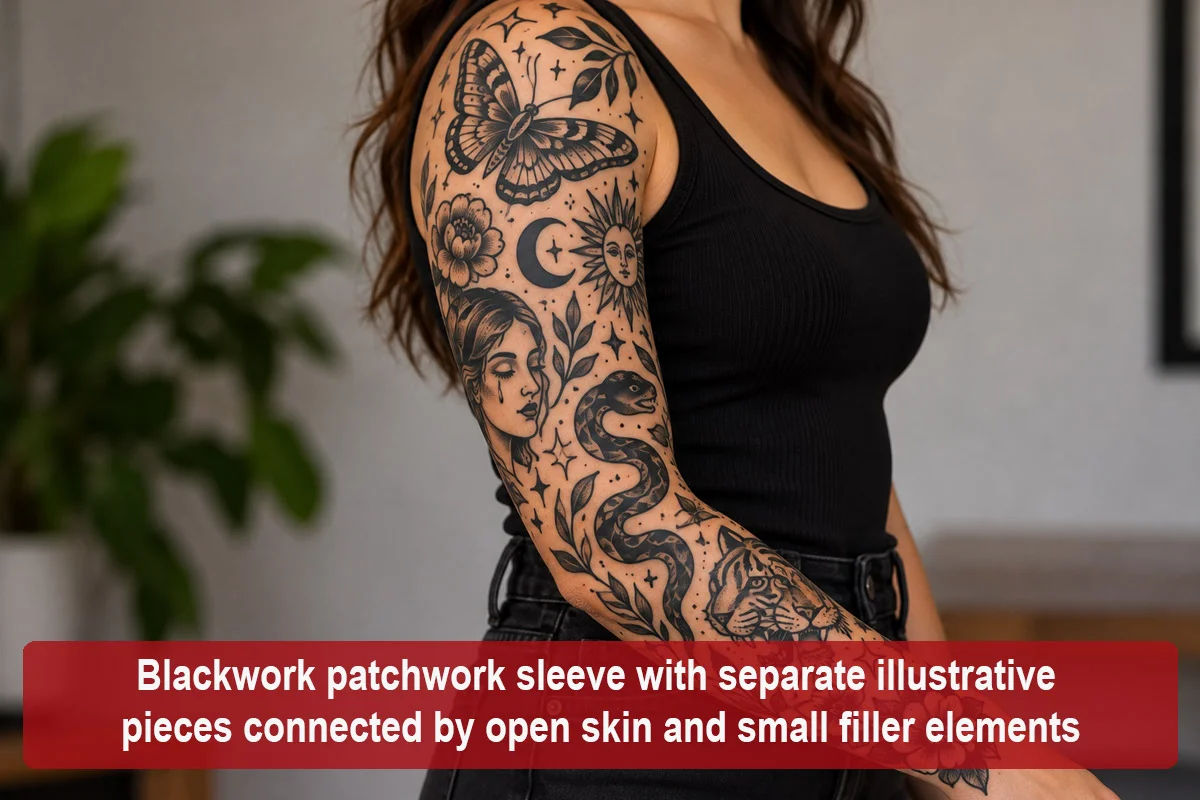
Blackwork patchwork tattoos take a different approach. Individual pieces remain visually separate, often using consistent line weights or similar artistic influences to establish cohesion.
Patchwork sleeves keep each piece visually separate.
Neither approach is inherently better. The choice depends on whether you want one continuous composition or a collection of independent tattoos.
Using Blackwork Filler Without Overcrowding the Design
Blackwork filler tattoos can connect existing pieces through dots, abstract marks, geometric fragments, small botanical elements, or decorative shapes.
However, filling every available gap may reduce the contrast that makes individual tattoos recognizable. Open skin can serve as a useful visual boundary between designs.
When planning a sleeve over several appointments, discuss the intended final coverage with your artist before committing to large pieces. Early decisions about placement and spacing can affect what remains possible later.
Do Blackwork Tattoos Age Well?
Blackwork tattoos can maintain strong visual impact over time, particularly when they use bold silhouettes, adequate spacing, and appropriately sized details.
However, the amount of black pigment alone does not determine how well a tattoo ages. Tattoo application, skin characteristics, placement, sun exposure, and healing all influence its appearance.
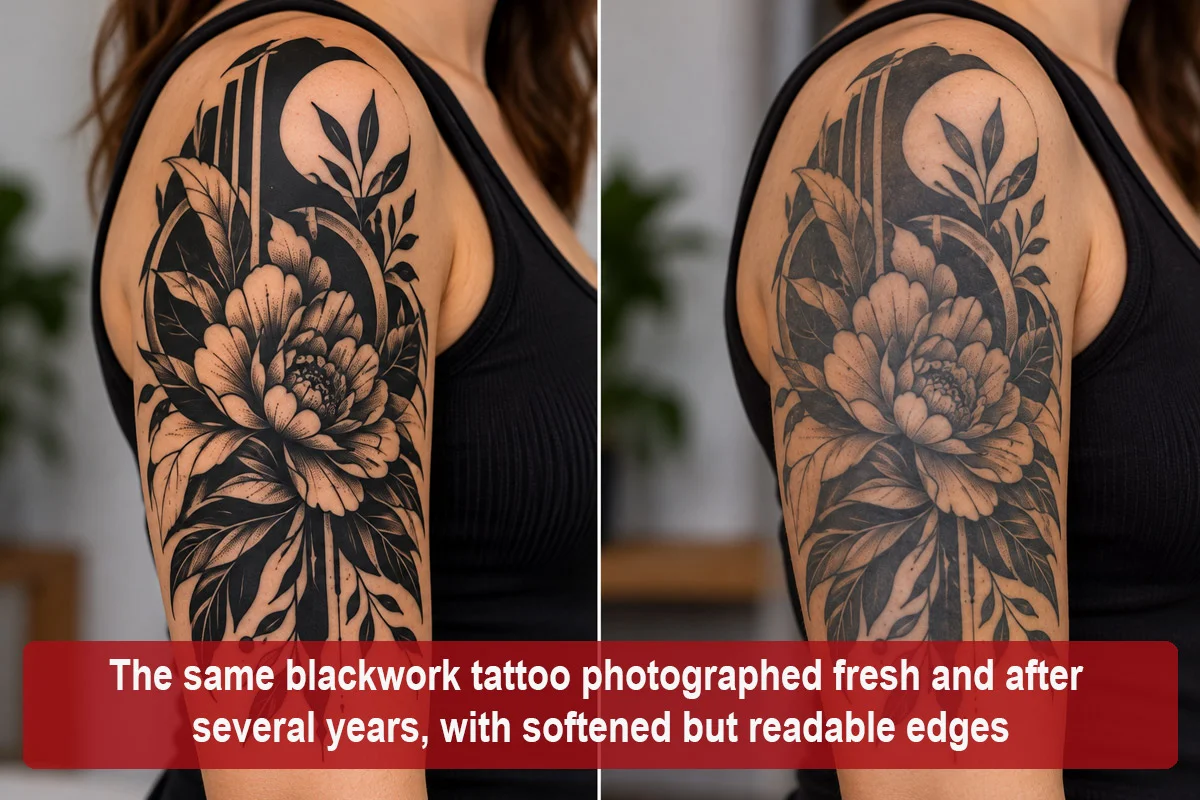
A design may remain dark while losing some of its original detail. For example, narrow spaces between black flower petals may become less visible as tattoo edges soften over time.
Bold shapes stay readable as edges soften over time.
This is why healed tattoo photographs are important when evaluating blackwork artists. They provide more useful evidence of long-term line clarity and saturation than freshly completed tattoos alone.
How to Maintain Blackwork Tattoos
Follow your tattoo artist's aftercare instructions while the tattoo heals. Avoid picking at scabs, unnecessary friction, and exposing healing skin to potentially contaminated water.
After healing, sun protection helps maintain the tattoo's appearance. The American Academy of Dermatology recommends broad-spectrum, water-resistant sunscreen with SPF 30 or higher for tattooed skin exposed to sunlight.
Large areas of solid black may require particular attention during healing. Increasing pain, spreading redness, pus, fever, or other concerning symptoms should be assessed by a healthcare professional.
How to Choose the Right Blackwork Tattoo Artist
Choosing a blackwork tattoo artist requires evaluating experience with the particular technique and placement you want. A specialist in small illustrative designs may not be the right choice for a large blackout project or a complex symmetrical backpiece.
Rather than focusing only on the number of tattoos in an artist's portfolio, examine whether the examples demonstrate the skills your design requires.
Solid blackwork: Look for healed examples showing consistent saturation across large areas.
Geometric blackwork: Examine line alignment, repeated pattern spacing, and symmetry across curved surfaces.
Illustrative blackwork: Evaluate subject readability, line variation, and the balance between black shapes and open skin.
Ornamental blackwork: Look at how decorative elements follow body contours and maintain visual balance.
Finger and hand blackwork: Prioritize healed examples from those specific placements.
Blackwork sleeves: Examine completed compositions rather than judging individual sections in isolation.
Ask whether the artist can show healed work in your preferred style, explain how they plan negative space, and discuss whether your design needs adjustments for its intended placement.
The strongest match is an artist whose completed work demonstrates the exact technical skills needed for your tattoo.
Find Blackwork Tattoo Shops and Artists Near You
When searching for blackwork tattoo shops, begin with the specific approach you want rather than assuming every artist who uses black ink specializes in the same techniques.
For example, someone interested in geometric blackwork should look for precise pattern work and healed symmetrical designs. Someone planning a large illustrative sleeve should prioritize composition, visual flow, and experience with multi-session projects.
Review individual artist portfolios, confirm their current specialties, and ask whether they accept projects of your intended size and complexity.
Explore blackwork tattoo shops and artists across the United States on TattooShopsNearYou.com to compare portfolios, discover specialists, and find studios suited to your design.
Frequently Asked Questions About Blackwork Tattoos
Blackwork emphasizes solid black pigment, graphic shapes, and negative space. Black and grey tattoos use varying tones of black ink to create gradients, smooth shading, and realistic depth. Both can feature detailed artwork, but they use different approaches to contrast and composition.
Bold blackwork designs may retain their overall shapes more clearly than very delicate fine line tattoos, especially when the artwork includes sufficient spacing. However, blackwork can still fade or lose small details. Artist technique, placement, healing, and sun exposure affect long-term results.
Blackwork finger tattoos can work for simple symbols and bold shapes, but fingers are challenging placements because of friction, frequent washing, and variable pigment retention. Detailed patterns may become less distinct over time. Review healed finger tattoo examples before choosing an artist.
Some blackwork designs can cover or incorporate existing tattoos, particularly when larger dark areas are involved. However, successful coverage depends on the original tattoo's darkness, size, location, and skin condition. A consultation can help determine whether a blackwork cover-up, redesign, or laser lightening is appropriate.
Yes. Small blackwork tattoos can feature simple silhouettes, botanical shapes, geometric symbols, and bold lettering. The important consideration is maintaining enough open space for the design to remain readable. Intricate illustrative or ornamental designs may need a larger size.
Look for artists experienced in your preferred blackwork approach, such as illustrative, geometric, ornamental, traditional, or heavy blackwork. Compare healed portfolios, line consistency, negative-space planning, and work on similar body placements. Contact the artist to discuss your specific design before booking.