What Makes Script Tattoos Different From Other Lettering Styles?
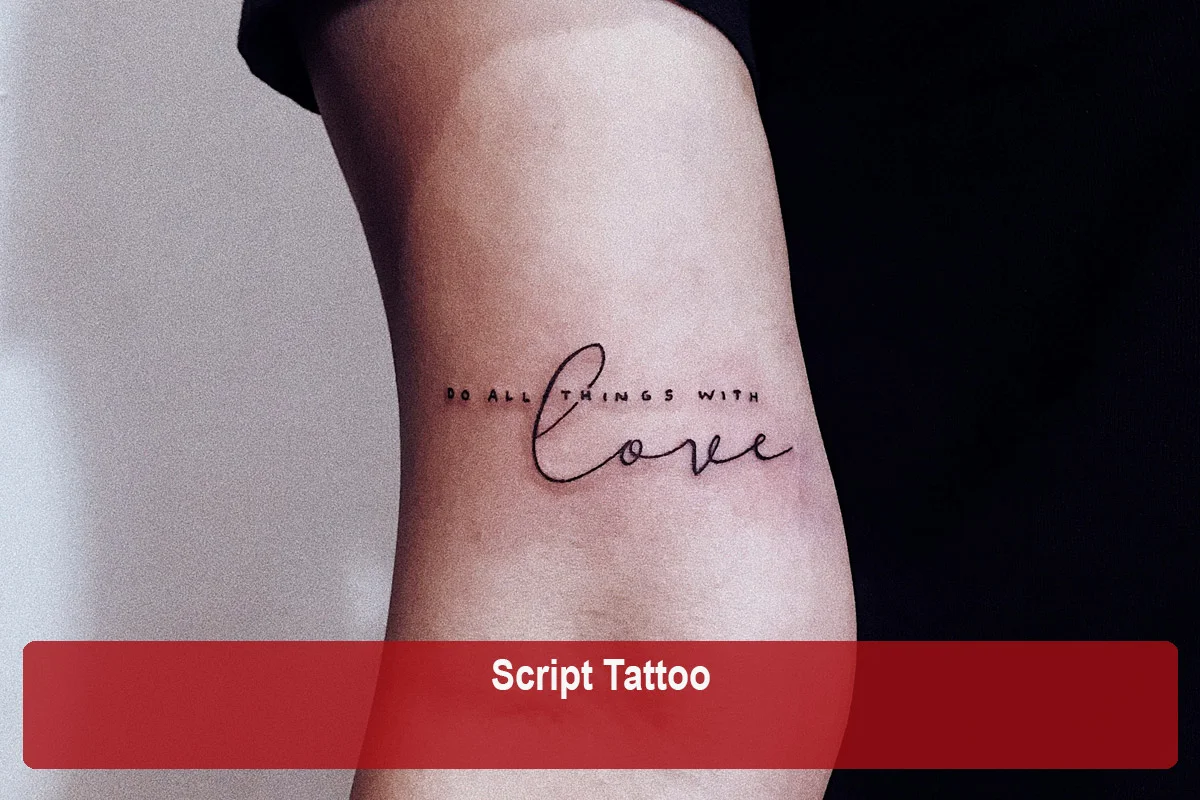
Script tattoos use letterforms inspired by handwriting, cursive writing, and calligraphy. Their defining characteristic is the visual movement created by connected letters, changing stroke thickness, natural slant, and sometimes decorative flourishes.
Unlike block lettering, where individual characters often stand independently, script depends on the relationship between adjacent letters. A small adjustment to one connecting stroke can change the appearance of an entire word.
Script is one category within the broader tradition of Lettering tattoos. Lettering also includes Gothic fonts, block capitals, printed typography, and other styles that do not necessarily resemble handwriting.
The technical challenge of script tattooing is maintaining the appearance of natural handwriting while ensuring that every letter remains distinguishable. A design can be visually elegant yet difficult to read if the artist places too many loops, flourishes, or narrow connecting strokes into a small space.
For this reason, choosing a script tattoo should begin with the exact words and their intended placement rather than selecting a decorative font first.
Why the Shape of a Word Matters More Than the Font Name
Two words written in the same cursive font can produce very different tattoo designs. Their visual balance depends on the combination of letters, the number of ascending and descending strokes, and the spaces created between connected characters.
Consider the difference between a short word such as "Love" and a longer name containing repeated letters, loops, and descending strokes. The shorter word may retain a recognizable silhouette at a relatively small size, while the longer name may require additional space.
In typography, letters extending above the main body of lowercase characters are called ascenders, while those extending below it are descenders. Letters such as "b," "d," and "h" contain ascenders, while "g," "j," and "y" commonly contain descenders.
These features influence how a script tattoo fits along a wrist, collarbone, forearm, or ribcage. Decorative descenders may also interfere with text placed on a second line.
A specialist script artist should evaluate the complete word or phrase as one composition rather than treating each letter as an isolated element.
Different Script Tattoo Styles and When They Work Best
Elegant Cursive Script Tattoos
Traditional cursive script uses flowing connections and a relatively consistent writing rhythm. It is commonly selected for names, short phrases, initials, and meaningful words.
The most successful cursive tattoos balance fluidity with clarity. Letter connections should appear intentional, and decorative loops should not interfere with the recognition of individual characters.
For a short name, cursive may create a compact design. For longer phrases, the artist may need to adjust letter spacing, line breaks, and overall dimensions.
Fine Line Script Tattoos
Fine line script uses delicate strokes to create understated handwriting and cursive designs. These tattoos are often chosen for small words, signatures, and short personal messages.
Thin strokes can create a subtle appearance, but they also leave less visual margin for changes in line definition after healing. Very small connected letters may become harder to distinguish over time.
Artists specializing in Fine Line tattoos may have relevant technical experience, but their portfolios should include actual healed script work rather than only fine line illustrations.
When planning a delicate script tattoo, ask whether increasing the letter height slightly would improve long-term readability without changing the intended appearance.
Chicano Script Tattoos
Chicano script is closely associated with Mexican American artistic traditions, particularly the lettering practices and tattoo culture of Southern California.
It may incorporate dramatic cursive forms, elongated strokes, decorative flourishes, and compositions combining words with roses, portraits, or religious imagery.
Chicano script is more than a decorative font category. Its visual history connects to neighborhood art, lowrider culture, placa lettering, and the broader development of fine-line black and grey tattooing.
For culturally specific lettering, choose an artist familiar with the relevant artistic tradition rather than someone who simply reproduces an online font.
Explore Chicano tattoos to understand the cultural context and related imagery.
Bold Calligraphy Script
Calligraphic script often uses noticeable variations between thick and thin strokes. The resulting design can appear formal, expressive, or dramatic depending on the letterforms.
This approach can work well for larger names, short statements, and compositions where the lettering itself is intended to be the main visual feature.
However, thick decorative strokes require enough separation from nearby thin lines. Excessive contrast between stroke weights can make very small calligraphy difficult to reproduce consistently.
Review completed tattoos rather than relying on digital calligraphy samples. The artist should demonstrate how the design translates from a flat drawing to living skin.
Signature and Natural Handwriting Script
Not every script tattoo needs a polished, decorative appearance. Some of the most personal designs preserve natural handwriting, including signatures, short notes, and messages written by loved ones.
These tattoos may include irregular letter heights, uneven spacing, or distinctive strokes that would normally be corrected in professional typography.
Those imperfections can be part of what makes the handwriting recognizable.
The challenge is deciding how much of the original writing can be preserved without compromising readability at the desired tattoo size.
Handwriting Tattoos: When the Original Writing Is the Design
Handwriting tattoos deserve special consideration because the emotional value often comes from the actual handwriting rather than the words alone.
A short message written by a parent, grandparent, partner, or friend may have recognizable features that a standard script font cannot reproduce.
For example, the unusual shape of a capital letter, an uneven baseline, or a distinctive signature flourish may be essential to preserving the character of the original writing.
How to Prepare a Handwriting Reference
Start with the clearest available version of the original handwriting. A high-resolution scan or well-lit photograph is generally preferable to a compressed screenshot.
If the original message appears on folded, damaged, or stained paper, ask the artist whether it can be cleaned up digitally without changing the character of the writing.
Some clients prefer an exact reproduction, including irregular spacing and imperfect letterforms. Others want limited adjustments to improve readability.
Discuss that decision before the artist prepares the final stencil.
Should You Correct Imperfect Handwriting?
There is no universal answer. Correcting irregular handwriting may make a tattoo easier to read but can remove the personal characteristics that made the original meaningful.
For a memorial tattoo, preserving the authentic shape of the letters may matter more than achieving perfectly uniform spacing.
However, when the original writing contains overlapping strokes or extremely small details, the artist may recommend enlarging the tattoo instead of redrawing the letters.
A good consultation should distinguish between necessary technical adjustments and changes that alter the identity of the handwriting.
Script Tattoo Ideas Based on Personal Meaning
The strongest script tattoo ideas begin with a message worth preserving. The typography should support that message rather than distract from it.
Names and Family Script Tattoos
Names are among the most common subjects for script tattoos. They may honor children, parents, partners, siblings, or other important relationships.
A single name can be designed as a flowing composition, while multiple names may require a more structured arrangement.
For several names, consider whether the lettering should share one baseline, appear on separate lines, or form independent elements within a larger design.
Check every name carefully before approving the stencil, including capitalization, spelling, and any accents.
Short Words With Personal Significance
Words such as "Hope," "Always," "Faith," or "Resilience" can work as compact script designs when their letterforms remain clear.
However, a word does not need to be popular or universally recognizable to make a meaningful tattoo.
A family expression, personal reminder, or word connected to an important experience may provide a more distinctive starting point.
Before choosing a decorative script, view the complete word at its proposed tattoo size and check whether the connecting strokes remain readable.
Quotes and Longer Script Tattoos
Longer phrases introduce additional challenges because connected lettering requires consistent spacing across multiple words and lines.
A phrase that looks balanced on a computer screen may become crowded when wrapped around the forearm or placed along the ribs.
For multi-line script, the artist must account for descending letters, line spacing, and the way the composition follows the body.
Consider whether a shorter excerpt communicates the intended meaning more effectively than a lengthy quotation reduced to very small letters.
Memorial Script Tattoos
Memorial script tattoos may combine names, dates, signatures, or meaningful phrases. Some use original handwriting, while others incorporate carefully selected calligraphy.
If the design includes a date, verify the numbers and formatting independently. If it uses a quotation, confirm the exact wording from the original source.
For a highly personal memorial, ask the artist to provide a complete stencil preview rather than approving individual elements separately.
How Small Can a Script Tattoo Be?
There is no universal minimum size for script tattoos. The smallest practical dimensions depend on the number of letters, the thickness of the strokes, the complexity of the connections, and the chosen placement.
A short word written in simple cursive may remain readable at a smaller size than an elaborate calligraphic phrase containing numerous loops and flourishes.
The important question is whether each character has enough room to remain visually distinct after healing.
Why Tiny Script Can Lose Readability
Tattoo pigment settles within the skin, and the appearance of fine lines can soften over time. In connected script, even modest changes can affect the spaces separating letters.
For example, the letters "m," "n," "u," and "i" may become difficult to distinguish when multiple narrow vertical strokes are crowded together.
Similarly, small openings inside cursive letters such as "a," "e," and "o" may lose definition if the original design provides insufficient space.
This does not mean all small script tattoos age poorly. It means the design should be adapted to the available space rather than reduced without modification.
Should You Use Single Needle Tattooing for Script?
Single needle tattooing is sometimes associated with delicate script because it can produce very fine marks. However, the needle configuration alone does not determine the quality or longevity of a tattoo.
An experienced artist must still control line consistency, placement, depth, and the relationship between individual strokes.
Explore Single Needle tattoos for more information about the technique, but prioritize healed script examples when evaluating artists.
Where Do Script Tattoos Look Best?
Script tattoos often follow a natural line of the body. Placement affects not only appearance but also orientation, available space, and how the lettering changes when the body moves.
| Placement |
Suitable Script Designs |
What to Consider |
| Inner Forearm |
Names, signatures, short quotes |
Orientation and sufficient letter height |
| Wrist |
Short words, initials, simple handwriting |
Limited space and frequent movement |
| Collarbone |
Short phrases and flowing cursive |
Body curvature and text alignment |
| Ribs |
Longer quotes and vertical compositions |
Breathing movement and line arrangement |
| Upper Arm |
Names, bold script, decorative calligraphy |
Curvature and visibility from different angles |
| Chest |
Large calligraphy and meaningful statements |
Symmetry and overall composition |
| Back |
Extended phrases and elaborate script |
Line breaks, scale, and balanced spacing |
Script Tattoos on the Wrist
Wrist script tattoos are popular for short words and signatures because they can be viewed easily by the wearer.
However, the available area is limited. A decorative script containing several long flourishes may need to be simplified or enlarged.
Orientation should also be considered. A word facing the wearer may appear upside down to others when the arm is in a natural resting position.
Ask the artist to demonstrate the proposed stencil in more than one orientation before making a final decision.
Script Tattoos Along the Collarbone
The collarbone can provide a natural visual direction for flowing text. Short phrases may follow the line of the bone, creating a composition that complements the body.
However, the lettering should not be forced into a curve that distorts individual characters.
View the stencil while standing naturally rather than evaluating it only while lying on the tattoo bed.
Script Tattoos on the Ribs and Spine
Rib and spine placements can accommodate longer text or vertically arranged phrases, but they require careful planning.
For rib tattoos, breathing and body movement can influence how the lettering appears. For spine designs, the artist must establish a deliberate alignment rather than assuming the body provides a perfectly straight reference line.
Ask to review the stencil while standing and moving naturally.
Do Script Tattoos Age Well?
Script tattoos can remain readable for many years, particularly when the design uses adequate letter height, clear spacing, and controlled linework.
However, highly decorative cursive designs can be vulnerable to losing fine detail when closely arranged strokes soften over time.
A script tattoo may retain its overall appearance while individual letters become less distinct. This is especially relevant when decorative loops overlap or multiple characters share narrow connecting spaces.
Long-term appearance also depends on skin characteristics, placement, application, healing, and sun exposure.
Why Healed Script Tattoos Are Important Portfolio Evidence
Fresh script tattoos often look crisp in close-up photographs. Healed examples provide a more realistic indication of how the artist's linework settles.
Look for photographs taken several months after tattooing and, when available, older examples showing long-term readability.
Examine whether individual characters remain identifiable, decorative flourishes stay separate, and the overall phrase can be read without magnification.
Be cautious about judging a portfolio exclusively through edited photographs or images taken immediately after the tattoo was completed.
How to Protect a Script Tattoo After Healing
Follow the tattoo artist's aftercare instructions during the initial healing period. Avoid picking at healing skin or exposing the tattoo to unnecessary friction.
After healing, sun protection helps reduce UV-related changes in tattoo appearance. The American Academy of Dermatology recommends broad-spectrum, water-resistant sunscreen with SPF 30 or higher on tattooed skin exposed to sunlight.
For delicate script, maintaining the appearance of individual strokes is particularly important because small changes can affect the readability of the entire word.
If a tattoo develops increasing pain, spreading redness, pus, fever, or other concerning symptoms, seek medical attention.
Choosing a Script Tattoo Artist: Look Beyond Beautiful Fonts
A tattoo artist may produce attractive lettering designs without having extensive experience with connected cursive or calligraphy.
For script tattoos, portfolio evaluation should focus on the construction and execution of the actual letterforms.
- Connection quality: Look for smooth transitions between connected letters without awkward interruptions.
- Consistent slant: Characters should follow a deliberate writing direction unless variation is part of the design.
- Stroke control: Examine whether thin and thick lines appear intentional and consistent.
- Spacing: Words should remain readable without crowded loops or excessive gaps.
- Body placement: Review script tattoos that follow curved surfaces without visibly distorting the letters.
- Healed results: Prioritize examples showing the readability of completed script after healing.
Five Questions to Ask Before Your Appointment
- Can you show healed script tattoos similar in size and style to my design?
- Will you customize the lettering or use an existing font?
- Is my preferred size large enough to preserve the important letter details?
- How will you adjust the lettering to fit my chosen body placement?
- Can I review the exact spelling, punctuation, and stencil orientation before tattooing begins?
For handwriting tattoos, also ask whether the artist can preserve the original character of the writing while making necessary technical adjustments.
Find Script Tattoo Artists Near You
When searching for script tattoo artists in the United States, focus on the type of lettering you want rather than choosing a studio based only on its general tattoo portfolio.
An artist experienced in bold Chicano script may have different strengths from someone specializing in delicate signatures or custom calligraphy.
Explore tattoo shops and artists on TattooShopsNearYou.com to compare portfolios, review available script work, and identify specialists in your area.
Before booking, confirm that the artist accepts your preferred type of project and can discuss lettering size, customization, placement, and long-term readability.
The goal is to create a tattoo that preserves both the meaning of your words and the visual character of the handwriting or script you choose.