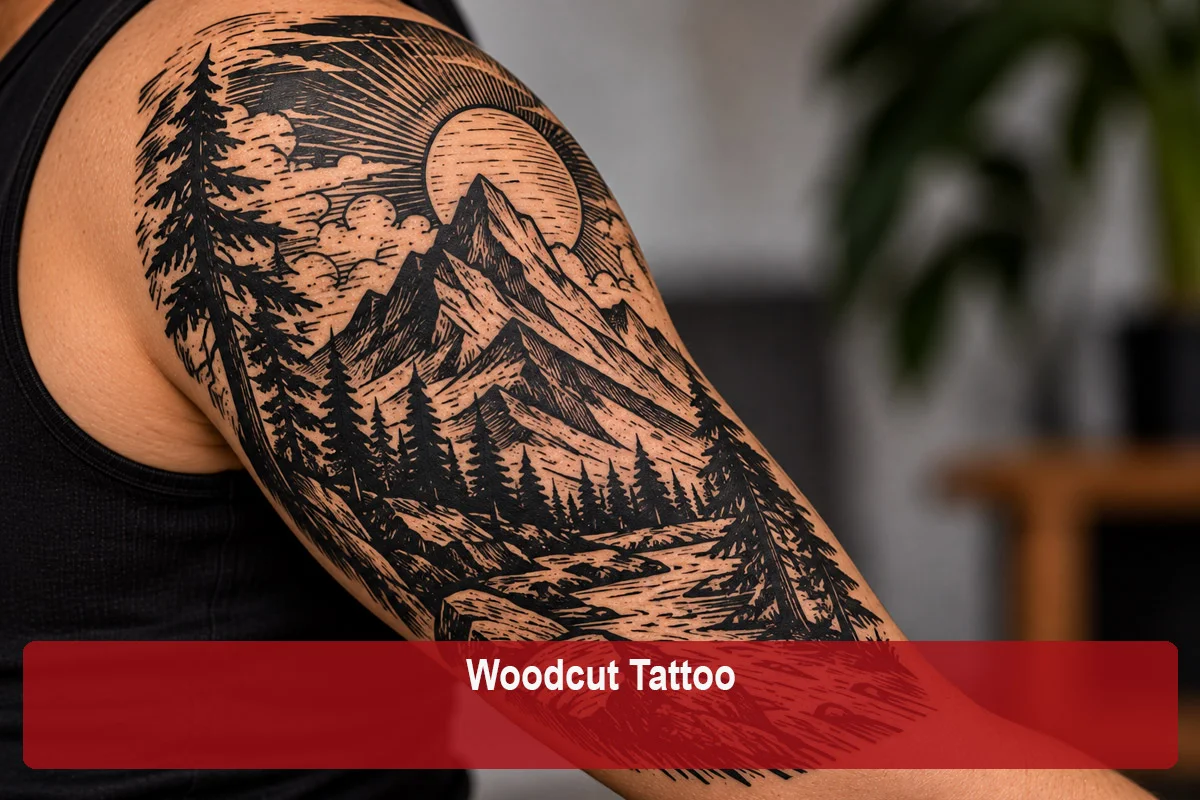
What Is a Woodcut Tattoo?
A woodcut tattoo recreates the appearance of an image printed from a carved wooden block. The style uses bold outlines, solid black areas, directional marks, and carefully preserved negative space to create illustrations with a distinctive handmade character.
In traditional woodcut printmaking, the artist removes sections of wood that should not receive ink. The remaining raised surfaces are inked and pressed against paper. This produces an image built from the relationship between printed shapes and unprinted spaces.
Woodcut tattoo artists adapt this visual principle to skin. Black ink represents printed areas, while untouched skin can function like the blank paper in a relief print.
The result may resemble an illustration from an early printed book, a medieval religious image, a folk-art print, or a bold contemporary woodblock design.
Woodcut is primarily a visual style rather than a requirement to use a particular tattoo machine or needle configuration.
The History Behind Woodcut Tattoo Art
Woodblock printing has a long history in East Asia. In Europe, woodcut images became increasingly important with the expansion of printing on paper during the fifteenth century.
Early European woodcuts often used strong outlines and relatively simple shading. These characteristics reflected both the tools and the physical limitations of carving wooden blocks.
As the technique developed, printmakers created increasingly sophisticated compositions with intricate textures, narrative scenes, and dramatic contrasts.
Albrecht Dürer and Renaissance Woodcuts
German artist Albrecht Dürer helped demonstrate the expressive possibilities of woodcut printing during the late fifteenth and early sixteenth centuries.
His work used complex arrangements of figures, architecture, and directional lines to create dramatic scenes.
For tattoo design, Dürer's work provides useful examples of how lines and negative space can establish form without relying on smooth photographic shading.
However, a detailed historical print may need significant simplification before it becomes suitable for tattooing.
Japanese Woodblock Printing
Japanese woodblock printing developed its own influential traditions, including the multicolor ukiyo-e prints associated with artists such as Katsushika Hokusai and Utagawa Hiroshige.
These works demonstrate how carved blocks can produce expressive outlines, carefully organized shapes, and sophisticated color compositions.
Japanese woodblock printing and European woodcut illustration are related through relief-printing techniques, but they are not interchangeable artistic traditions.
When drawing inspiration from a particular historical culture or artwork, understand the original context rather than treating all woodblock imagery as one generic aesthetic.
For tattoos drawing more directly from Japanese tattoo composition and imagery, explore Japanese tattoos.
What Makes Woodcut Tattoo Linework Different?
The defining feature of woodcut tattoos is the way black and uninked areas construct the image.
Unlike photographic realism, where shadows may be created through smooth gradients, woodcut designs often suggest shading through directional marks, black shapes, and openings that resemble carved cuts.
Bold Outlines and Strong Silhouettes
A recognizable silhouette gives a woodcut tattoo its foundation. Before examining the internal lines, the viewer should usually be able to identify the main subject.
For example, a raven tattoo should retain the recognizable outline of the bird even when its feathers contain intricate carved textures.
Strong silhouettes are particularly important for smaller tattoos because fine interior marks may become less distinct over time.
Carved-Line Textures
Woodcut textures may use irregular strokes, tapered marks, short parallel lines, or areas that resemble gouges cut through a dark surface.
These marks should follow the subject's form. Lines representing feathers may follow the direction of the wing, while marks describing a face should support its underlying anatomy.
Random scratches can imitate a distressed print superficially, but they do not necessarily create convincing dimensional artwork.
Negative Space as a Design Element
Negative space refers to areas of skin intentionally left without ink.
In woodcut tattoos, these openings can define highlights, separate overlapping shapes, and create the appearance of carved marks.
For example, a dark animal silhouette may contain narrow skin breaks that suggest fur, muscle, or reflected light.
The artist must leave enough space for these openings to remain visible as the tattoo heals and ages.
Contrast Instead of Smooth Gradients
Woodcut tattoos often depend on clear differences between black and uninked skin.
This does not mean every design must be entirely black or white. Some contemporary artists incorporate limited grey shading or color.
However, the printmaking aesthetic is usually strongest when the main forms remain understandable through deliberate shapes and line patterns.
Popular Woodcut Tattoo Designs and Ideas
Woodcut tattooing can be applied to historical, natural, symbolic, and contemporary subjects. The technique works especially well when the image has a recognizable silhouette and textures that can be expressed through carved-looking marks.
Medieval Woodcut Tattoos
Medieval-inspired imagery is a common direction for woodcut tattoos. Subjects may include knights, castles, heraldic animals, shields, swords, and figures resembling illustrations from early printed books.
However, not every image described as medieval actually originated in the Middle Ages. Some familiar printmaking aesthetics developed during the Renaissance and later periods.
If historical accuracy matters, identify the source period and reference artwork before finalizing the design.
For a knight tattoo, consider whether the helmet, armor, and weapon details will remain distinguishable at the proposed size.
Woodcut Animal Tattoos
Ravens, wolves, foxes, deer, snakes, bears, and other animals can translate effectively into woodcut designs.
Directional marks can describe fur, feathers, scales, and muscle structure without requiring photographic detail.
A raven may use bold black wings with carved-looking feather highlights, while a wolf may feature short marks that follow the direction of its fur.
For smaller tattoos, choose a clear pose rather than an image containing several overlapping animals.
Woodcut Botanical Tattoos
Flowers, leaves, roots, and branches can resemble historical botanical illustrations when rendered with printmaking-inspired linework.
A woodcut rose might use broad black petal shadows and carefully spaced highlights. A branch or tree could feature irregular carved textures that emphasize bark and natural growth.
These designs work well as individual compositions or as supporting elements around larger subjects.
Pay attention to leaf spacing and internal petal details, particularly when the design contains many narrow lines.
Woodcut Skull and Memento Mori Tattoos
Skulls, hourglasses, candles, and related imagery can draw on the historical tradition of memento mori, a reminder of mortality.
Woodcut treatment can give these subjects the appearance of old printed illustrations.
For example, a skull may use strong black eye sockets and carved highlights across the forehead, while an hourglass may incorporate simplified sand and glass details.
The imagery does not have to carry a religious or philosophical meaning for every wearer. Some people choose it primarily for its visual character.
Folklore and Mythological Creatures
Dragons, griffins, serpents, and creatures drawn from folklore can suit the bold, expressive qualities of woodcut tattoos.
These designs may resemble illustrations from historical bestiaries, myths, or fantasy-inspired prints.
For complex creatures, the main challenge is separating overlapping wings, claws, scales, and surrounding decorative elements.
Choose a composition that remains readable before adding intricate textures.
Religious and Historical Woodcut Imagery
Religious figures, symbolic objects, and narrative scenes have a substantial history in European printmaking.
Some contemporary woodcut tattoos draw on this visual tradition through saints, angels, architectural frames, or other historical motifs.
When reproducing culturally or religiously significant imagery, consider its original meaning and whether the design requires particular details to remain accurate.
A complicated historical scene may need a larger placement to preserve the relationship between figures and symbols.
Modern Woodcut Tattoo Designs
Woodcut tattoos do not need historical subject matter.
A modern building, favorite animal, mountain landscape, or personal object can be reinterpreted using bold relief-printing textures.
This can produce a distinctive design without copying an existing historical print.
For example, a familiar city landmark might be simplified into strong architectural shapes with carved-looking shadows.
The technique provides the visual character, while the subject makes the tattoo personal.
Woodcut vs. Etching, Engraving, and Blackwork Tattoos
These styles overlap visually, but their underlying artistic influences differ.
| Style |
Typical Visual Approach |
Main Distinction |
| Woodcut |
Bold printed shapes, carved-looking marks, strong negative space |
Inspired by relief printing from carved wood |
| Etching |
Fine contours, layered hatching, delicate tonal detail |
Inspired by lines etched into a printing plate |
| Engraving |
Precise incised-line effects and structured shading |
May draw on metal engraving or wood engraving traditions |
| Blackwork |
Solid black areas, silhouettes, graphic patterns |
Broader category not necessarily connected to printmaking |
| Sketch |
Loose drawing marks, construction lines, expressive contours |
Emphasizes the appearance of a drawing in progress |
One important historical distinction is that traditional woodcut and wood engraving are both relief-printing processes, while metal engraving and etching are intaglio processes. In relief printing, raised surfaces receive ink; in intaglio printing, recessed lines hold the ink.
Modern tattoo artists may combine these visual influences, so a tattoo marketed as woodcut can contain engraving-style hatching or other illustrative techniques.
Explore Etching / Engraving tattoos for a closer comparison of fine-line printmaking textures.
For designs emphasizing solid black and graphic contrast, see Blackwork tattoos.
Woodcut Tattoos vs. Sketch Tattoos
Both styles can appear handmade, but they communicate different stages of the artistic process.
A sketch tattoo may preserve construction lines, loose contours, and marks that resemble a drawing before completion.
A woodcut tattoo typically resembles a finished print, where every black shape and carved-looking opening contributes to the final image.
Sketch tattoos can appear spontaneous and unfinished, while woodcut tattoos often have a more deliberate graphic structure.
Explore Sketch tattoos if you prefer expressive pencil-like or drawing-study effects.
Can Woodcut Tattoos Include Color?
Yes. Although black ink is strongly associated with woodcut-style tattoos, relief printing has a long history of using color.
Japanese multicolor woodblock prints are a well-known example of how separate blocks can be used to build complex color images.
Contemporary woodcut tattoos may use limited red, brown, green, or other colors while preserving bold carved-line structures.
A restrained palette can help emphasize selected elements without overwhelming the printmaking aesthetic.
However, a design should not rely entirely on subtle color differences to establish its main shapes. Strong underlying contrast can help maintain readability.
How Small Can a Woodcut Tattoo Be?
Small woodcut tattoos are possible when the design has a simple silhouette and limited internal detail.
A single raven, flower, dagger, or symbolic object may translate more effectively at a compact size than a detailed battle scene or architectural composition.
The minimum practical dimensions depend on the number of lines, thickness of black areas, spacing between carved-looking marks, and placement.
Why Historical Prints Often Need Simplification
A historical woodcut may contain hundreds of small marks that work beautifully on paper.
Transferring every mark into a small tattoo can create crowded areas that lose definition as the tattoo ages.
The artist may need to remove secondary textures, widen narrow openings, or strengthen the main silhouette.
These adjustments should preserve the visual character of the source rather than reproduce every detail literally.
Why Negative Space Matters for Small Designs
Woodcut tattoos frequently contain white-looking cuts surrounded by black ink. On skin, these areas are usually left uninked.
If the openings are too narrow, they may become less distinct over time.
Ask the artist whether important highlights and separations will remain visible at the proposed tattoo size.
Best Placements for Woodcut Tattoos
Woodcut tattoos can work on many body areas, but the placement should support the subject's shape and level of detail.
| Placement |
Suitable Woodcut Designs |
What to Consider |
| Forearm |
Ravens, flowers, daggers, vertical figures |
Width, orientation, and line density |
| Upper Arm |
Animals, circular compositions, framed illustrations |
Curvature and viewing angles |
| Thigh |
Detailed medieval scenes, large animals, historical illustrations |
Space for multiple figures and textures |
| Calf |
Knights, towers, botanical subjects, vertical compositions |
Muscle curvature and subject orientation |
| Chest |
Heraldic imagery, symmetrical symbols, larger prints |
Body contours and overall balance |
| Back |
Large narrative scenes and complex woodcut compositions |
Planning the full design before tattooing |
| Wrist |
Small symbols and simplified single subjects |
Limited room for intricate carved marks |
Woodcut Tattoo Sleeves
A woodcut sleeve may combine several related illustrations or form one continuous narrative composition.
For example, a sleeve could feature a central animal, surrounding botanical elements, and smaller symbols rendered with consistent printmaking textures.
To maintain visual unity, consider using similar line weights, black density, and negative-space patterns across the design.
Leaving separation between major subjects can prevent the sleeve from becoming visually crowded.
Do Woodcut Tattoos Age Well?
Woodcut tattoos can maintain strong visual clarity when they use suitable scale, solid black shapes, and enough separation between internal marks.
However, the style is not automatically resistant to aging simply because it uses bold lines.
Closely arranged carved textures, dense hatching, and very narrow negative-space openings may become less distinct over time.
Long-term appearance also depends on tattoo application, placement, skin characteristics, healing, and sun exposure.
What to Look for in Healed Woodcut Tattoos
Fresh woodcut tattoos often display sharp contrast between black ink and uninked skin.
Healed photographs provide better evidence of how the artist's linework and negative space settle.
Look for examples photographed several months after completion and, where available, older tattoos.
Check whether the main silhouette remains clear, internal marks retain useful separation, and dark areas do not overwhelm the subject.
For detailed designs, examine the tattoo at normal viewing distance rather than relying exclusively on close-up photographs.
How to Choose a Woodcut Tattoo Artist
Woodcut tattooing requires an understanding of graphic composition, line spacing, and the visual principles of relief printing.
An artist who specializes in realistic shading may not necessarily have the same experience with bold carved-line illustrations.
When evaluating portfolios, focus on the quality of the printmaking-inspired artwork rather than simply looking for black tattoos.
1. Examine the Artist's Linework
Look for deliberate line placement, consistent execution, and marks that follow the structure of the subject.
Carved-looking textures should appear intentional rather than random.
2. Evaluate Black and Negative-Space Balance
Strong woodcut designs use black areas and uninked skin together.
Check whether important highlights remain open and whether the main shapes are easy to recognize.
3. Review Original Designs
Historical printmaking can provide inspiration, but original compositions offer greater opportunities for personalization.
Look for artists who can adapt the woodcut aesthetic to new subjects rather than only reproducing existing prints.
4. Look for Healed Examples
Ask for healed tattoos containing similar line density and blackwork.
A healed woodcut animal or medieval illustration provides more relevant evidence than an unrelated fresh tattoo.
5. Match the Artist to Your Subject
Some artists specialize in medieval imagery and folklore, while others focus on botanical illustrations, animals, or contemporary graphic designs.
Choose someone whose portfolio demonstrates both the woodcut aesthetic and the type of subject you want.
What to Discuss During a Woodcut Tattoo Consultation
Bring references that demonstrate the type of printmaking aesthetic you prefer.
Explain whether you want bold, simplified woodcut marks or a more intricate illustration with detailed internal textures.
If your reference comes from a historical print, ask whether the design needs simplification or modification to suit the intended size.
Discuss how the artist will maintain negative space, whether limited color is appropriate, and how the composition will follow the chosen body placement.
For a large sleeve or narrative piece, ask how the artist plans to maintain consistent linework and visual balance across the entire project.
Woodcut Tattoo Aftercare and Long-Term Protection
Follow the tattoo artist's aftercare instructions during healing. Avoid picking at the skin and protect the tattoo from unnecessary friction or contamination.
After healing, protect exposed tattooed skin from excessive ultraviolet exposure. Broad-spectrum, water-resistant sunscreen with SPF 30 or higher is recommended by the American Academy of Dermatology.
Sun protection can help preserve the appearance of dark ink and fine printmaking-inspired details.
If you experience spreading redness, increasing pain, pus, fever, or another concerning skin reaction, seek medical attention.
Find Woodcut Tattoo Artists Near You
Woodcut tattoo artists can be found throughout the United States, although individual artists may specialize in different interpretations of printmaking-inspired artwork.
Some focus on medieval and folklore imagery, while others create botanical illustrations, animals, contemporary woodblock designs, or elaborate blackwork compositions.
Use TattooShopsNearYou.com to explore tattoo shops and artists by location and style. Compare woodcut portfolios, examine healed examples, and identify artists experienced in bold relief-printing textures and negative-space design.
Before booking, discuss your preferred subject, reference imagery, tattoo size, placement, and the artist's approach to adapting printmaking details for skin.
The right woodcut tattoo artist should demonstrate the ability to translate the graphic strength of a carved print into a clear, original, and carefully executed tattoo.