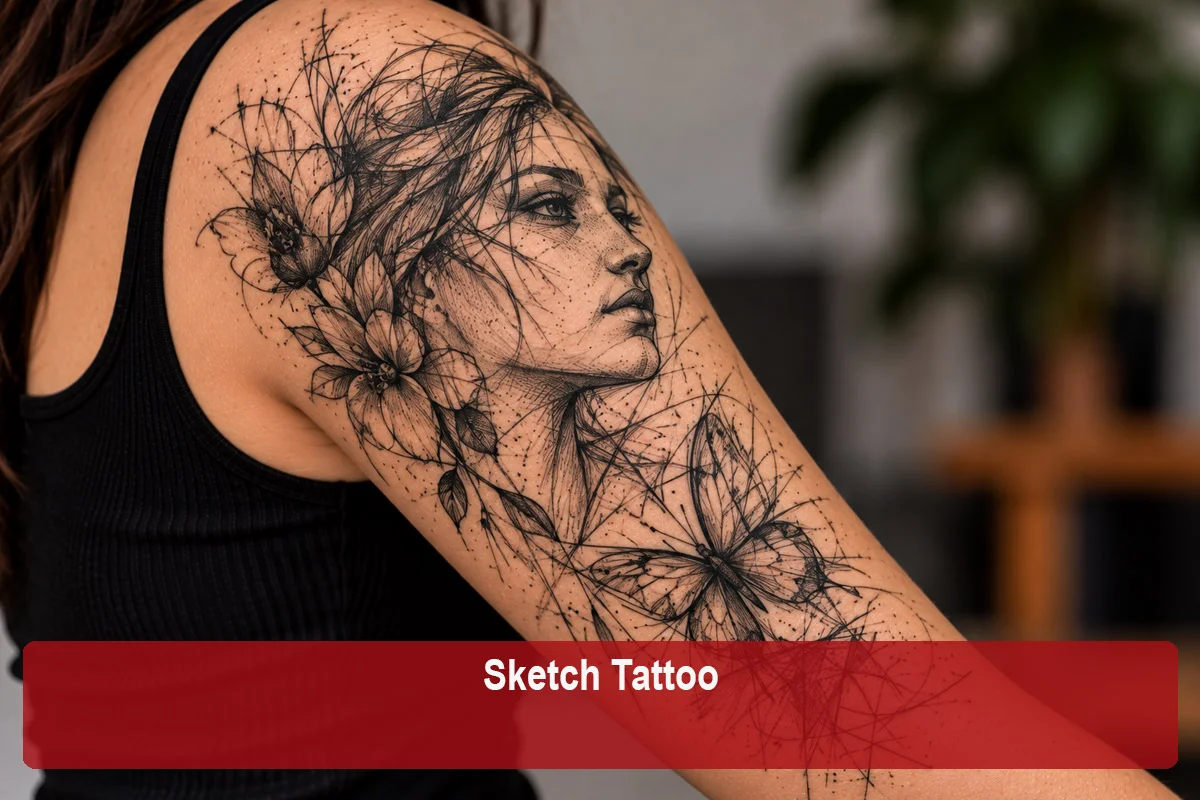
What Is a Sketch Tattoo?
A sketch tattoo recreates the appearance of a drawing in progress. Instead of using only polished outlines and smooth shading, the artist may deliberately include rough contours, overlapping marks, cross-hatching, construction lines, and areas that appear unfinished.
The result can resemble a pencil study, an ink drawing, a charcoal sketch, or an illustration taken directly from an artist's notebook.
However, a sketch tattoo should not be confused with an unfinished tattoo. Its loose appearance is intentional. The artist still needs to control line placement, visual hierarchy, contrast, and composition.
A successful sketch tattoo often combines expressive marks with a clearly recognizable subject. For example, a wolf portrait may have accurately constructed eyes and facial proportions while its fur and outer contours dissolve into loose drawing strokes.
Sketch tattooing overlaps with Illustrative tattoos, but sketch work places particular emphasis on the marks associated with drawing and visual experimentation.
Why Sketch Tattoos Look Unfinished on Purpose
In traditional drawing, artists often begin with loose construction lines before developing the final image. These preliminary marks help establish proportion, perspective, and movement.
Most finished illustrations remove or conceal these marks. Sketch tattoos may preserve them as part of the design.
This can create a sense of movement and reveal how the subject was constructed. A figure may contain visible circles indicating joints, a portrait may include overlapping facial guidelines, or an animal may be surrounded by expressive strokes suggesting motion.
The important distinction is whether the marks contribute to the composition.
Random lines do not automatically make a tattoo more artistic. Each stroke should help establish form, direction, texture, or visual emphasis.
Intentional Sketch Lines vs. Poor Tattoo Linework
Sketch tattoos sometimes use broken, irregular, or overlapping lines. These characteristics can be mistaken for technical mistakes, especially when viewed without understanding the style.
The difference lies in control and consistency.
An intentional sketch line follows a deliberate direction and supports the subject. Poorly executed linework may show unintended gaps, inconsistent pigment application, or distorted proportions.
When reviewing portfolios, look for evidence that the artist can produce both controlled lines and expressive sketch effects.
The style should appear spontaneous without looking accidental.
Popular Sketch Tattoo Techniques
Sketch tattoos can use several drawing-inspired techniques. Understanding their differences helps you choose an artist whose work matches the appearance you want.
Pencil Sketch Tattoos
Pencil-style tattoos imitate graphite drawing through fine lines, layered shading, and changes in tonal intensity.
Some designs use soft grey transitions to resemble pencil shading, while others feature darker outlines with visible construction marks.
This approach is often used for portraits, animals, botanical subjects, and architectural studies.
The main challenge is reproducing the softness of graphite without relying on shading so subtle that the design loses definition after healing.
Cross-Hatching Tattoos
Cross-hatching creates shadows and texture through intersecting lines. In drawing, the density and direction of these lines help establish depth.
For tattoos, cross-hatching requires careful spacing. Lines that appear distinct on paper may become visually crowded when transferred at a small scale.
An experienced artist should adjust the number, thickness, and separation of the marks to suit the tattoo's actual dimensions.
For a related approach using traditional printmaking aesthetics, explore Etching and Engraving tattoos.
Loose Linework and Gesture Sketch Tattoos
Gesture drawing focuses on the movement and overall action of a subject rather than carefully rendering every detail.
Gesture-inspired sketch tattoos may use sweeping contours, repeated strokes, and deliberately incomplete shapes.
These techniques work especially well for dancers, animals in motion, human figures, and flowing botanical compositions.
The subject should remain recognizable even when some contours are incomplete.
Charcoal-Inspired Sketch Tattoos
Charcoal drawings often combine dark marks, soft tonal transitions, and expressive textures.
In tattooing, artists can suggest this appearance through black and grey shading, controlled dotwork, and irregular mark-making.
However, actual charcoal smudges cannot be reproduced literally in skin. The artist must translate the visual effect into tattoo techniques that retain sufficient contrast.
For larger charcoal-inspired compositions, compare artists experienced in Black & Grey tattoos.
Mixed-Media Sketch Tattoos
Some sketch tattoos combine drawing-style black lines with watercolor effects, abstract shapes, or selective color accents.
For example, a bird may be outlined with loose black strokes while a limited area of blue or red creates visual emphasis.
The color should support the main composition rather than obscure the sketch structure.
Explore Watercolor tattoos if you prefer expressive color effects alongside drawing-inspired linework.
Sketch Tattoo Ideas: Choosing the Right Subject
Not every image benefits equally from a sketch treatment. The style works particularly well when the subject has recognizable contours, expressive movement, or interesting textures.
Sketch Portrait Tattoos
Sketch portraits can resemble pencil studies of people, combining accurate facial structure with loose construction lines and unfinished edges.
The most important consideration is likeness. If the tattoo represents a specific person, the sketch effect should not interfere with recognizable facial features.
For example, the artist might use controlled shading around the eyes and mouth while leaving the hair and surrounding contours more expressive.
When choosing an artist, examine both drawing quality and actual healed portrait tattoos.
See Portrait tattoos for more guidance on reference selection and facial accuracy.
Animal Sketch Tattoos
Animals are well suited to sketch tattoos because fur, feathers, and natural movement can be represented through directional strokes.
Popular subjects include wolves, lions, horses, birds, dogs, and cats.
A sketch of a running horse, for example, may use repeated contour lines to suggest movement, while a bird may feature loose feather marks extending beyond its main silhouette.
For a pet portrait, recognizable features should remain the priority. Decorative sketch marks should not change the animal's distinctive expression or proportions.
Botanical and Flower Sketch Tattoos
Flowers, leaves, and branches can be represented using loose contours, visible drawing lines, and selective shading.
Instead of filling every petal with detail, the artist may emphasize the flower's overall structure and allow some edges to remain open.
This approach can create the appearance of a botanical study from an artist's sketchbook.
For small botanical tattoos, avoid excessive overlapping lines inside narrow petals or leaves.
Human Figure and Anatomy Sketch Tattoos
Figure drawing is closely associated with sketching because artists use gesture lines and construction shapes to study posture, movement, and proportion.
A figure-inspired tattoo might show a dancer, an athlete, or a human silhouette surrounded by preliminary drawing marks.
These designs can communicate movement without requiring fully rendered realistic shading.
The artist should still understand anatomy. Deliberately loose lines cannot compensate for an unintentionally distorted body.
Architecture and Travel Sketch Tattoos
Buildings, city streets, bridges, and landmarks can be adapted into sketch-style tattoos inspired by travel journals and architectural drawings.
Perspective lines, partial outlines, and selective shading can give the design the appearance of an on-location sketch.
For meaningful landmarks, prioritize recognizable architectural features rather than attempting to include every window, brick, or background object.
A simplified composition may remain more legible than an extremely detailed miniature building.
Abstract Sketch Tattoos
Sketch techniques can also be used without a recognizable subject.
Overlapping marks, gestural lines, geometric construction shapes, and expressive textures may form an abstract composition.
These designs can emphasize movement, tension, balance, or visual rhythm.
Explore Abstract tattoos for artwork where the relationship between shapes and marks is more important than representing a specific object.
Sketch Tattoos vs. Illustrative, Fine Line, and Etching Tattoos
Sketch tattooing overlaps with several other styles. The main distinction is how the artist uses linework and texture.
| Style |
Visual Characteristics |
Key Difference |
| Sketch |
Loose contours, construction lines, cross-hatching, drawing effects |
Emphasizes the appearance of an expressive or unfinished drawing |
| Illustrative |
Stylized outlines, drawing-inspired textures, varied shading |
Broader category that includes both polished and loose illustrations |
| Fine Line |
Delicate strokes and restrained visual weight |
Describes line thickness and execution rather than a sketch aesthetic |
| Etching / Engraving |
Structured hatching, printmaking textures, deliberate line patterns |
Typically resembles a finished printed illustration |
| Abstract |
Nonrepresentational shapes, gestures, marks, and textures |
Does not require a recognizable subject or drawing-study appearance |
A sketch tattoo can incorporate fine lines, but not every fine line tattoo is a sketch tattoo.
Similarly, an etching tattoo may use cross-hatching while appearing more structured and finished than an expressive sketch.
Black and Grey vs. Color Sketch Tattoos
Black and Grey Sketch Tattoos
Black and grey is a natural fit for sketch tattooing because it can resemble graphite, charcoal, or black ink drawing.
Artists may combine darker structural lines with lighter secondary marks to create depth.
The challenge is establishing enough contrast to keep the subject readable while preserving the appearance of loose drawing.
If every line is equally dark, the tattoo may appear cluttered. If the secondary lines are excessively light, some sketch effects may become less visible after healing.
Color Sketch Tattoos
Color sketch tattoos can incorporate small accents or larger expressive areas of pigment.
A portrait may feature black drawing lines with a limited red accent. A flower may combine loose outlines with soft color fills.
Color can establish focal points, but it should not overwhelm the linework that defines the sketch aesthetic.
When reviewing artist portfolios, look for examples where the drawing remains visually coherent without depending entirely on bright color.
How Small Can a Sketch Tattoo Be?
Sketch tattoos can work at relatively small sizes when the design uses a simple subject and a limited number of expressive marks.
However, highly detailed pencil effects, overlapping construction lines, and dense cross-hatching require more space.
The smallest practical size depends on the complexity of the subject, line thickness, placement, and the artist's technique.
Why Too Many Sketch Lines Can Become a Problem
Tattoo lines can soften and appear wider as the tattoo ages. When numerous fine marks are placed close together, their separation may become less distinct.
This is especially relevant for cross-hatching, facial details, and areas where several construction lines overlap.
For example, a miniature lion sketch with dozens of closely arranged fur marks may gradually lose some of its texture.
A larger design or simplified line structure can help maintain the subject's readability.
Should You Remove Some Construction Lines?
Sometimes. A digital drawing may contain many marks that look attractive when enlarged but become unnecessary at tattoo size.
An experienced artist should identify which lines establish movement and which merely add visual noise.
Removing a few secondary strokes does not necessarily weaken the sketch aesthetic. It may make the remaining lines more expressive.
Best Placements for Sketch Tattoos
Placement should complement the subject's proportions, the direction of its lines, and the amount of detail required.
| Placement |
Suitable Sketch Designs |
What to Consider |
| Forearm |
Animal sketches, portraits, botanical drawings |
Orientation and available width |
| Upper Arm |
Medium-sized portraits, figures, abstract sketches |
Curvature and viewing angles |
| Thigh |
Detailed portraits, architecture, large drawing compositions |
Scale and space for complex linework |
| Calf |
Vertical figures, animals, architectural sketches |
Movement and leg curvature |
| Shoulder |
Expressive botanical designs and abstract forms |
How the drawing wraps around the shoulder |
| Back |
Large figure studies, detailed artistic compositions |
Overall visual balance and focal points |
| Wrist |
Small symbols and simplified sketch designs |
Limited space for overlapping strokes |
Sketch Tattoos on the Forearm
The forearm can accommodate vertical designs such as animals, human figures, and botanical studies.
However, the tattoo should be evaluated from several angles because the arm's rotation can change the appearance of the composition.
For a portrait or architectural drawing, avoid positioning important features where they wrap too far around the side of the arm.
Sketch Tattoo Sleeves
A sketch sleeve can combine several drawing-inspired subjects into a larger composition.
However, filling every available area with loose strokes may make the sleeve visually crowded.
Consider using a consistent line weight, recurring textures, or a shared drawing technique to connect individual pieces.
Negative space can help preserve separation between subjects and prevent the sleeve from becoming an indistinct collection of marks.
Do Sketch Tattoos Age Well?
Sketch tattoos can retain their artistic character for many years, but their long-term appearance depends on how the design uses fine lines, contrast, spacing, and shading.
The style's intentionally loose appearance does not eliminate the need for technical precision.
Dense cross-hatching may become less distinct over time, while very faint secondary marks may lose some visibility.
Clear primary contours can help preserve the subject's identity even if some delicate sketch textures soften.
What to Look for in Healed Sketch Tattoos
Fresh photographs often emphasize the sharpness of fine drawing marks. Healed examples provide more useful information about line consistency and the readability of overlapping strokes.
Look for examples photographed several months after completion and, when possible, older healed work.
Pay attention to whether the main subject remains recognizable, whether fine lines retain useful separation, and whether the sketch effect still appears intentional.
Ask the artist about the approximate size of the tattoo so you can evaluate the level of detail realistically.
How to Choose a Sketch Tattoo Artist
Sketch tattooing requires a combination of drawing ability and tattoo application skills.
An artist may produce beautiful pencil illustrations but have limited experience translating those effects onto skin. Conversely, someone may be technically proficient at tattooing without demonstrating strong gesture drawing or composition.
Look for portfolios that show both.
1. Examine the Artist's Drawing Style
Review whether the artist uses expressive lines with a clear purpose.
The best sketch tattoos generally maintain recognizable forms despite their unfinished appearance.
2. Look for Consistent Line Control
Intentional roughness should not be confused with accidental inconsistencies.
Examine whether the artist can create clean primary contours and controlled secondary marks.
3. Review Healed Tattoos
Ask for healed examples containing similar line density and detail.
A healed animal sketch provides more relevant evidence for a planned animal tattoo than a freshly completed unrelated design.
4. Evaluate Composition at Normal Viewing Distance
Sketch tattoos often contain fine details that look impressive in close-up photographs.
However, the main subject should remain understandable when viewed from a normal distance.
Ask to see full-placement photographs rather than only tightly cropped images.
5. Check Experience With Your Preferred Subject
An artist who specializes in expressive botanical sketches may not have equivalent experience with human faces or complex architecture.
Choose someone whose portfolio demonstrates both the sketch aesthetic and the subject matter you want.
What to Discuss During a Sketch Tattoo Consultation
Bring examples showing the type of drawing effect you prefer. A pencil portrait, architectural sketch, and loose charcoal-inspired design may require different techniques.
Explain which parts of the reference you want to preserve: construction lines, cross-hatching, loose contours, or expressive shading.
Ask the artist whether the design should be simplified for the proposed size.
If the tattoo represents a specific person, pet, or landmark, discuss how the artist will maintain recognizable features while incorporating the sketch effect.
Review the stencil carefully. The final tattoo should look intentionally drawn rather than accidentally incomplete.
Sketch Tattoo Aftercare and Long-Term Protection
Follow the tattoo artist's aftercare instructions during the initial healing period. Avoid picking at healing skin and protect the tattoo from unnecessary friction or contamination.
Once healed, protect exposed tattooed skin from excessive ultraviolet exposure. The American Academy of Dermatology recommends broad-spectrum, water-resistant sunscreen with SPF 30 or higher.
Sun protection is particularly relevant for sketch tattoos that depend on delicate linework and subtle shading.
If you experience spreading redness, increasing pain, pus, fever, or another concerning skin reaction, seek medical attention.
Find Sketch Tattoo Artists Near You
Sketch tattoo artists can be found throughout the United States, but their artistic approaches vary considerably.
Some specialize in realistic pencil-style portraits, while others create expressive animals, botanical studies, abstract compositions, or mixed-media artwork.
Use TattooShopsNearYou.com to explore tattoo shops and artists by location and style. Compare available sketch tattoo portfolios, examine healed examples, and identify artists whose drawing techniques match your preferred design.
Before booking, discuss your subject, reference images, desired size, placement, and how the artist plans to preserve the sketch aesthetic over time.
The right sketch tattoo artist should demonstrate that expressive drawing and precise tattoo execution can work together in one coherent design.