
 Tattoo Ideas & Designs
How Do Tattoo Artists Connect Existing Tattoos Into a Sleeve...
Published On 07-10-2026
Published by the Tattoo Shops Near You Editorial Team
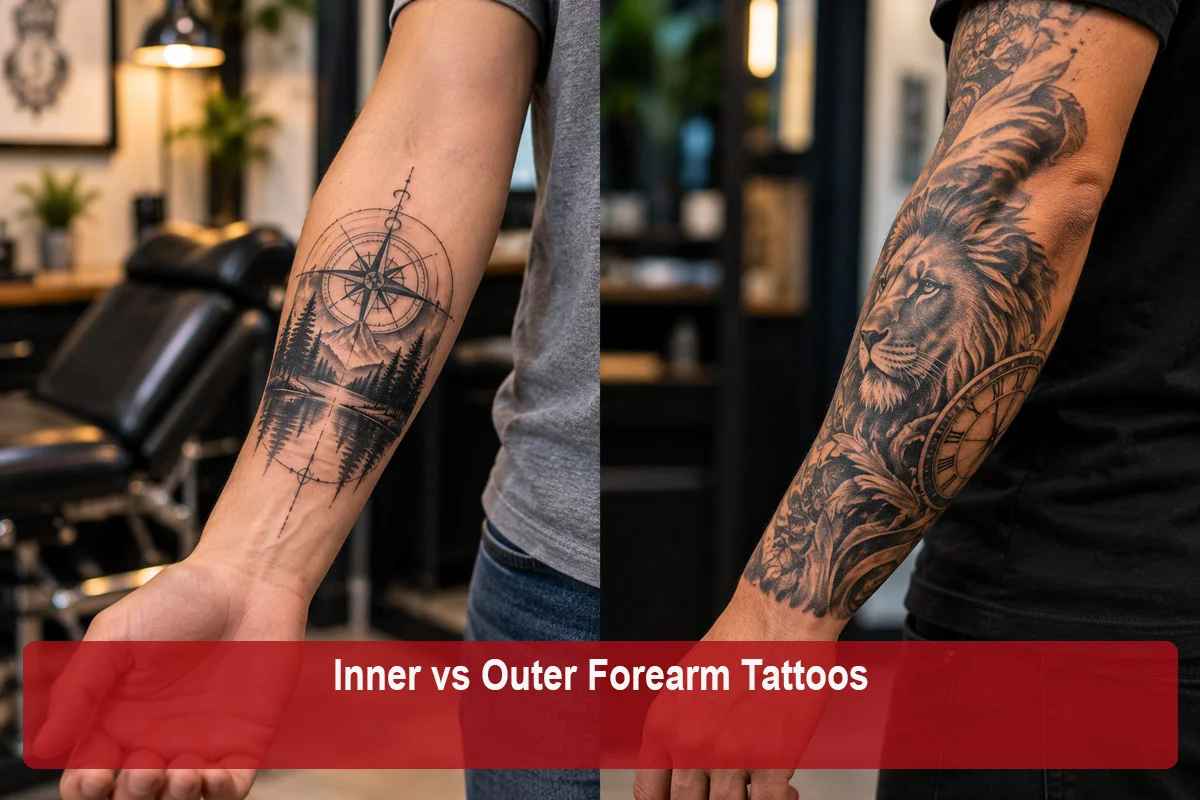
Once you have decided on a forearm tattoo, a smaller but surprisingly important choice follows: inner or outer? Both sides sit on the same part of the arm, but they differ in visibility, surface, comfort, aging, and the kind of designs they suit. Many people find that the side they choose changes how they feel about the tattoo every day.
This article compares the inner and outer forearm directly, so you can weigh the differences and choose the side that fits your design and your life.
The inner forearm is the side that faces up when your palm is turned upward. It runs from the inner wrist to the inner elbow crease. The outer forearm is the side that faces up when your palm is turned downward, running from the back of the wrist to the elbow.
In everyday life, your outer forearm is what others see when your arms hang at your sides or rest on a table. Your inner forearm is what you see when you look at your own arm, hold a phone, or read a book.
This is often the deciding factor.
The outer forearm is outward facing. Others see it easily in conversation, when you gesture, or when you are seated. It is a natural choice for designs meant to be seen and shared.
The inner forearm is more personal. It faces you and is partly hidden when your arms are relaxed. Many people choose it for meaningful lettering, memorial pieces, or designs they want to enjoy privately while still having the option to show them.
Ask yourself whether you mostly want to see the tattoo yourself or want others to see it. That one question resolves the choice for many people.
Both sides can be covered with long sleeves, but the inner forearm is usually easier to keep discreet. Even in short sleeves, an inner forearm tattoo can be mostly hidden by how you hold your arms. Outer forearm tattoos are more consistently visible whenever your forearms are uncovered.
If you work in an environment where you occasionally need to minimize visible tattoos, this difference may matter.
The inner forearm is commonly described as smoother and softer, with thinner skin and fewer hairs for many people. Its relatively flat surface makes it popular for fine line work and lettering, since the design sits evenly.
The outer forearm is generally firmer and often hairier. Artists shave the area before tattooing, so hair is not a barrier. The surface is slightly more rounded and has a bit more muscle beneath it, which suits bold designs and larger images.
Both sides are considered good surfaces for tattooing. The differences mostly shape which styles feel most natural on each side.
Pain is personal and varies widely, but common reports suggest a general pattern. The outer forearm is frequently described as one of the more comfortable placements on the body, thanks to firmer skin and muscle. The inner forearm is often reported as somewhat more sensitive, particularly near the wrist and the inner elbow crease, where skin is thinner.
That said, many people get inner forearm tattoos without significant discomfort. If comfort is a major concern, the outer forearm may be the gentler starting point. Our article on whether forearm tattoos hurt covers this in more depth.
The outer forearm typically receives more sun, since it faces upward when you drive, walk, or rest your arms. Over time, sun exposure is widely cited as a key factor in fading. Fine lines and soft shading on the outer forearm may show this first.
The inner forearm is more sheltered, which many people believe helps delicate work stay crisp longer. This is one reason fine line artists often favor the inner forearm.
On either side, protecting healed tattoos from sun, following the guidance your artist provides, helps preserve clarity.
| Factor | Inner Forearm | Outer Forearm |
|---|---|---|
| Visibility | More personal; faces you | Outward facing; easily seen by others |
| Ease of covering | Easier to keep discreet | Visible whenever forearms are uncovered |
| Skin surface | Smoother, softer, flatter | Firmer, often hairier, slightly rounder |
| Commonly reported comfort | Often described as more sensitive near wrist and elbow | Often described as one of the more comfortable areas |
| Sun exposure | More sheltered | More exposed |
| Popular styles | Fine line, lettering, delicate botanicals | Traditional, realism, bold blackwork |
| Sleeve role | Often fills in around outer pieces | Often holds the main focal piece |
The inner forearm's smooth, flat surface and personal orientation make it a favorite for:
Lettering here often faces the wearer, so it reads correctly when you look down at your arm.
The outer forearm's visibility and firm surface make it ideal for:
Because others see it most, many people orient outer forearm designs so they look upright when the arm hangs naturally.
Lettering raises a specific question: who should be able to read it? On the inner forearm, text oriented toward you reads easily when you look down. On the outer forearm, text is usually oriented for others to read.
The inner forearm's flat surface also helps longer phrases sit evenly, while text wrapping around the more rounded outer forearm can be harder to read in one glance. Running text lengthwise along either side generally helps.
If you are planning a lower sleeve, you will eventually use both sides. A common approach is placing the main focal piece on the outer forearm, where it is most visible, and using the inner forearm for secondary elements, complementary imagery, or background that ties everything together.
If you get one side tattooed first, think about how the other side might be filled later. Mention your plans to your artist so the first piece leaves room for what comes next.
Some people put related designs on the inner and outer forearm of the same arm, or on both arms. Matching pieces can create symmetry, while contrasting pieces can tell two sides of a story, such as a private meaning on the inner arm and a public statement on the outer arm.
Whatever you choose, it helps to view the arm as a whole so each piece feels intentional.
If you are still unsure, run through these questions:
Your artist can also place the stencil on each side so you can see the design in both positions before deciding.
The side you choose affects how you sit during the appointment. For inner forearm work, you will usually rest your arm palm up on an armrest or padded surface. For outer forearm work, your arm typically rests palm down. Both positions are generally comfortable for most people, but long sessions in one position can become tiring.
If you have any wrist or shoulder discomfort that makes one position harder to hold, mention it to your artist beforehand. They can adjust the setup or plan breaks to help.
Both sides heal similarly in most respects, but daily habits affect them differently. The inner forearm tends to brush against desks, keyboards, and your own body when you rest your arms. The outer forearm is more likely to bump into objects and catch on sleeves or bags.
Being aware of these contact points helps you protect the tattoo during early healing. Loose sleeves and a little extra care when resting your arms on surfaces go a long way. Always follow your artist's aftercare instructions for the healing process itself.
For many people, the outer forearm offers a slightly larger visible canvas because it includes more of the rounded muscle along the top of the arm. The inner forearm can feel narrower, especially near the wrist. This can influence how large a design you can comfortably fit without it wrapping out of view.
If you have a specific design in mind, ask your artist to place a stencil on each side. Seeing how much of the design stays visible from a natural viewing angle can quickly show which side suits it better.
The side you choose can influence which artist is the best fit. If you are leaning toward delicate lettering or fine line work on the inner forearm, look for an artist with healed fine line and script examples. If you want a bold outer forearm statement piece, look for artists who specialize in traditional, realism, or the style you have in mind, with healed examples on similar placements.
Many artists post forearm work frequently, since it photographs well, so you should have plenty of examples to compare. Focus on healed photos to see how each artist's work holds up on the side you are considering.
The inner and outer forearm offer different experiences. The inner forearm is personal, smoother, more sheltered, and well suited to lettering and fine line work. The outer forearm is visible, firmer, often more comfortable, and ideal for bold statement pieces.
Neither side is better overall. The right choice depends on who the tattoo is for, the style of the design, and how it fits into your life and your long-term plans. Try the stencil on both sides, trust what feels right, and enjoy a placement that suits you.
This article was reviewed by the Tattoo Shops Near You Editorial Team for accuracy, clarity, and relevance. We use reliable industry resources, official business information, and other authoritative sources where applicable to help readers make informed decisions about tattoo shops, artists, styles, and services.
Last reviewed: October 2026
Tattoo Ideas & Designs
 Tattoo Ideas & Designs
 Tattoo Ideas & Designs
 Tattoo Ideas & Designs