
 Getting a Tattoo
How to Plan a Tattoo Sleeve
Published On 07-10-2026
Published by the Tattoo Shops Near You Editorial Team
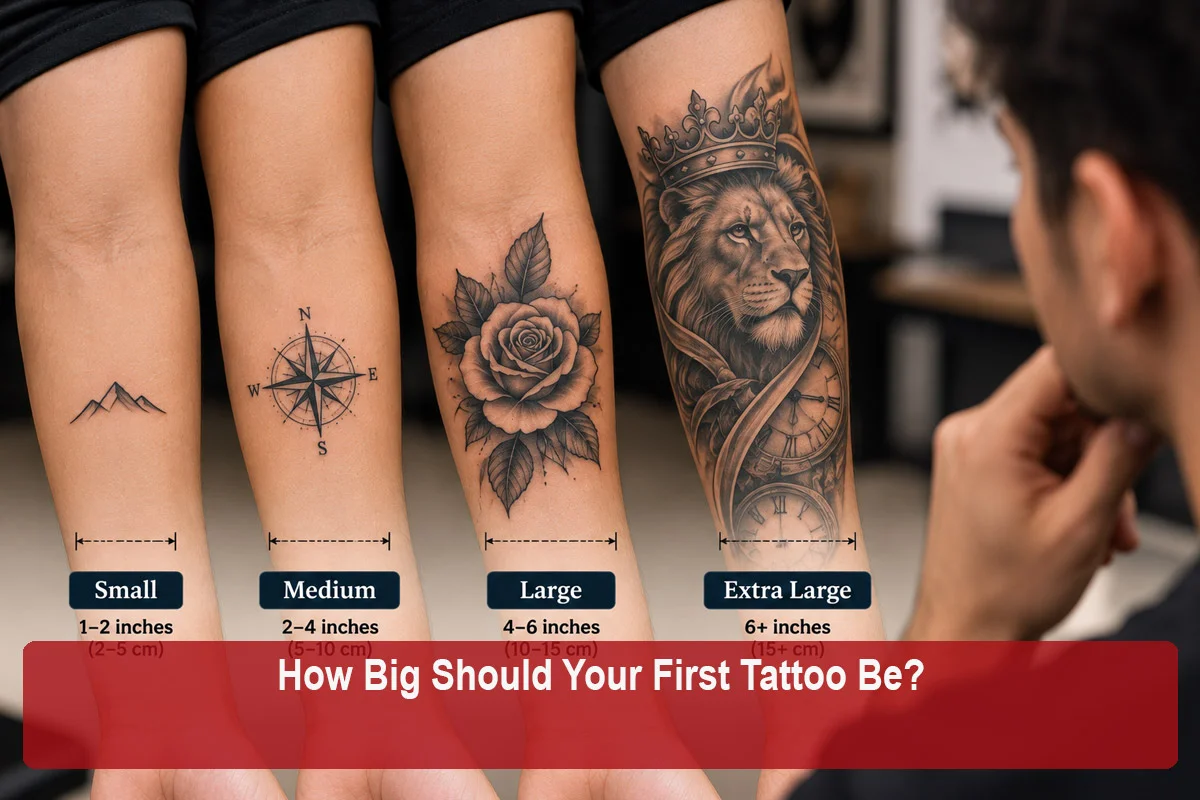
Choosing the size of your first tattoo can feel surprisingly difficult. Go too small and the design might blur or feel underwhelming. Go too large and you may feel you committed to more than you were ready for. Most first-timers have a rough idea in mind, such as something small on the wrist or a medium piece on the forearm, but are unsure whether that size will actually work for their design.
This guide is a practical walkthrough for choosing the right size for your first tattoo. It covers how design detail, placement, shop minimums, and comfort all affect size, and how to test a size before committing. If you are still deciding whether to start small at all, our companion article on whether your first tattoo should be small looks at that decision in more depth. For a broader overview of getting started, see our guide to getting your first tattoo.
Many first-timers start with a size in mind, such as a coin or a credit card, and then try to fit a design into it. It usually works better the other way around. The design determines how much space it needs to look good and stay readable over time.
A simple outline of a heart can look great at a small size. A detailed portrait of a pet needs much more room. Before you settle on a size, think about how much detail your design includes, how many elements it has, and whether it contains text.
Every tattoo softens slightly as it ages, with lines spreading a little over time. The more detail a design has, the more space it needs so that softening does not cause elements to merge.
Our guide on how tattoo size affects detail explains this relationship in depth.
Your placement sets practical limits. The inner wrist, finger, and behind the ear only fit small designs. The forearm, calf, and upper arm offer space for small to medium pieces. The thigh, back, and chest can hold much larger work.
Placement also changes how a size feels. A design that looks large on the wrist may look modest on the thigh. Curvature matters too, since designs on rounded areas like the upper arm or calf partly wrap out of view. If you already know where you want your tattoo, let that guide the size range, and if you know the size, let that guide the placement.
| Design Type | Typical Size Range | Good First Tattoo Placements |
|---|---|---|
| Simple symbol or outline | Small | Inner wrist, ankle, behind the ear, collarbone |
| Single word or initials | Small | Inner wrist, inner forearm, collarbone |
| Short phrase | Small to medium | Inner forearm, collarbone, ribs |
| Small illustration with some detail | Small to medium | Forearm, upper arm, ankle, shoulder |
| Detailed animal or flower | Medium | Forearm, upper arm, calf, thigh |
| Portrait or complex scene | Medium to large | Upper arm, thigh, calf, back |
These ranges are general guidance. Your artist will recommend a size based on your specific design and body.
One of the most common first tattoo mistakes is choosing a size that is too small for the design. Tiny tattoos with fine details or small text can look crisp at first but may blur or fill in over the years. Our article on how small is too small for a tattoo explains where the limits usually are.
If your artist suggests making the design bigger, it is usually because they have seen how small detailed tattoos age. Their advice is about protecting how your tattoo will look years from now.
Size affects how long your session lasts. A small, simple tattoo may take a short time, while a medium or large piece can take hours. For a first tattoo, many people prefer a shorter session so they can experience the process without committing to a long sitting.
That said, a medium-sized first tattoo is perfectly achievable for most people. If you choose a larger first piece, prepare by eating well, staying hydrated, and asking your artist about breaks. Choosing a placement commonly reported as more comfortable, such as the outer forearm or thigh, can also help.
Many shops have a minimum charge that covers setup, sterile supplies, and preparation regardless of size. This means a very small tattoo may cost the same as a slightly larger one. Our article on what a tattoo shop minimum is explains how this works.
If you are choosing a tiny size mainly to keep costs down, check the shop's minimum first. You may find you can choose a slightly larger, more durable size for the same price.
Seeing a size on your body is the best way to know whether it feels right. Try these steps:
At your appointment, your artist will apply a stencil. This is your final chance to check the size and position. Move around, look in the mirror from different angles, and ask for adjustments if anything feels off.
Many people get more tattoos after their first. If you think you might, consider how your first piece fits into that future. A small tattoo placed in the middle of the forearm can make it harder to fit a larger piece there later. A medium piece positioned thoughtfully can become part of a sleeve or collection.
You do not need a full plan, but mentioning possible future tattoos to your artist helps them size and position your first piece wisely.
Our guide on choosing an artist for your first tattoo can help you find someone who will give honest, helpful advice.
Different tattoo styles need different amounts of space. Fine line and minimalist designs can work at smaller sizes when they are simple, though thin lines still need enough spacing. American traditional designs use bold outlines and solid color, which hold up well but need a moderate size to look balanced. Realism needs the most space, since shading and texture require room to read clearly.
If you have a style in mind, ask your artist what size range typically works for it. A traditional rose and a realistic rose of the same size will look very different years from now.
Text is one of the most popular first tattoo choices, and one of the easiest to size too small. Letters with enclosed spaces, like a, e, and o, can fill in over time if they are tiny. Long phrases need more length, and ornate scripts need more height than simple fonts. If your first tattoo includes text, give it a little more size than you think you need, and choose a clean, open font.
One helpful way to think about size is that tattoos can be expanded later but cannot be made smaller. If you start with a small to medium design and later wish it were bigger, an artist can often add elements around it or build it into a larger piece. If you start too large and wish it were smaller, there is no simple fix.
At the same time, a design that is too small for its detail cannot simply be enlarged later either, since the original lines will have softened. The safest approach is to choose a size that suits the design from the start.
Larger tattoos cover more skin, which can mean a longer and more involved healing period. Small and medium tattoos are generally simpler to care for. If you want an easy first healing experience, a small to medium size on a stable placement like the forearm or upper arm is a good balance. Whatever size you choose, follow your artist's aftercare instructions closely.
Think about how your tattoo will usually be seen. A tattoo you mostly look at up close, like one on the inner forearm, can include a bit more detail at a modest size. A tattoo others usually see from across a room, like one on the back of the arm or calf, needs bolder shapes and a slightly larger size to read clearly. Matching size to viewing distance helps your tattoo look good in everyday life, not just in close-up photos.
The right size for your first tattoo depends on your design's detail, your placement, your comfort with session length, and your plans for future tattoos. Start with the design, avoid going too small for its level of detail, check the shop minimum, and test the size on your body before committing.
Most importantly, listen to your artist's recommendation. A first tattoo sized well will look good on day one and for years to come.
This article was reviewed by the Tattoo Shops Near You Editorial Team for accuracy, clarity, and relevance. We use reliable industry resources, official business information, and other authoritative sources where applicable to help readers make informed decisions about tattoo shops, artists, styles, and services.
Last reviewed: October 2026
Getting a Tattoo
 Getting a Tattoo
 Getting a Tattoo
 Getting a Tattoo