
 Tattoo Ideas & Designs
How Do Tattoo Artists Connect Existing Tattoos Into a Sleeve...
Published On 07-10-2026
Published by the Tattoo Shops Near You Editorial Team
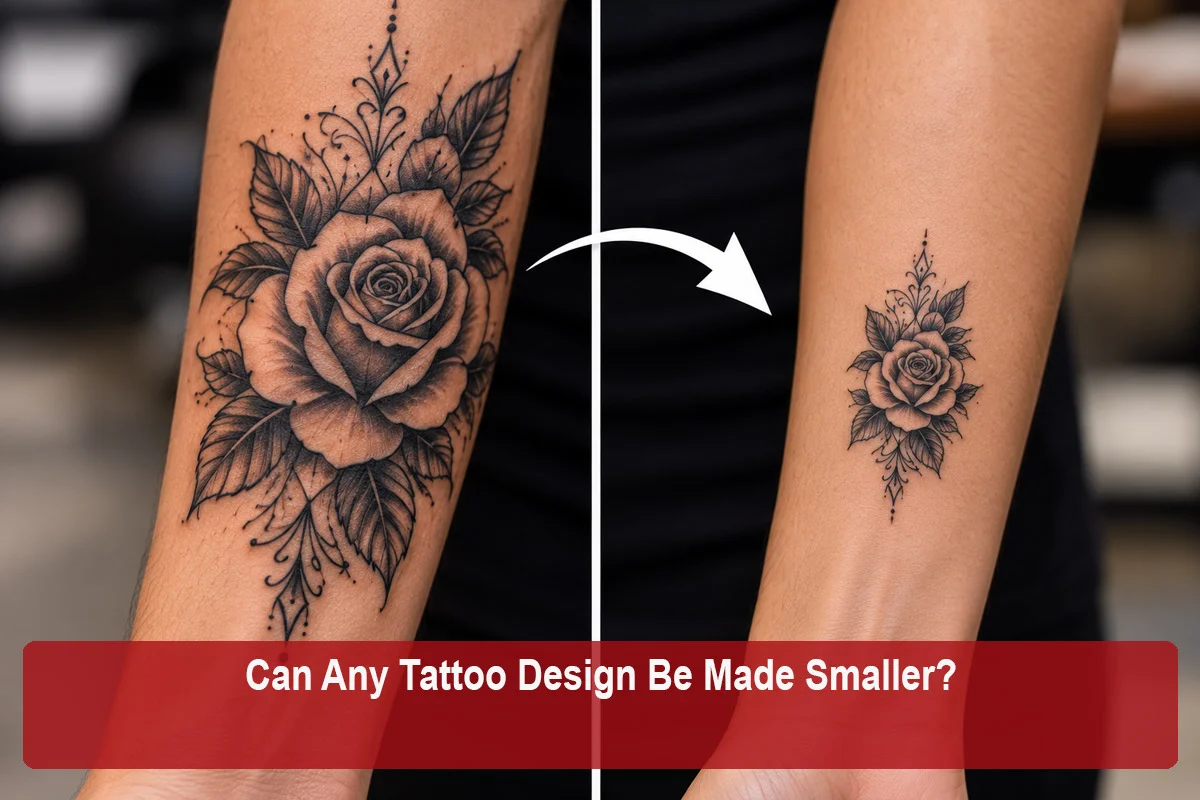
It is one of the most common requests in tattoo studios: can you make it smaller? Sometimes the answer is an easy yes. A simple heart, a bold symbol, or a short word can shrink comfortably. Other times, the honest answer is that the design will not survive the reduction. A detailed portrait, a long quote, or a complex scene can turn into an unreadable blur if it is scaled down too far.
So, can any tattoo design be made smaller? Technically, any image can be drawn smaller. Whether it will work as a tattoo, and still look good years later, depends on the type of design. This guide explains which designs scale down well, which do not, how to test your own design, and what your options are when a design simply will not shrink.
On a screen, you can shrink an image endlessly and zoom back in to see every detail. Skin does not work that way. Tattoo lines have a minimum practical width, and every tattoo softens slightly as it ages, with lines spreading a little over time.
When a design is scaled down, its lines do not get proportionally thinner in the same way. Instead, the spaces between lines shrink. Once those spaces become too small, lines that were separate in the original design can merge as the tattoo ages. That is the core reason some designs scale down well and others do not.
Our guide on how small is too small for a tattoo explains the general limits. This article focuses on how different types of design respond to being made smaller.
These designs share one feature: open space. Their elements are well separated, so even after shrinking, there is room for natural softening.
These designs rely on fine distinctions between nearby elements. When shrunk, those distinctions disappear.
| Design Type | Scales Down Well? | Common Solution if Too Small |
|---|---|---|
| Simple outline or symbol | Usually yes | Rarely needs changes |
| Bold traditional icon | Usually yes, within limits | Reduce interior detail |
| Short word or initials | Usually yes | Choose an open, clean font |
| Long quote | Often no | Shorten text or enlarge |
| Portrait | Often no | Enlarge or switch to a stylized approach |
| Detailed landscape or scene | Often no | Remove elements or enlarge |
| Dense pattern or mandala | Often no | Open up the pattern or enlarge |
| Textured animal | Depends on detail | Simplify texture or enlarge |
Before your consultation, you can get a rough sense of how your design will scale.
If the design is hard to read at arm's length on paper, it is likely to be harder to read as a tattoo, especially as it ages. This test is not a substitute for an artist's judgment, but it can help you have a more informed conversation.
When you ask an artist to make a design smaller, they usually consider:
An artist who says a design will not work at your preferred size is usually drawing on experience with how small tattoos age. Our article on why tattoo artists recommend making designs bigger explains this reasoning.
Removing secondary details, reducing texture, opening up spacing, and focusing on the main shapes can make a design suitable for a smaller size while keeping its essence. Our guide on why tattoo artists simplify small designs explains how artists approach this.
Sometimes the best solution is to accept a slightly larger tattoo. Even a modest increase can give details room to stay distinct.
A larger, flatter placement can accommodate the size the design needs. Moving from the wrist to the forearm, or from the ankle to the calf, opens up space.
Instead of shrinking a full scene, choose its most meaningful element. A single flower from a bouquet or the head of an animal rather than its whole body can work beautifully at a smaller size.
Switching from realism to a bolder style, such as traditional, blackwork, or simple line art, can make a subject work at a smaller size.
Text is one of the most common elements people want smaller. Short words in a clean font generally scale down well. Long phrases, very ornate scripts, and small serif fonts often do not. Letters with enclosed spaces, such as a, e, and o, can fill in over time if tattooed too small. If your text is long, consider shortening it, choosing a simpler font, or increasing the size.
Making a tattoo smaller does not always make it cheaper. Many shops have a minimum charge that covers setup, sterile supplies, and preparation regardless of size. A very small tattoo may cost the same as a slightly larger one. Our article on what a tattoo shop minimum is explains why. If you are shrinking a design mainly to save money, ask the shop about pricing first.
Enlarging a design is usually far less risky than shrinking it. When a design grows, spaces between lines grow too, giving every element more room. The main limits to enlarging are the available space on your chosen placement and whether the design still looks balanced at a larger size. If you are unsure between two sizes, many artists will recommend the larger one for detailed designs.
Many tattoo ideas come from images found online, which are usually designed for screens or prints where they can be viewed at any size. A design that looks perfect on your phone might have been drawn much larger than the tattoo you want. Before your consultation, consider how large the original artwork was intended to be. Your artist can then tell you whether it will work at your size or how to adapt it. They will usually also want to create their own version rather than copying another artist's design directly.
How a tattoo is usually seen matters when deciding on size. A tattoo on the inner wrist is mostly viewed up close by you, so moderate detail may be appreciated. A tattoo on the back of the shoulder or calf is often seen from a distance by others, where small details disappear and bold shapes do the work. If a shrunken design will mostly be viewed from a distance, simplicity becomes even more important.
Placement can either help or hurt a smaller design. Flat, stable areas like the inner forearm or upper arm let small designs sit evenly and stay readable. Curved areas like the ankle or wrist bone can distort small shapes, and high-friction areas like fingers can soften them faster. If you want a design as small as possible, choosing a stable placement gives it the best chance.
When simplifying a design to make it smaller, focus on what makes it meaningful. Ask your artist to keep the elements that matter most to you and remove the rest. A smaller, simpler design that preserves the heart of your idea will usually feel more satisfying than a crowded one that tries to keep everything.
Any design can be drawn smaller, but not every design will work as a smaller tattoo. Simple outlines, bold symbols, short words, and silhouettes usually scale down well. Portraits, long quotes, detailed scenes, and dense patterns often do not.
Test your design at the intended size, listen to your artist's advice, and be open to simplifying, enlarging, or changing the placement. The goal is a tattoo that looks as good in ten years as it does on the day it is finished.
This article was reviewed by the Tattoo Shops Near You Editorial Team for accuracy, clarity, and relevance. We use reliable industry resources, official business information, and other authoritative sources where applicable to help readers make informed decisions about tattoo shops, artists, styles, and services.
Last reviewed: October 2026
Tattoo Ideas & Designs
 Tattoo Ideas & Designs
 Tattoo Ideas & Designs
 Tattoo Ideas & Designs